Muscle-growth potentialHow well this movement can be loaded and progressed for building muscle.
Exercises · IA-KNE-EXE-011
Barbell Back Squat
Learn barbell back squat setup, form, muscles worked, benefits, common mistakes and practical progressions.
At a glance
Exercise profile
- Target muscles
- quadriceps, gluteus maximus
- Exercise type
- Strength
- Equipment
- Barbell, squat rack and safety arms
- Mechanics
- Compound
- Movement pattern
- Squat (bilateral)
- Experience level
- intermediate
- Secondary muscles
- adductors, hamstrings
What the science says
Study in a back-squat programme
What it found: Seven weeks of parallel back-squat training increased the size of every quadriceps muscle measured.
What that means here: For this lift, the useful message is simple: a controlled, progressively loaded squat is a credible quad-building choice—not just a strength test.
Compound lower-body strength and muscle building
What this exercise works
The quadriceps and gluteus maximus drive the squat while the trunk, hips and feet stabilize the barbell and control the descent.
Primary emphasis
- quadriceps
- gluteus maximus
Secondary muscles
- adductors
- hamstrings
Stabilizers
- abdominal muscles
- erector spinae
- gluteus medius
Movement and joint actions
- Knee flexion and extension
- Hip flexion and extension
Muscle contribution changes with position, range, resistance and individual technique.
Why it can help
Potential benefits and carryover
Benefits depend on technique, dosage, consistency and whether the exercise suits the person. Sport carryover means supporting the physical demands of the activity—not guaranteeing performance or preventing injury.
Everyday benefits
- Builds substantial quad and glute strength with one efficient movement
- Trains controlled depth, bracing and leg drive under load
- Can be progressed gradually for strength or muscle gain
Training carryover
- Foundation lift for leg-focused strength programs
- Carries over to lunges, step-ups and many athletic lower-body tasks
Sport carryover
- Supports jumping, acceleration and change-of-direction strength
Technique
Barbell Back Squat tips
Use these cues to keep the movement controlled and focused on its intended purpose.
- Set the bar securely across the upper back, not the neck.
- Brace before each repetition and keep the whole foot grounded.
- Let the knees track in line with the toes rather than collapsing inward.
- Use a depth you can control without losing your back position.
Overview
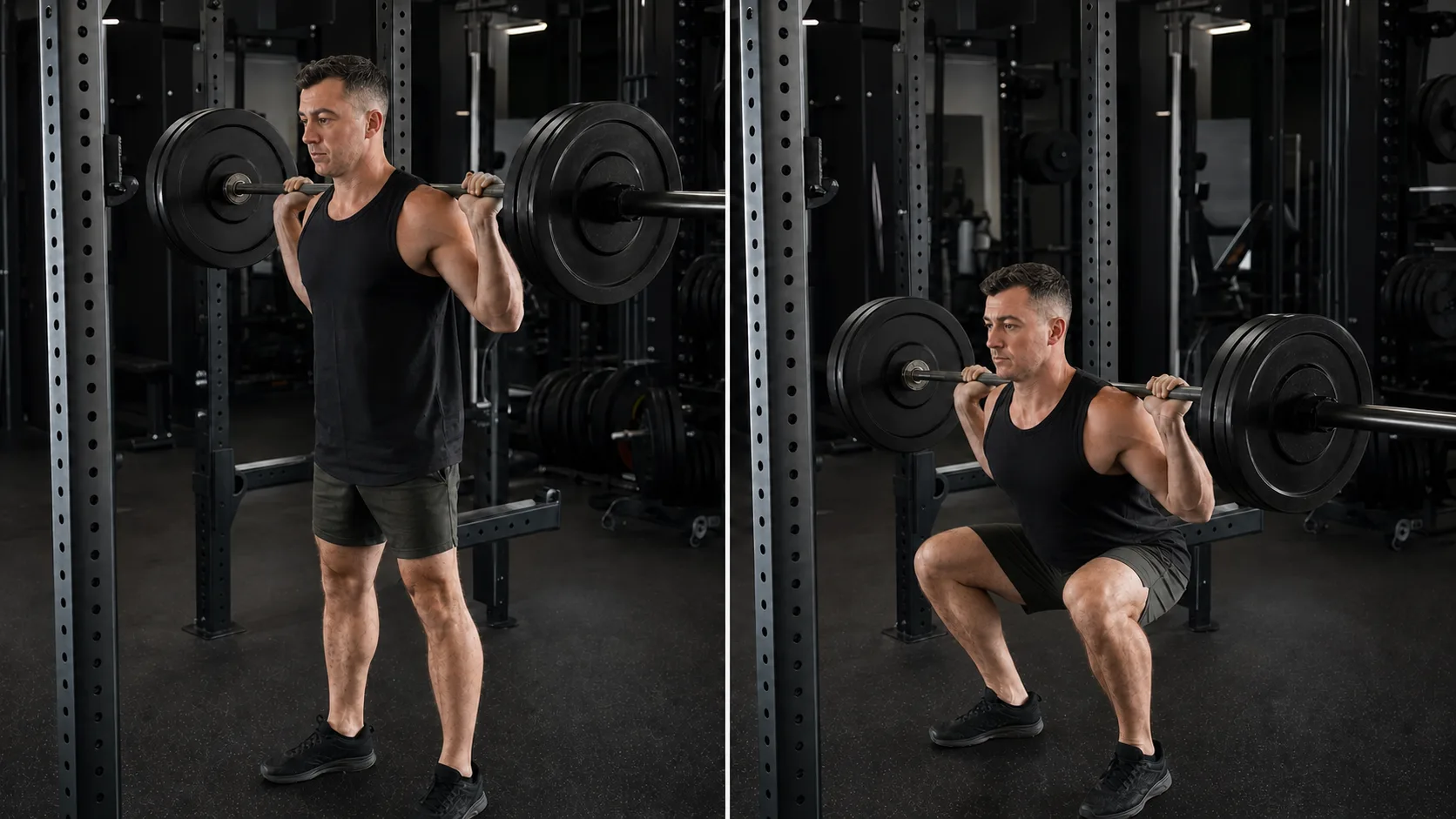
The barbell back squat is a full lower-body strength exercise. With the bar supported on the upper back, you sit down between the hips and knees, then stand by driving through the feet.
How to Do It
- Set the safety arms just below your planned squat depth and position the bar on your upper back.
- Step back with feet about shoulder-width apart, then brace your trunk.
- Sit down under control, allowing the knees and hips to bend together.
- Keep the pressure spread across the whole foot and maintain a stable torso.
- Drive the floor away to stand tall, finishing with the hips and knees straight.
What You Should Feel
Mostly the front of the thighs and glutes, plus strong trunk effort to keep the bar steady. Sharp knee, hip or back pain is a reason to reduce the load or get assessed.
Common Mistakes
- Letting the knees collapse inward
- Losing the brace and folding forward under the bar
- Shifting onto the toes or lifting the heels
- Adding load before the depth and control are repeatable
Progression
Start with a light bar or goblet squat variation. Add small amounts of weight only when the same controlled depth and balance are maintained across the set.
When to Stop
Do not chase depth or load through sharp knee, hip or back pain. Stop for instability, locking, rapid swelling or a sudden loss of strength, and have those symptoms assessed.
Educational information only — not a diagnosis.
This information does not diagnose an injury or replace care from a qualified healthcare professional.