Overview
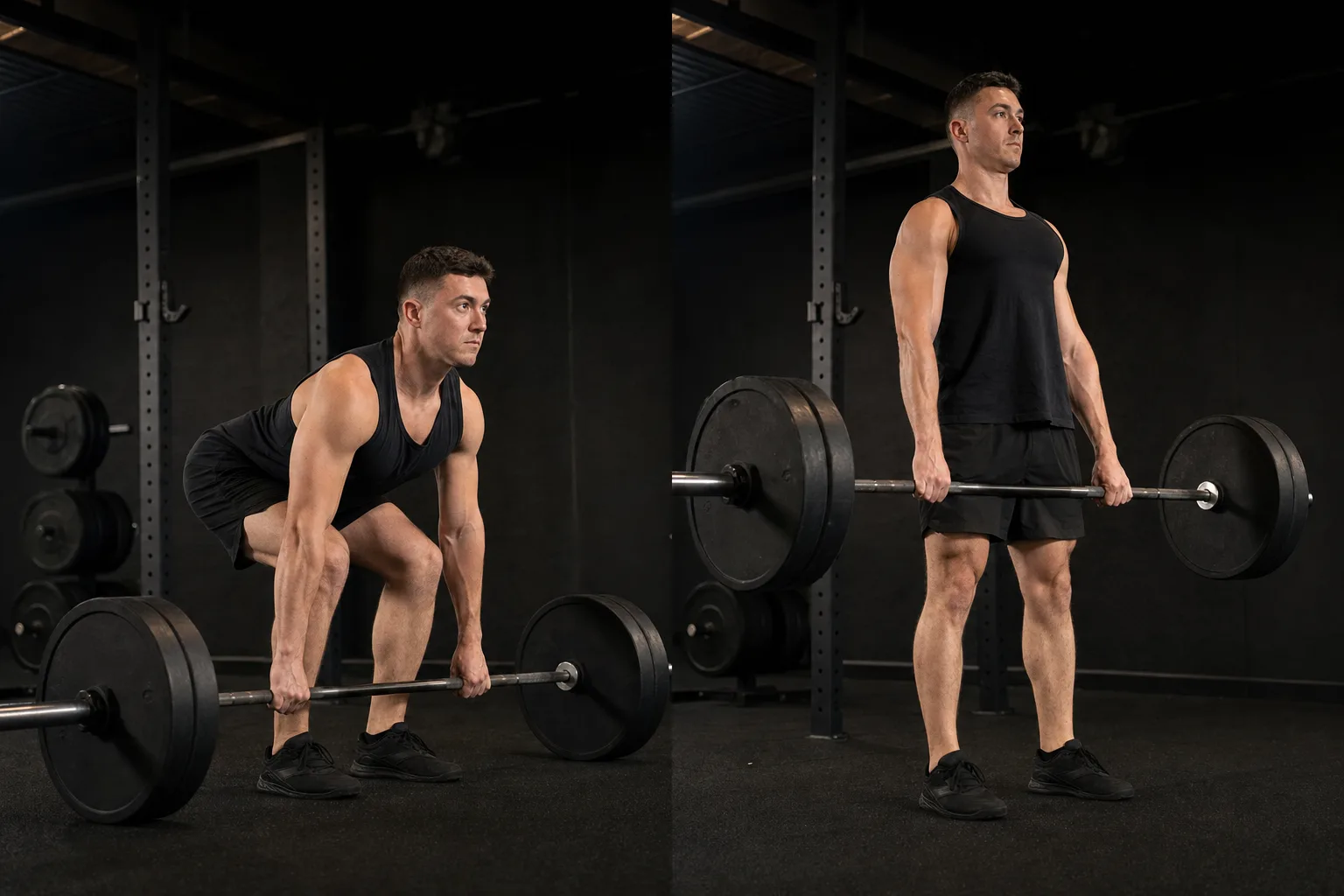
The conventional deadlift is a barbell lift where you pick a loaded bar up from the floor by hinging at the hips and extending the knees and hips together. It loads the entire posterior chain — glutes, hamstrings and spinal erectors — in one movement, and is one of the most effective exercises for building total-body strength and muscle mass.
It is the loaded version of the hip hinge pattern: the same technique, with a barbell and real weight on it.
How to Do It
- Stand with the bar over the middle of your feet, feet roughly hip-width apart.
- Bend down and grip the bar just outside your legs, arms straight.
- Drop your hips, lift your chest and set a neutral spine before pulling.
- Take the slack out of the bar — you should feel the bar's weight before it leaves the floor.
- Push the floor away with your legs while keeping the bar close to your shins as it rises.
- Once the bar clears your knees, drive your hips forward to finish standing tall.
- Lower the bar under control by hinging back at the hips first, then bending the knees as the bar passes them.
What You Should Feel
- Tension through the glutes, hamstrings and mid-back throughout the lift
- The bar tracking close to your body the whole way up
- A strong, braced trunk rather than a rounding lower back
- Effort concentrated in the hips and legs, not the arms
Common Mistakes
- Letting the bar drift away from the shins, turning the pull into a squat
- Rounding the lower back to reach the bar
- Yanking the bar off the floor before the hips and trunk are set
- Hyperextending the lower back at the top instead of stopping at hips-forward, standing tall
Progression
- Master the hip hinge pattern with no load before adding a bar.
- Start with an empty bar or light weight and prioritize identical form on every rep.
- Add small amounts of weight once you can complete all working sets with clean technique.
- Typical strength-building work is in the 3-6 rep range at a challenging but controlled weight; higher rep ranges (8-12) work well for hypertrophy-focused blocks.
- Rest 2-3 minutes between heavier sets so technique doesn't break down from fatigue.
Common Questions
How much should I be able to deadlift?
There's no single number — it depends on training age, body weight and experience. Progress relative to your own recent lifts, not to arbitrary benchmarks, and prioritize consistent form over chasing weight increases.
Is the deadlift bad for your back?
Not when performed with a controlled, neutral-spine technique and a weight you can manage — it's one of the better exercises for building a strong, resilient back. Technique breakdown under too much weight or fatigue is the actual risk, not the movement itself.
How often should I deadlift?
Once or twice per week is typical for most lifters, with enough recovery between sessions since it's demanding on the whole posterior chain. Newer lifters often do better starting with once weekly.
References
- National Strength and Conditioning Association. "Essentials of Strength Training and Conditioning." 4th edition.
- Journal of Strength and Conditioning Research. "Biomechanical Analysis of the Deadlift." https://journals.lww.com/nsca-jscr/
This information is for education only and is not a medical diagnosis. InjuryAtlas does not replace an assessment by a qualified health professional or strength coach. If you have severe pain, visible deformity, numbness, loss of function, or symptoms that are getting worse, seek medical care promptly.