Overview
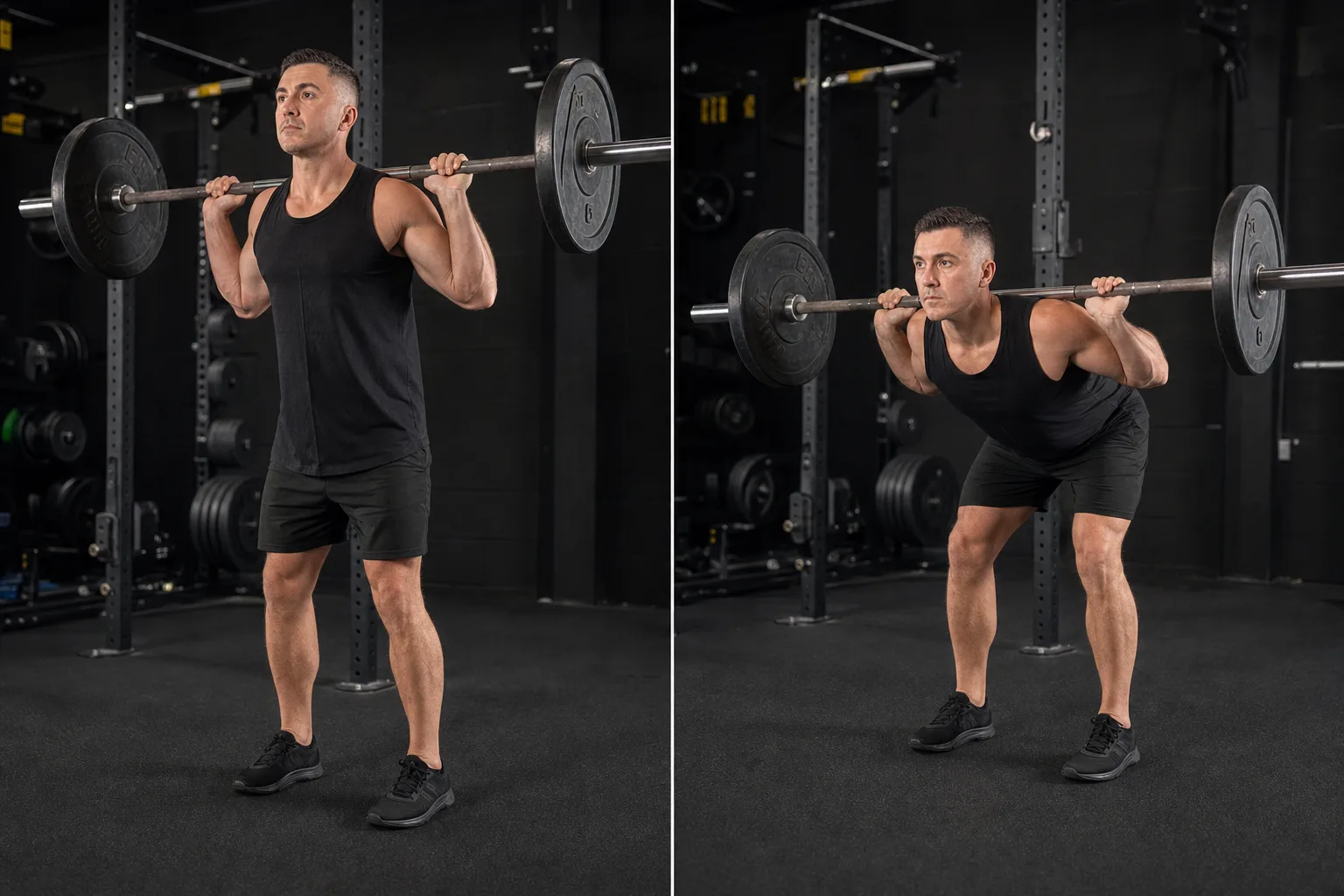
The barbell good morning is a hip-hinge exercise performed with a barbell racked across the upper back, similar to a squat. Instead of bending the knees, you hinge forward at the hips with a soft knee bend held throughout, loading the hamstrings, glutes and lower back intensely.
It is a more technical, more demanding cousin of the hip hinge and the conventional deadlift — the same movement pattern, but with the load on your back instead of in your hands, which changes the leverage and increases the demand on the lower back specifically.
How to Do It
- Set the bar in a rack at about shoulder height and position it across your upper back, same placement as a squat.
- Unrack the bar and step back with feet shoulder-width apart, knees softly bent.
- Take a breath and brace your trunk before initiating the movement.
- Push your hips backward and let your torso hinge forward, keeping the soft knee bend fixed — don't let the knees bend further as you descend.
- Lower until your torso is roughly parallel to the floor, or until you feel your lower back wanting to round — whichever comes first.
- Reverse the movement by driving your hips forward to return to standing.
- Re-rack the bar when the set is complete rather than trying to set it down from a hinged position.
What You Should Feel
- A strong stretch and loading sensation through the hamstrings
- Firm bracing through the trunk and lower back the entire time
- The hips doing the hinging, with the knee bend staying constant
- No rounding or loss of control in the lower back at any point
Common Mistakes
- Using too much weight before the pattern is well controlled with an empty bar
- Letting the knees bend further during the descent, turning it into a squat
- Rounding the lower back to reach a deeper position
- Rushing the tempo instead of controlling both the lowering and lifting phases
Progression
- This is an advanced accessory lift — get comfortable with the hip hinge and conventional deadlift first.
- Start with just the empty bar for several sessions before adding any weight.
- Keep the range of motion conservative (well short of parallel) until your lower back stays neutral throughout.
- Typical use is as an accessory lift in the 6-10 rep range at a moderate weight, not a lift to push toward heavy singles.
Common Questions
Is the good morning dangerous?
It carries more lower-back demand than most hip-hinge variations because of where the load sits, which makes technique and conservative loading especially important — it isn't inherently dangerous when done with appropriate weight and full control.
How is this different from a Romanian deadlift?
A Romanian deadlift holds the bar in the hands and hinges with a similar knee bend; the good morning holds the bar on the back instead, which shifts more of the load onto the lower back and hamstrings and generally calls for lighter weight.
Do I need a spotter or safety bars?
Using a rack with safety pins set at an appropriate height is a reasonable precaution, particularly while you are still building confidence with the pattern.
References
- National Strength and Conditioning Association. "Essentials of Strength Training and Conditioning." 4th edition.
- Journal of Strength and Conditioning Research. "Muscle Activation During the Barbell Good Morning." https://journals.lww.com/nsca-jscr/
This information is for education only and is not a medical diagnosis. InjuryAtlas does not replace an assessment by a qualified health professional or strength coach. If you have severe pain, visible deformity, numbness, loss of function, or symptoms that are getting worse, seek medical care promptly.