Overview
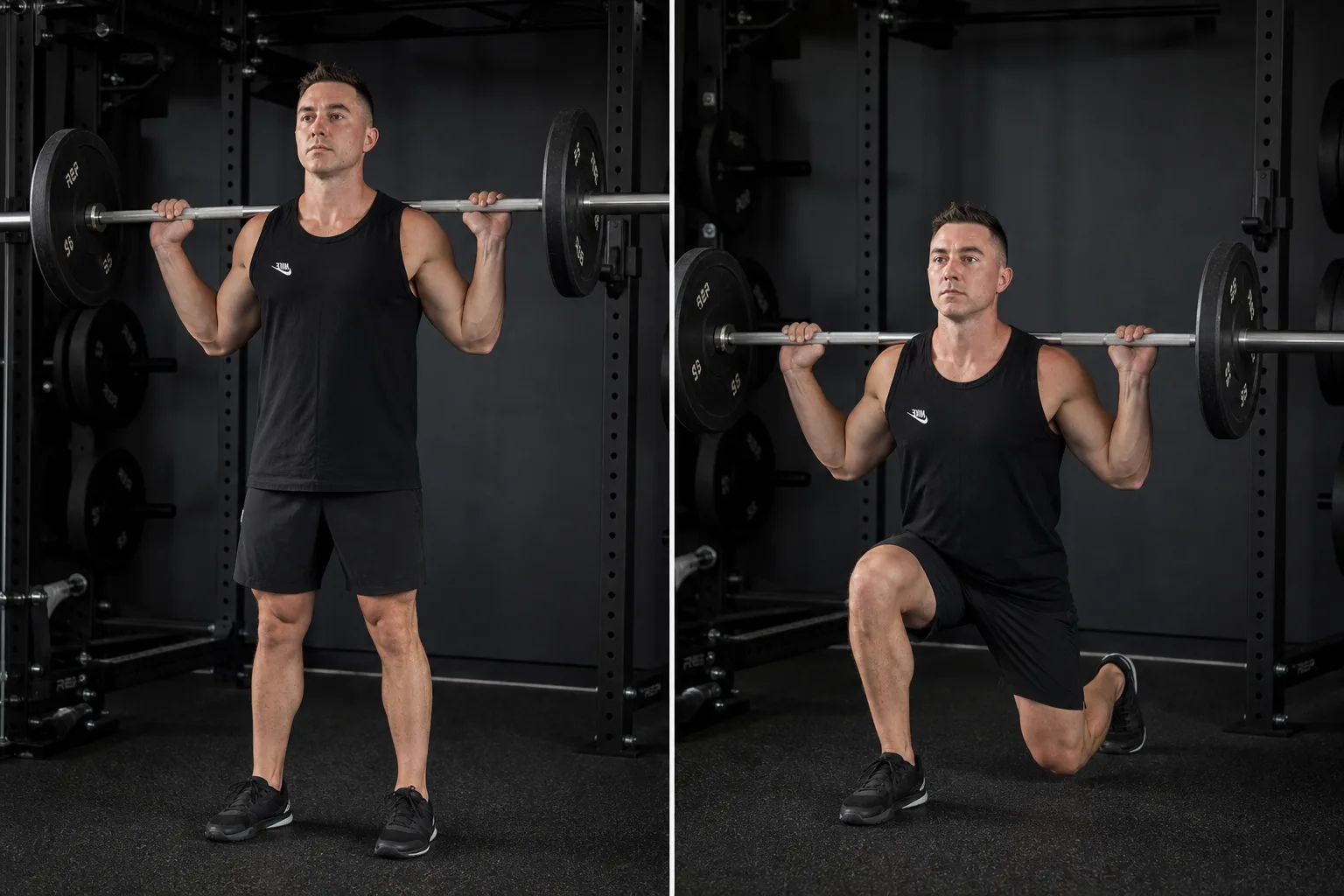
The barbell reverse lunge is a single-leg exercise where you step backward into a lunge position with a barbell racked across your upper back, then return to standing. Stepping backward rather than forward generally loads the front leg's quadriceps and glutes similarly to a squat, and tends to be more comfortable for the front knee than a forward-stepping lunge.
It is a core single-leg accessory lift for building leg strength and correcting side-to-side imbalances that bilateral lifts like squats and deadlifts can hide.
How to Do It
- Set the bar across your upper back as you would for a squat and step out of the rack.
- Stand with feet hip-width apart, core braced.
- Step one foot backward into a long stride, lowering your back knee toward the floor.
- Keep your front shin close to vertical and your torso upright throughout.
- Lower until your back knee lightly touches or hovers just above the floor.
- Push through your front foot to drive back up to standing, bringing your feet back together.
- Complete all reps on one side before switching, or alternate legs each rep depending on your program.
What You Should Feel
- Effort concentrated through the front leg's quad and glute
- A stretch through the back leg's hip flexor at the bottom position
- Balanced, controlled movement without wobbling side to side
- No sharp pain at the front knee or back knee
Common Mistakes
- Letting the front knee travel far forward past the toes
- Leaning the torso forward instead of staying upright
- Taking too short a step, which increases forward knee travel
- Rushing the descent instead of lowering under control
Progression
- Master the movement with bodyweight only before adding a barbell.
- Add dumbbells or kettlebells held at your sides as an easier-to-control loading option before progressing to a barbell.
- Increase weight in small increments once both sides can complete the set with even, controlled form.
- Typical work is in the 6-12 rep range per leg; higher reps with lighter weight if balance is still developing.
Common Questions
Which leg does the reverse lunge work — the front or the back?
Primarily the front leg, which does the bulk of the lowering and lifting work. The back leg contributes some hip-flexor stretch and light stabilizing effort.
Is the reverse lunge easier on the knees than a forward lunge?
For most lifters, yes — stepping backward tends to keep the front knee more stacked over the ankle, similar to a squat, which generally reduces forward knee travel compared with stepping forward.
Should I do the same weight on both legs?
Yes, use the same load on both sides and track each leg's reps separately — this is one of the main benefits of a unilateral lift, since it won't let a stronger side compensate for a weaker one.
References
- National Strength and Conditioning Association. "Essentials of Strength Training and Conditioning." 4th edition.
- Journal of Strength and Conditioning Research. "Comparison of Muscle Activation Between Forward and Reverse Lunge Variations." https://journals.lww.com/nsca-jscr/
This information is for education only and is not a medical diagnosis. InjuryAtlas does not replace an assessment by a qualified health professional or strength coach. If you have severe pain, visible deformity, numbness, loss of function, or symptoms that are getting worse, seek medical care promptly.