Overview
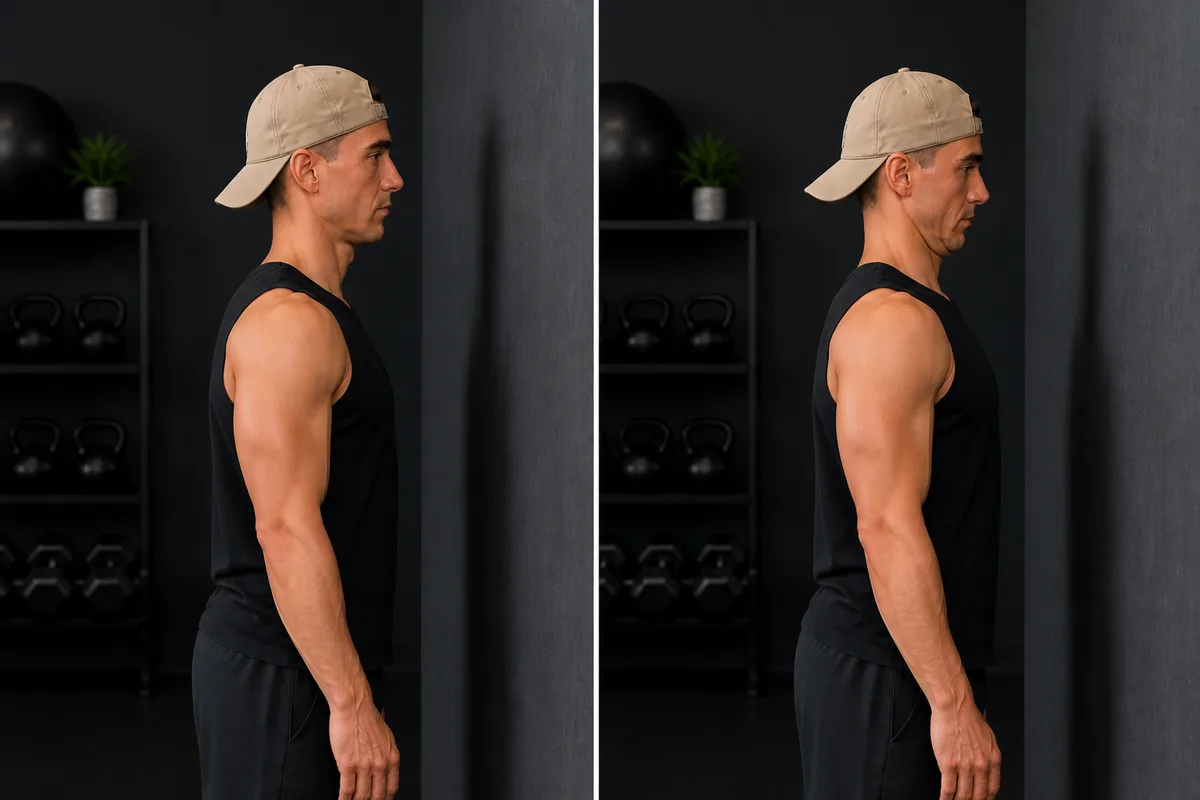
The chin tuck is a gentle exercise that strengthens the deep flexors at the front of the neck — the muscles that hold the head balanced rather than relying on the larger superficial muscles. It is a common starting point in neck rehabilitation.
The movement is small. You are drawing the chin straight back, as if making a double chin, without tilting the head up or down.
How to Do It
- Sit or stand tall with your head in a comfortable, neutral position.
- Keep your eyes level and draw your chin straight back, as if gently sliding the whole head backward.
- Hold the position for 2–3 seconds while breathing normally.
- Relax and let the head return to the starting position.
- Repeat for 8–12 controlled repetitions.
The movement should be small and smooth. If it feels like tilting, poking the chin forward, or straining, reset and try a smaller range.
What You Should Feel
- Mild effort at the front and back of the neck
- A lengthening sensation at the back of the neck
- No sharp pain, headache, or pain down the arm
Make It Easier
- Reduce the range so the movement is barely visible
- Lie on your back with a small cushion behind the head
- Press the back of the head gently into a wall or hand instead of moving
Progression
- Hold the retracted position longer
- Add a slow head turn while keeping the chin tucked
- Progress to lifting the head slightly from the floor or a bench once it is controlled
References
- Blanpied PR, et al. "Neck Pain: Revision 2017. Clinical Practice Guidelines." Journal of Orthopaedic & Sports Physical Therapy. 2017;47(7):A1-A83. https://www.jospt.org/doi/10.2519/jospt.2017.0302
- "The Treatment of Neck Pain-Associated Disorders and Whiplash-Associated Disorders: A Clinical Practice Guideline." 2016. https://pubmed.ncbi.nlm.nih.gov/27836071/
This information is for education only and is not a medical diagnosis. InjuryAtlas does not replace an assessment by a qualified health professional. If you have severe pain, visible deformity, numbness, loss of function, or symptoms that are getting worse, seek medical care promptly.