Overview
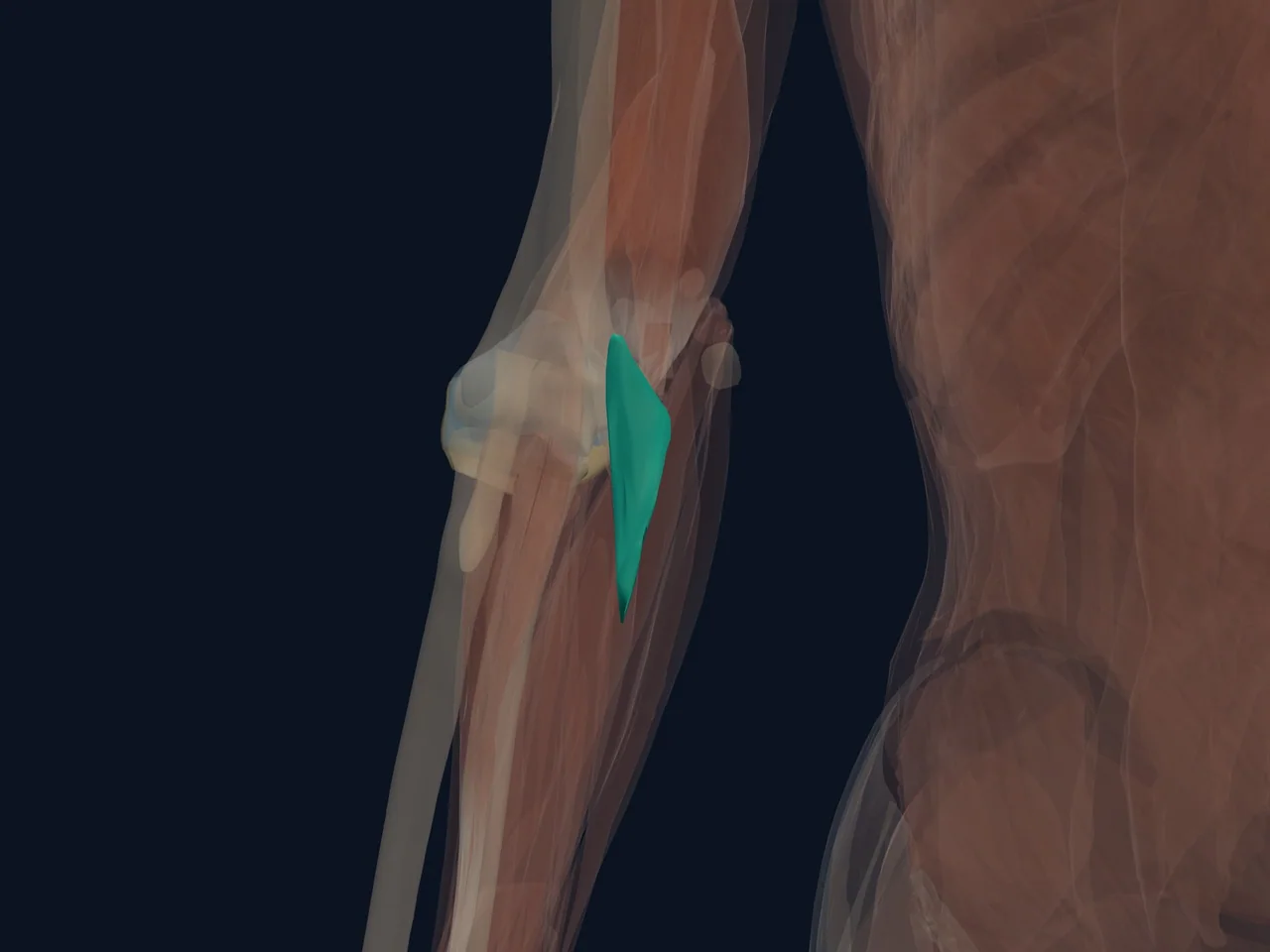
The anconeus is a small triangular muscle at the back and outer side of the elbow. It blends functionally with the triceps and helps make elbow extension smooth and stable.
Its size makes it easy to overlook, but its position lets it support the elbow capsule and make small adjustments as the forearm rotates.
Location
- Begins at the lateral epicondyle on the outer side of the humerus
- Crosses the back of the elbow
- Attaches to the olecranon and upper posterior ulna
Origin, Insertion, Nerve Supply, and Action
- Origin: Posterior surface of the lateral epicondyle of the humerus
- Insertion: Lateral olecranon and upper posterior ulna
- Nerve supply: Radial nerve, mainly C7–T1
- Action: Assists elbow extension and helps stabilize the elbow
Function
- Assists the triceps when straightening the elbow
- Helps control the elbow joint capsule during movement
- May help position the ulna during forearm pronation
Common Problems
Isolated anconeus injuries are uncommon. The muscle may become sore after repeated throwing, forceful elbow extension or direct trauma, but pain in this area more often overlaps with triceps-tendon, elbow-joint or lateral-elbow problems.
When to Get It Assessed
Seek an assessment if posterior elbow pain follows a fall, includes major swelling or locking, or makes it difficult to straighten the elbow. Persistent pain should also be examined rather than assumed to come from this small muscle.
Related Anatomy
References
- OpenStax. “Muscles of the Pectoral Girdle and Upper Limbs.” https://openstax.org/books/anatomy-and-physiology-2e/pages/11-5-muscles-of-the-pectoral-girdle-and-upper-limbs
- Moore KL et al. Clinically Oriented Anatomy. Wolters Kluwer.
- Standring S, ed. Gray’s Anatomy: The Anatomical Basis of Clinical Practice. Elsevier.