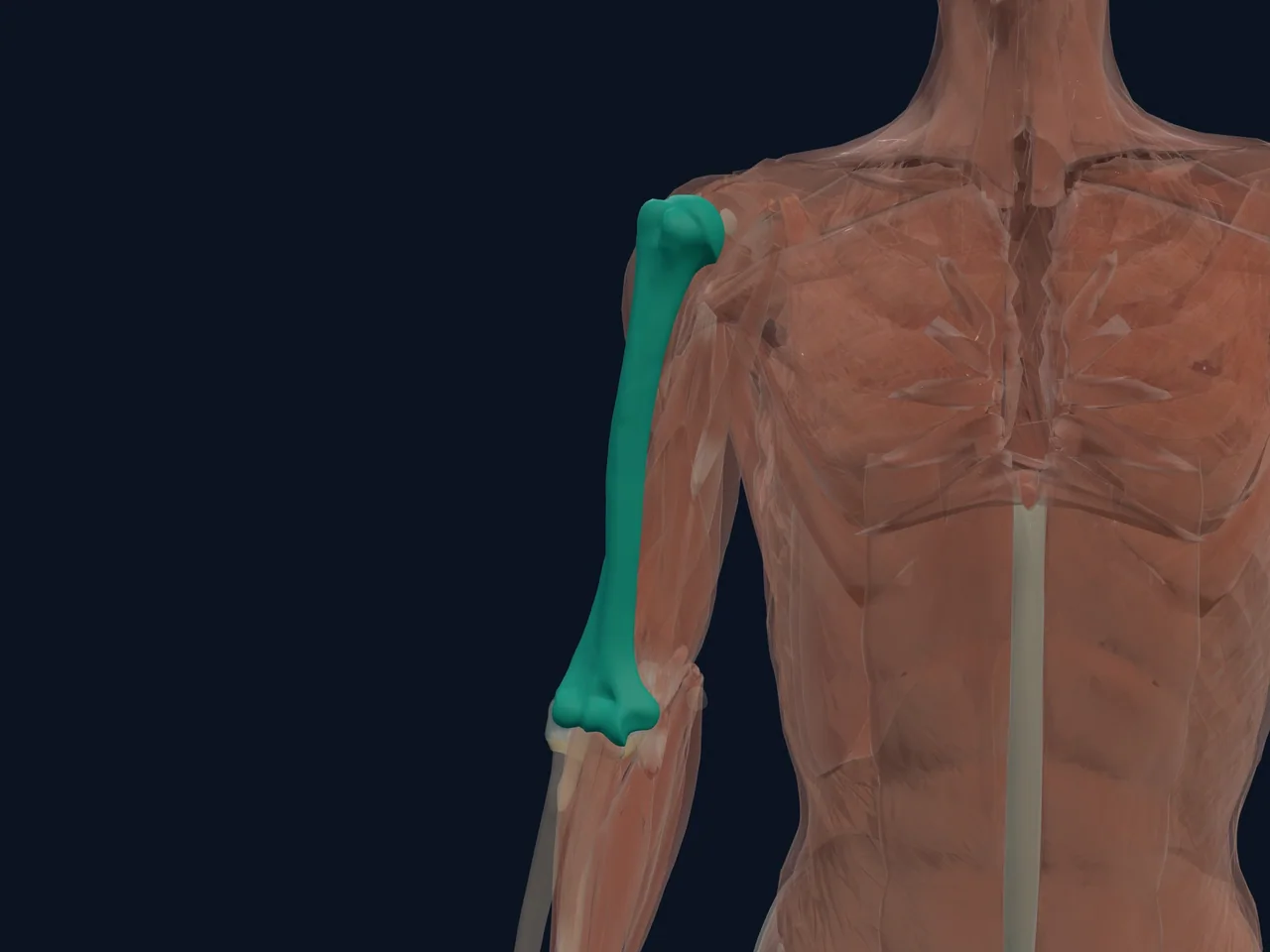
Overview
The distal humerus is the lower end of the upper-arm bone. Its curved surfaces form the upper half of the elbow joint.
The trochlea fits into the ulna’s trochlear notch to create the main hinge. The capitellum meets the radial head and helps transmit force from the hand and forearm. The medial and lateral epicondyles are the prominent inner and outer bumps where major forearm muscles and stabilizing ligaments attach.
Why the Landmarks Matter
- The common flexor tendon and ulnar collateral ligament attach near the medial epicondyle.
- The common extensor tendon and lateral ligament complex attach near the lateral epicondyle.
- The ulnar nerve passes behind the medial epicondyle—the sensitive “funny bone” area.
- Fossae above the joint receive the ulna and radius as the elbow bends and straightens.
Common Problems
The epicondyles are reference points for golfer’s elbow and tennis elbow, though those conditions primarily involve tendons rather than the bone itself. Falls and high-energy injuries can fracture the distal humerus. Arthritis, loose fragments or previous trauma can also reduce joint motion.
When to Get It Assessed
Major swelling, deformity, inability to bend or straighten the elbow, or numbness after a fall requires prompt assessment.
References
- StatPearls. “Anatomy, Shoulder and Upper Limb, Humerus.” https://www.ncbi.nlm.nih.gov/books/NBK534821/
- StatPearls. “Elbow Fractures Overview.” https://www.ncbi.nlm.nih.gov/books/NBK441976/