Overview
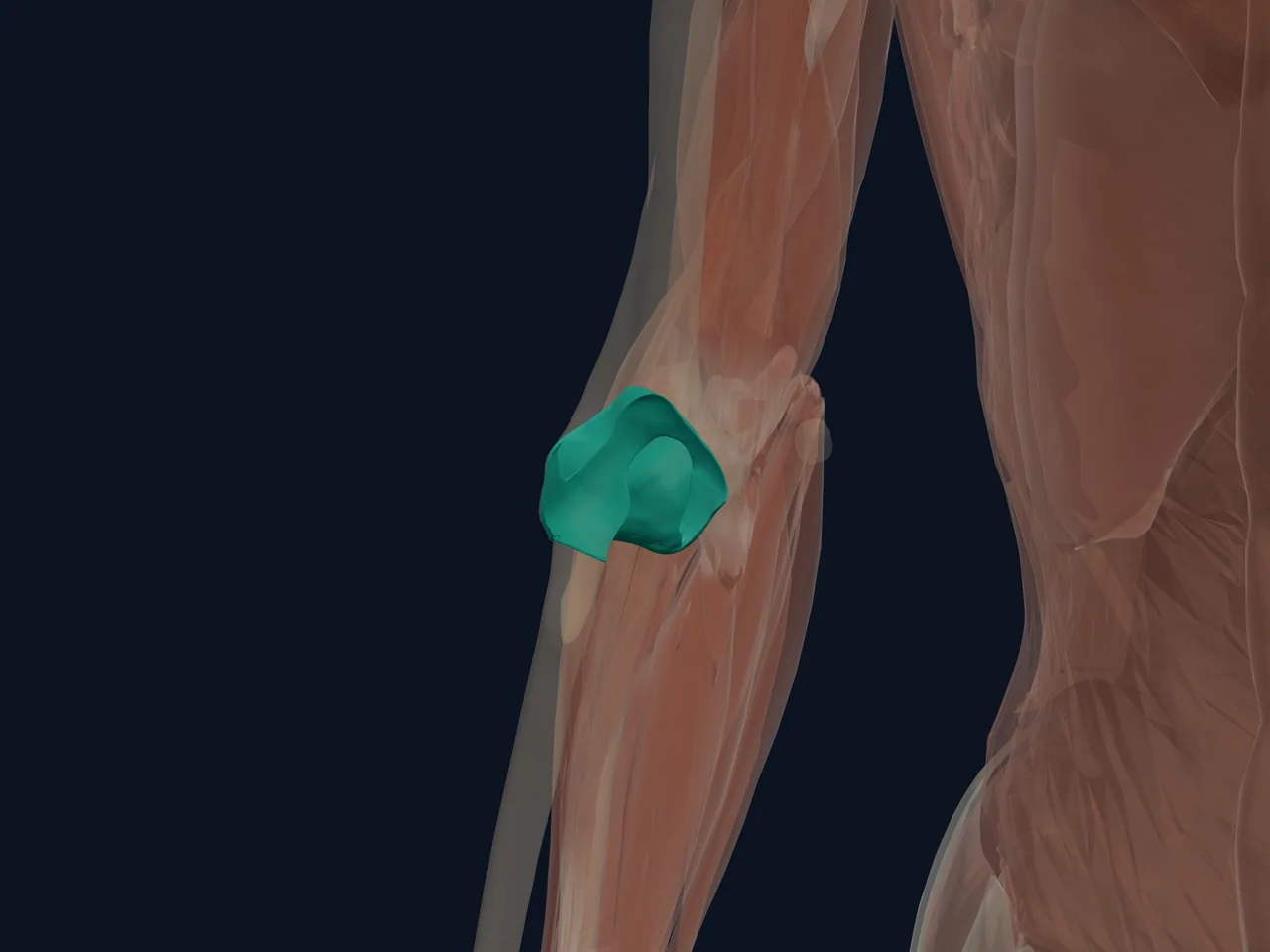
The elbow is not a single hinge between two bones. Three bones form three closely connected joints inside one capsule:
- The distal humerus and proximal ulna create the main hinge for bending and straightening.
- The humerus also meets the radial head, helping transfer load through the forearm.
- The radius rotates against the ulna at the proximal radioulnar joint, letting the palm turn up and down.
This combination gives the arm a wide working range while keeping the hand positioned for lifting, pushing, pulling and gripping.
What Keeps It Stable
The shape of the humerus and ulna provides substantial stability. The ulnar collateral ligament supports the inner elbow, while the lateral collateral ligament complex supports the outer side and resists rotational instability. The annular ligament holds the radial head against the ulna while still allowing it to spin.
Muscles crossing the joint add dynamic control. The biceps, brachialis and brachioradialis bend the elbow; the triceps and anconeus straighten it. Forearm muscles also contribute to stability during gripping and throwing.
Common Problems
Pain may come from a tendon, ligament, bursa, nerve, bone or the joint surface itself. Common patterns include tennis elbow, golfer’s elbow, cubital tunnel syndrome, tendon injuries and elbow dislocation. Pain location is a clue, but it cannot identify the structure on its own.
When to Get It Assessed
Seek urgent assessment after a major injury if the elbow looks deformed, cannot move normally, or the hand becomes pale, cold, numb or weak. Locking, major swelling, fever or progressive loss of motion also deserves assessment.
References
- StatPearls. “Anatomy, Shoulder and Upper Limb, Elbow Joint.” https://www.ncbi.nlm.nih.gov/books/NBK532948/
- OpenStax. “The Pectoral Girdle and Upper Limb.” https://openstax.org/books/anatomy-and-physiology-2e/pages/7-6-the-pectoral-girdle-and-upper-limb