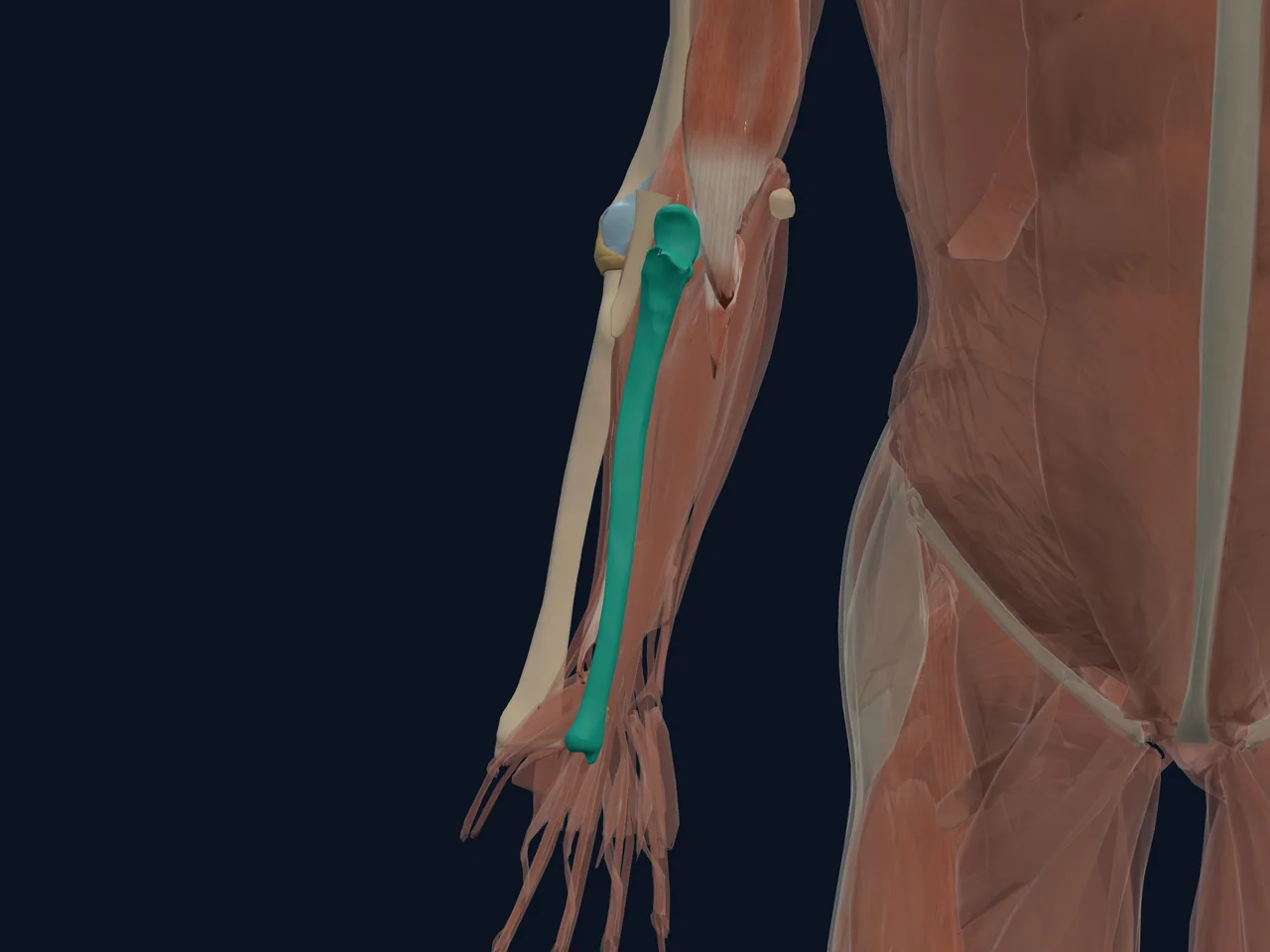
Overview
The proximal ulna forms the deep, wrench-shaped part of the elbow hinge. The olecranon is the point you can feel at the back of the elbow. It fits into the humerus during extension and provides the attachment for the distal triceps tendon.
The trochlear notch wraps around the humeral trochlea. At its front edge, the coronoid process helps resist the ulna sliding backward and provides important ligament and muscle attachments.
Function
- Creates the main bony hinge of the elbow
- Provides strong passive stability
- Gives the triceps leverage to straighten the arm
- Anchors portions of the collateral ligaments
Common Problems
A direct fall can fracture the olecranon. Dislocation can injure the coronoid and nearby ligaments. The superficial olecranon bursa can swell after pressure, trauma, inflammation or infection without the bone itself being injured.
When to Get It Assessed
Prompt assessment is needed for deformity, inability to straighten the elbow, major swelling after trauma, or an open wound over the olecranon.
References
- StatPearls. “Elbow Fractures Overview.” https://www.ncbi.nlm.nih.gov/books/NBK441976/
- StatPearls. “Anatomy, Shoulder and Upper Limb, Elbow Joint.” https://www.ncbi.nlm.nih.gov/books/NBK532948/