If your elbow hurts during curls, rows, pull-ups or even while carrying groceries, the exercise is not a diagnosis. The useful first clue is where the pain sits.
Pain on the outside often involves the wrist-extensor tendon commonly associated with tennis elbow. Pain on the inside may involve the flexor-pronator tendons often called golfer’s elbow. Pain in the front can involve the distal biceps tendon, while pain at the back may involve the triceps tendon or tissues around the tip of the elbow.
These patterns overlap, and pain can also come from the joint or a nearby nerve. The goal is not to identify one damaged structure from a diagram. It is to recognize the pattern, adjust the aggravating load and watch for signs that need an examination.
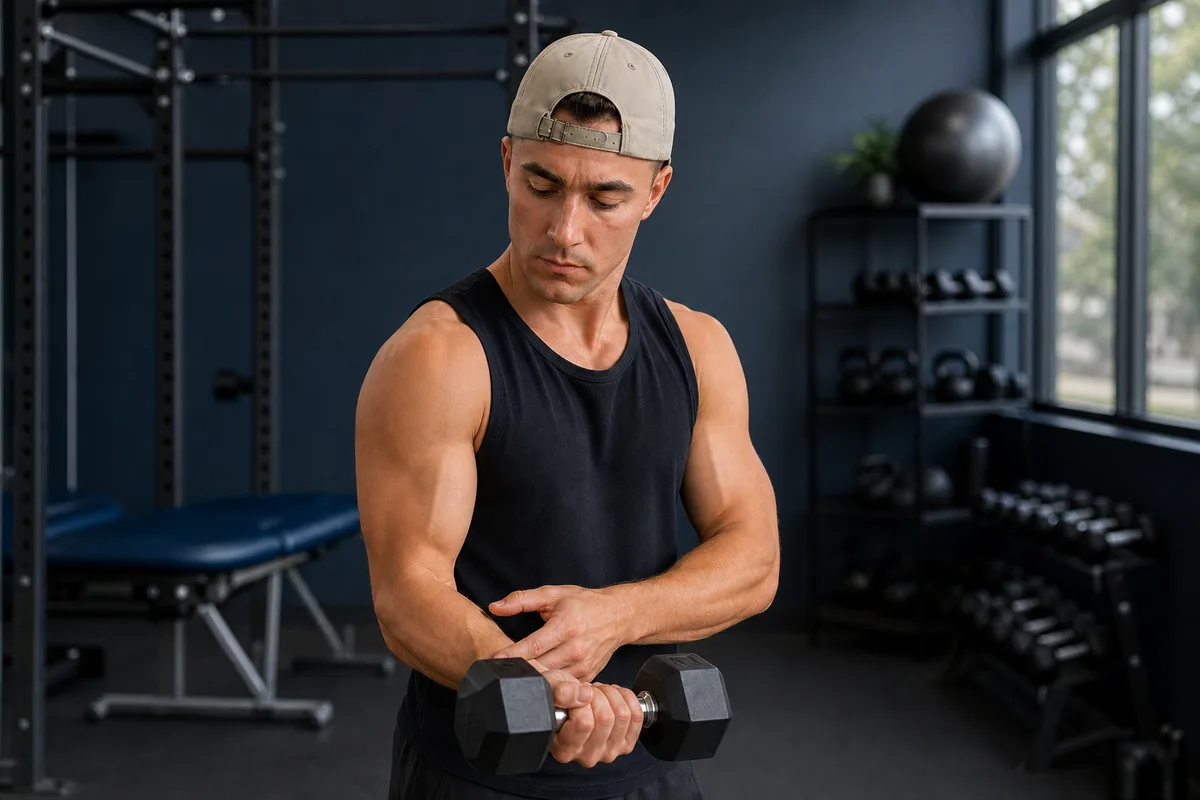
Start with the location
Use the location as a starting point, not a self-diagnosis.
| Where it hurts | A common pattern | Movements that may provoke it |
|---|---|---|
| Outside of the elbow | Lateral elbow tendinopathy, often called tennis elbow | Gripping, rows, curls, carrying and resisted wrist extension |
| Inside of the elbow | Medial elbow tendinopathy, often called golfer’s elbow | Curls, gripping, pull-ups and resisted wrist flexion or forearm rotation |
| Front of the elbow | Distal biceps tendon irritation | Palm-up curls, heavy pulling and turning the palm upward against resistance |
| Back of the elbow | Distal triceps tendon irritation or olecranon-region pain | Pressing, dips, pushdowns and forceful elbow straightening |
| Inner elbow with tingling | Ulnar-nerve irritation | Prolonged elbow bending, leaning on the elbow and some pulling positions |
Explore the elbow joint in the InjuryAtlas encyclopedia, then open any structure in the interactive model to see how closely these tissues sit together.
Pain on the outside: tennis-elbow pattern
You do not need to play tennis to develop pain on the outer elbow. Lateral elbow tendinopathy can affect lifters, tradespeople, racquet-sport athletes and anyone whose work repeatedly loads the wrist and grip.
The pain is usually near the bony point on the outside of the elbow and may extend into the upper forearm. Gripping a dumbbell, carrying a bag, opening a jar or extending the wrist against resistance may reproduce it.
During curls, the wrist extensors work to keep the wrist steady while the elbow bends. If the weight is too heavy for that system, the wrist may repeatedly collapse or the grip may become far harder than the biceps need. The elbow can become the place where the total training load shows up.
Read the dedicated tennis-elbow guide.
Pain on the inside: golfer’s-elbow pattern
Pain at the inner bony point of the elbow may involve the common flexor-pronator tendon. It can become sensitive with gripping, wrist flexion, forearm rotation, throwing and repeated pulling.
Curls are not automatically harmful, but a sudden increase in curl volume, pull-ups, rows and grip work can add up quickly. A lifter may blame the final exercise even though the elbow was loaded through the entire session.
Inner-elbow pain also deserves a little extra care because the ulnar nerve and important stabilizing structures are nearby. Tingling into the ring or little finger is not a typical tendon-only symptom.
See golfer’s elbow and the ulnar nerve.
Pain at the front: distal biceps tendon
The distal biceps tendon crosses the front of the elbow and attaches to the radius. It helps bend the elbow and, importantly, turn the palm upward.
Irritation here may feel like a deep ache in the crease at the front of the elbow. Palm-up curls, chin-ups and heavy underhand rows may be more provocative than neutral-grip versions.
Gradual pain is different from a sudden tear. A pop during a heavy lift followed by bruising, a change in the biceps shape or marked weakness turning the palm upward needs prompt assessment. A completely torn distal biceps tendon does not simply grow back onto the bone, and treatment decisions can be time-sensitive for people who need full strength.
Explore the distal biceps tendon or read about distal biceps tendinopathy and tears.
Pain at the back: triceps tendon or olecranon region
The triceps tendon attaches to the olecranon, the point at the back of the elbow. It is loaded when you straighten the arm during pressing, dips, pushdowns and throwing.
Gradual tendon pain may build with repeated heavy extension work. A sudden injury, however, may cause a pop, swelling, bruising and clear weakness when pushing or straightening the elbow.
Pain directly over a swollen tip of the elbow may instead involve the olecranon bursa. That small cushioning sac can become irritated after direct pressure, a blow or prolonged leaning. A hot, red, rapidly swollen elbow, especially with fever or feeling unwell, should be medically assessed because infection is possible.
See the distal triceps tendon, triceps tendon injuries and olecranon bursitis.
Why curls can aggravate several different tissues
A curl is more than a biceps exercise. The wrist and finger muscles hold the weight, the forearm rotates, the elbow flexors produce force and the shoulder keeps the upper arm controlled.
Small changes alter where the demand is felt:
- A palm-up grip increases the biceps’ role in forearm supination.
- A neutral grip shares more work with the brachialis and brachioradialis.
- A very tight grip increases forearm demand.
- Letting the wrist bend under the dumbbell changes the load on the forearm tendons.
- Swinging a weight creates a faster, less predictable load.
- Training curls after heavy rows and pull-ups adds load to tissues that may already be fatigued.
No grip is universally “safe” or “bad.” The better variation is usually the one you can control at a tolerable dose while the elbow settles.
What to change in your next workout
You often do not need to stop training completely. Start by changing the smallest amount necessary.
Reduce the dose
Try one or two of these changes:
- Use less weight.
- Stop farther from muscular failure.
- Reduce the number of direct arm sets.
- Train the painful movement less often for a short period.
- Shorten only the sharply painful part of the range.
- Use a neutral grip if palm-up curls provoke the front of the elbow.
- Use straps temporarily if hard gripping is the main outer- or inner-elbow trigger.
Do not change weight, range, grip, tempo and exercise selection all at once. One change at a time tells you what the elbow actually tolerates.
Keep the wrist quiet
During curls and rows, keep the wrist roughly in line with the forearm rather than letting it repeatedly bend under the load. This is a coaching cue, not a rigid rule, but it often makes the exercise easier to control.
Watch the response afterward
Mild discomfort may be acceptable when it stays stable, does not change your technique and returns to its usual baseline by the next day. Sharp pain, escalating pain or a clear next-day flare suggests the current dose is too high.
Should you stretch or strengthen it?
Stretching is optional. It may temporarily reduce stiffness, but forcing the elbow or wrist into a strong stretch is not required to make a tendon heal.
Progressive resistance exercise is commonly used for lateral and medial elbow tendinopathy. That may include wrist-extension or wrist-flexion loading, forearm rotation and gradually heavier gripping. Eccentric exercise can help, but it is not the only useful contraction type and it does not need to be painful to work.
The appropriate exercise depends on the location and stage of the problem. A wrist-extension program for outer-elbow pain is not automatically the right choice for front-of-elbow biceps pain or tingling from a nerve.
When the problem may be a nerve
The ulnar nerve passes behind the inner elbow, the area people call the “funny bone.” Irritation can cause tingling, numbness or burning that travels toward the ring and little fingers. Symptoms may worsen when the elbow stays bent or rests on a hard surface.
Numbness is not something to train through as though it were ordinary tendon soreness. Persistent tingling, loss of hand coordination or grip weakness deserves assessment.
Things to avoid
- Testing the heaviest painful curl every few days
- Assuming all outer-elbow pain is tennis elbow
- Digging aggressively into a nerve or swollen bursa
- Training through a sudden pop, bruising or deformity
- Letting pain relief convince you the tissue is ready for maximal loading
- Wearing a strap or brace so tightly that it causes numbness or colour change
- Resting for weeks and then returning immediately to the old volume
When to get it assessed
Arrange an assessment if:
- Pain began with a sudden pop or forceful injury
- Bruising, swelling or a visible change in the biceps or triceps appeared
- You have clear weakness bending or straightening the elbow, or turning the palm upward
- The elbow locks, repeatedly gives way or will not fully move
- Tingling or numbness travels into the hand
- The elbow is hot, red or rapidly swelling
- Pain is worsening or affecting sleep and daily tasks
- Sensible load changes have not improved the problem
Seek urgent care after significant trauma if the elbow looks deformed, you cannot move it, or the hand becomes cold, pale, blue or numb. Fever with a hot, red and swollen elbow also needs prompt medical attention.
Frequently asked questions
Can I keep doing curls with elbow pain?
Often you can keep a tolerable curl variation, but sharp or escalating pain is a reason to reduce the load, range, volume or frequency. A sudden injury with bruising or weakness is different and should be assessed before you test it again.
Are hammer curls better for elbow pain?
Sometimes. A neutral grip may reduce the demand of turning the palm upward and can feel better with front-of-elbow biceps symptoms. It is not universally better for outer- or inner-elbow pain, so use the elbow’s response rather than the exercise name.
Why does my elbow hurt during curls but not rows?
Curls may use a different grip, wrist position, range or forearm rotation. They may also come later in the workout after pulling has already fatigued the elbow and forearm muscles.
Should I use an elbow sleeve or forearm strap?
A sleeve may provide warmth and a sense of support. A counterforce strap can reduce pain for some people with lateral elbow tendinopathy during activity, but it does not rebuild capacity and it should not cause numbness or circulation changes.
How long will it take to improve?
There is no reliable universal timeline. Recent mild symptoms may settle over weeks, while persistent tendon pain can take months of progressive rehabilitation. The diagnosis, duration, workload and consistency of the plan all matter.
Do I need imaging?
Usually not for gradual, uncomplicated elbow pain. Imaging becomes more relevant after trauma, when a tendon tear or fracture is suspected, when substantial weakness persists, or when the result would change treatment.
Key takeaways
- Where the elbow hurts is more useful than the fact that curls hurt.
- Outer, inner, front and back-of-elbow pain involve different loading patterns.
- A curl can load the biceps, forearm, grip and shoulder at the same time.
- Modify weight, volume, grip or range instead of automatically stopping all exercise.
- Gradual progressive loading is usually more useful than endless rest for tendon-related pain.
- A sudden pop, bruising, deformity, major weakness, numbness or a hot swollen elbow should be assessed.
See it in 3D
Explore the bones, tendons, ligaments, capsule and bursa around the elbow, then select the structure closest to where you feel the pain.
Continue learning
Educational information only
This article provides general education and does not diagnose an injury or replace personalized care from a qualified healthcare professional.
Sources: Lucado et al., “Lateral Elbow Pain and Muscle Function Impairments: Clinical Practice Guidelines,” Journal of Orthopaedic & Sports Physical Therapy, 2022; Karanasios et al., “Effectiveness of Non-invasive Therapies for Lateral Elbow Tendinopathy: A Systematic Review and Meta-analysis,” British Journal of Sports Medicine, 2024; Pavlova et al., “Effect of Resistance Exercise Dose Components for Tendinopathy Management: A Systematic Review With Meta-analysis,” British Journal of Sports Medicine, 2023; AAOS, Biceps Tendon Tear at the Elbow; AAOS, Triceps Tendon Tear at the Elbow; AAOS, Medial Epicondylitis (Golfer’s Elbow).