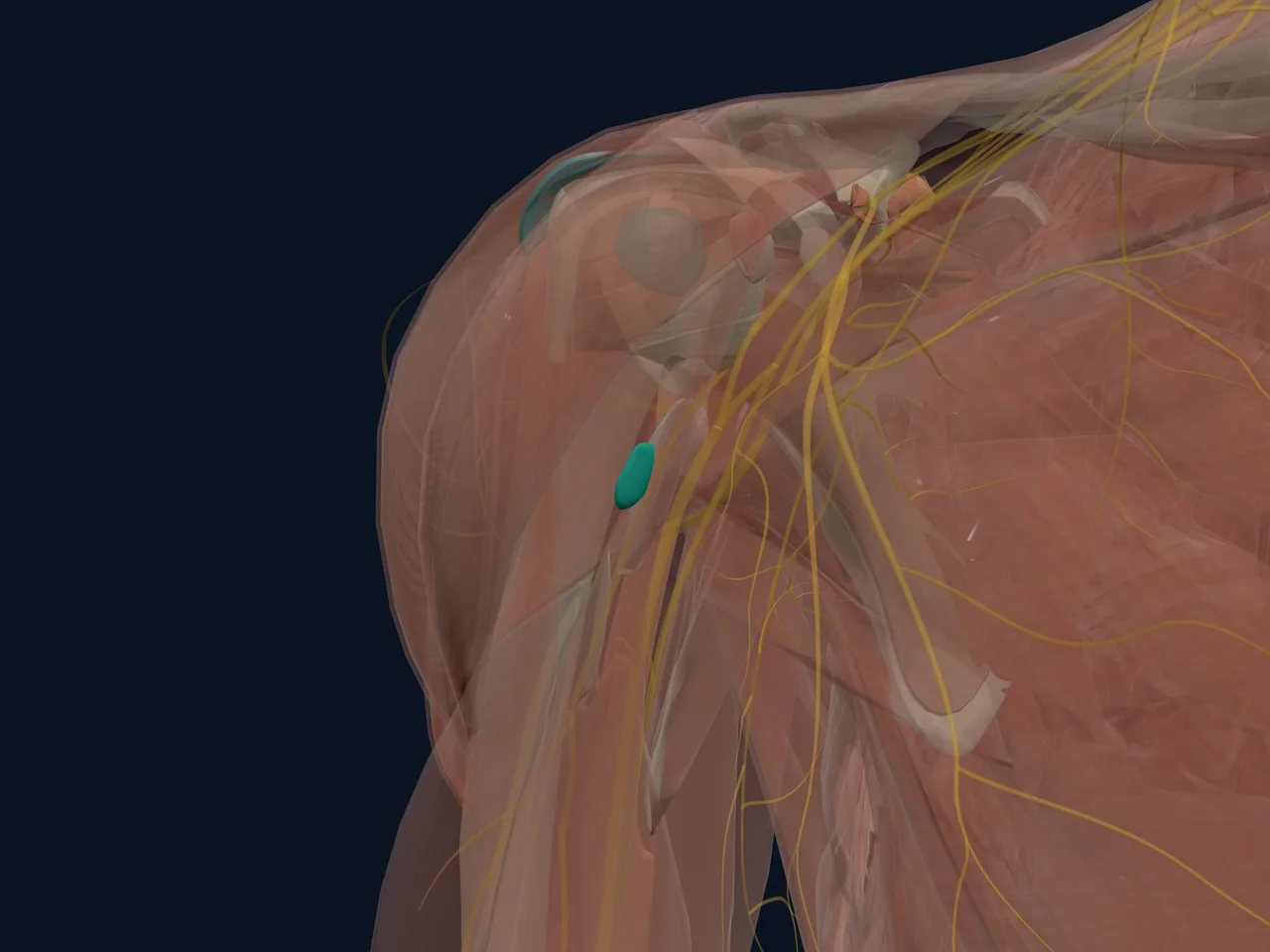
The teres major bursa is a small fluid-lined sac near the tendon of the teres major, behind and below the shoulder joint. It helps the tendon glide where it passes close to neighbouring muscles and the upper arm.
Location
- Near the lower border of the back of the shoulder
- Adjacent to the teres major tendon
- Close to the latissimus dorsi tendon and proximal humerus
- Separate from the larger subacromial-subdeltoid bursa
Function
The bursa reduces friction as teres major helps pull the arm inward, downward and backward.
Why It Matters
The teres major bursa is small and is rarely treated as a common isolated pain source. Pain in this area can also involve teres major, latissimus dorsi, the long head of the triceps, the shoulder joint, or pain referred from another region.
A scan showing fluid near the bursa does not establish that it is causing the symptoms. The history, exact pain location, strength and movement findings remain important.
Related Anatomy
- Teres major — the muscle and tendon most closely related to the bursa
- Latissimus dorsi — a neighbouring tendon with a similar action
- Subacromial bursa — the shoulder’s larger and more commonly discussed bursa
References
- Kennedy MS, Nicholson HD, Woodley SJ. “The morphology of the subacromial and related shoulder bursae: an anatomical and histological study.” Journal of Anatomy. 2022. https://pmc.ncbi.nlm.nih.gov/articles/PMC9005683/
- Miniato MA, Anand P, Varacallo M. “Anatomy, Shoulder and Upper Limb, Shoulder Muscles.” StatPearls Publishing. https://www.ncbi.nlm.nih.gov/books/NBK482410/