Exercises · IA-UAE-EXE-004

Forearm Pronation and Supination

Learn a controlled palm-up and palm-down forearm rotation exercise, with options for mobility and resistance.

Browse Arms
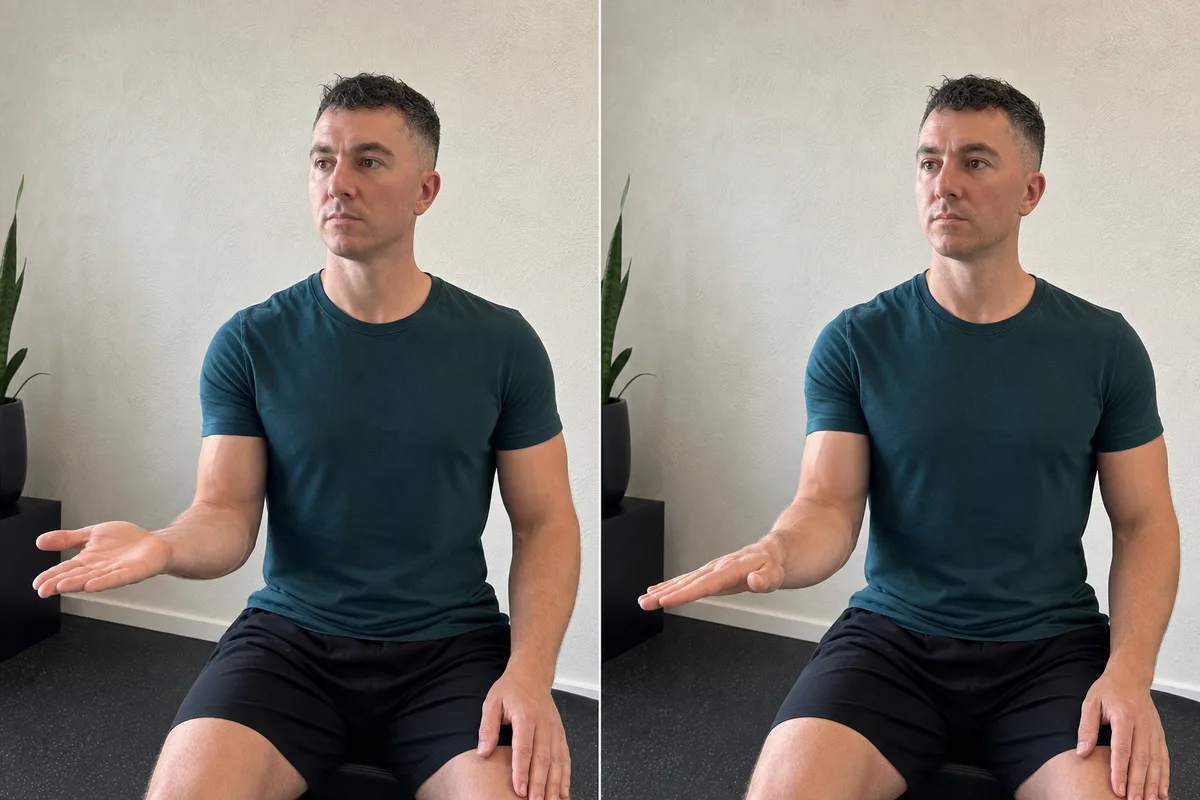
Start and finish demonstration of Forearm Pronation and Supination
Start and finishUse the written steps below for the full technique and safety guidance.

At a glance

Exercise profile

Target muscles
Pronator teres, Pronator quadratus, Supinator
Exercise type
Mobility and strength
Equipment
Optional light hammer or dowel
Mechanics
Isolation
Movement pattern
Forearm rotation (unilateral)
Experience level
beginner
Secondary muscles
Biceps brachii, Brachioradialis

Forearm rotation and control

What this exercise works

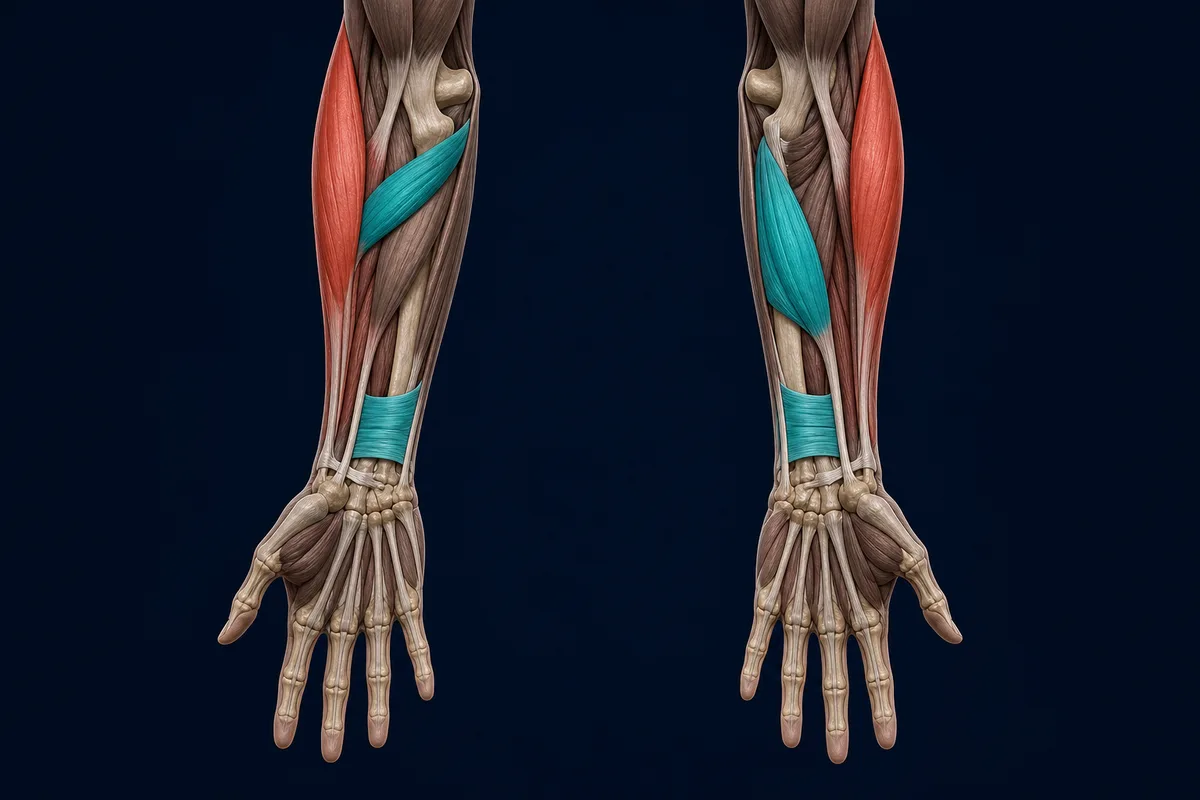
The pronator muscles turn the palm downward while the supinator and biceps help turn it upward, with the wrist kept steady.

Anatomy highlighting the structures involved in Forearm Pronation and Supination
Teal — primary muscles doing most of the workRed — secondary muscles assistingGrey — stabilizers and surrounding anatomy

Primary emphasis

  • Pronator teres
  • Pronator quadratus
  • Supinator

Secondary muscles

  • Biceps brachii
  • Brachioradialis

Stabilizers

  • Wrist flexors and extensors
  • Grip muscles
  • Rotator cuff

Movement and joint actions

  • Forearm pronation
  • Forearm supination
  • Radioulnar-joint control

Muscle contribution changes with position, range, resistance and individual technique.

Why it can help

Potential benefits and carryover

Benefits depend on technique, dosage, consistency and whether the exercise suits the person. Sport carryover means supporting the physical demands of the activity—not guaranteeing performance or preventing injury.

Everyday benefits

  • Practises comfortable palm-up and palm-down motion
  • Builds control for keys, jars and tool use
  • Allows mobility or resistance training with the same movement
  • Develops forearm coordination without moving the shoulder

Training carryover

  • Supports grip orientation during curls, rows and carries
  • Builds control for dumbbell and cable exercises
  • Prepares the forearm for progressively off-centre resistance

Sport carryover

  • Supports forearm control in tennis and racquet sports
  • Builds rotational capacity useful in climbing, paddling and throwing tasks

Technique

Forearm Pronation and Supination tips

Use these cues to keep the movement controlled and focused on its intended purpose.

  1. Keep the elbow tucked beside the body and bent to roughly 90 degrees.
  2. Rotate through the forearm instead of turning the shoulder or trunk.
  3. Hold close to the centre of the object before increasing leverage.
  4. Use a relaxed grip and stop before a hard block or catching sensation.

Overview

This exercise trains the forearm to rotate palm-up and palm-down while the elbow stays close to the body. It can be used unloaded for mobility or with a light off-centre object for strength.

How to Do It

  1. Sit or stand with the elbow bent to 90 degrees and tucked against your side.
  2. Begin with the thumb pointing upward.
  3. Slowly turn the palm toward the ceiling, then toward the floor.
  4. Keep the upper arm still and move only through a comfortable range.
  5. Start with 10 slow rotations; add a light hammer only when unloaded motion is easy.

What You Should Feel

Expect gentle forearm muscle work and a comfortable elbow rotation. Do not force through a hard block, sharp pain or catching.

Common Mistakes

  • Letting the elbow drift away from the side
  • Rotating the whole shoulder and trunk
  • Gripping the weight too tightly
  • Holding too far from the centre before control is established

Progression

Move the hand slightly farther from the centre of a light hammer to increase leverage, then add repetitions before choosing a heavier object.

References

  • Newcastle Hospitals NHS Foundation Trust. "Tennis Elbow." Elbow flexion-extension and pronation-supination guidance. https://www.newcastle-hospitals.nhs.uk/services/newcastle-occupational-health-service/information-for-staff/physiotherapy/self-help-leaflets/tennis-elbow/
This is general education. Follow specific restrictions after fracture, dislocation, tendon repair or surgery.
Educational information only

This information does not diagnose an injury or replace care from a qualified healthcare professional.