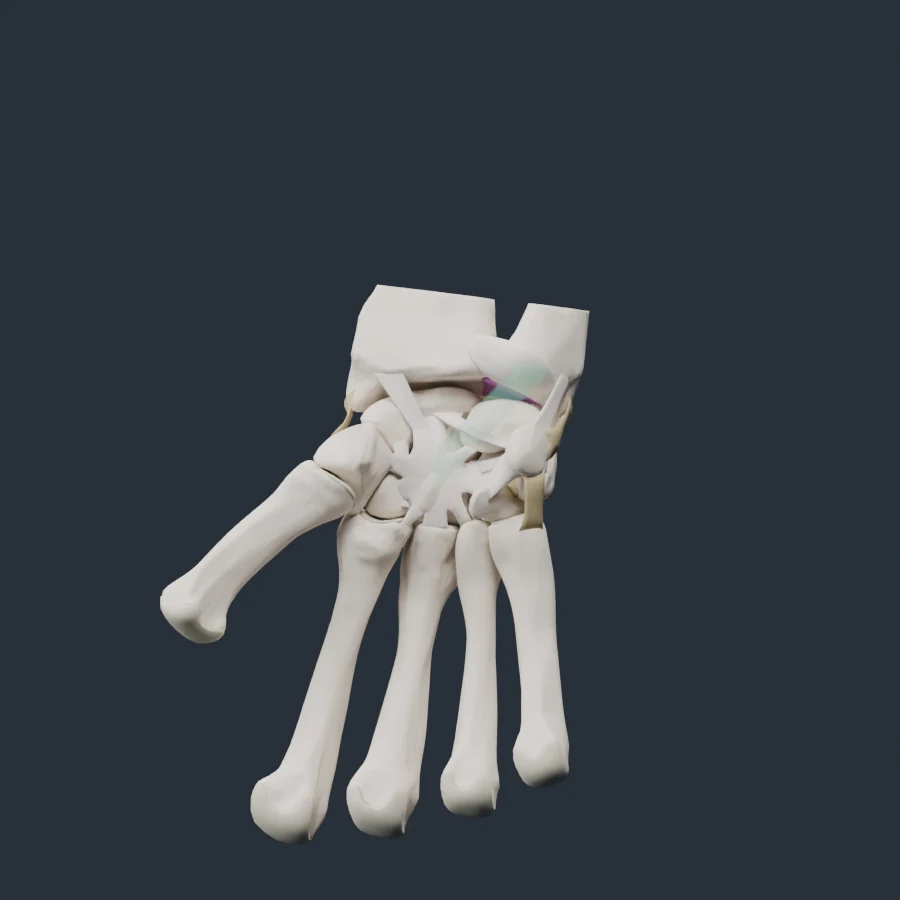
Overview
The triangular fibrocartilage complex (TFCC) is a group of cartilage and ligaments on the little-finger side of the wrist. It helps cushion the wrist and stabilize the joint between the radius and ulna when you rotate the forearm.
TFCC injury is one possible cause of ulnar-sided wrist pain. A tear can follow a fall onto the hand, a twisting force or a heavy loaded wrist. Wear-related changes can also appear over time—and a scan can show a TFCC tear in people with no pain—so the image must match the symptoms and examination.
Typical Pattern
- Pain on the little-finger side of the wrist
- Pain with twisting a jar, turning a key or rotating the forearm
- Clicking, popping, reduced grip or a feeling of instability
- Pain bearing weight through the palm, such as pushing up from a chair
Not all ulnar wrist pain is TFCC-related. Tendons, the distal radioulnar joint, the ulna, small wrist bones and nerve irritation can create similar symptoms.
What Often Helps First
-
Protect and assess
- Avoid painful twisting, heavy grip and palm weight-bearing
- Rule out fracture or instability after trauma
Progress when: The wrist is safe to move and symptoms are settling
-
Restore controlled motion
- Build comfortable wrist and forearm rotation
- Keep finger, elbow and shoulder motion active
Progress when: Rotation and daily grip are improving
-
Build strength
- Progress grip, rotation and supported loading
- Introduce light carries and pressing gradually
Progress when: The wrist is stable and strong for daily tasks
-
Return to demand
- Restore heavier lifting, racquet work or impact in steps
- Add loaded extension and hanging last
Progress when: There is no instability, swelling or next-day flare
- Stop repeatedly testing painful twisting, push-up or heavy-grip positions
- Use a brace or short period of immobilization only when advised after assessment—especially after trauma
- Keep shoulder, elbow and fingers moving, while respecting any wrist restrictions
- Reintroduce range, rotation, grip and weight-bearing in stages once instability or fracture has been excluded
Avoid aggressive self-mobilization or forcing wrist rotation after a fresh injury. It can be difficult to distinguish a TFCC injury from a fracture or unstable joint without an examination.
How It Is Assessed
A clinician checks the exact pain location, forearm rotation, grip, distal radioulnar joint stability and other causes of ulnar wrist pain. X-rays may be used after trauma to look for fracture or alignment problems. MRI can help in selected cases, but it is not a stand-alone diagnosis because incidental TFCC changes are common.
Recovery and Treatment
The first plan depends on whether the joint is stable and whether there was trauma. Many stable, non-fracture cases begin with activity modification, temporary support and supervised hand therapy. Persistent pain, clear instability or certain tear patterns may need assessment by a hand specialist and sometimes surgery.
Return to Sport and Lifting
Return in this order: comfortable daily wrist use → rotation and grip → light supported loading → longer carries and pressing → sport-specific impact, hanging or push-up positions. Do not jump straight back to heavy barbell front-rack, hand-supported gymnastics or racquet work just because pain at rest has settled.
Seek Urgent or Prompt Assessment
- Pain after a fall, especially with swelling, bruising or tenderness over a bone
- A wrist that looks deformed, feels unstable or cannot rotate
- Sudden loss of grip or a cold, pale, blue or numb hand
- Clicking with clear instability after injury
- Persistent little-finger-side wrist pain that is limiting work, sport or daily tasks
References
- American Society for Surgery of the Hand. "TFCC Tears & Repairs." https://www.assh.org/handcare/servlet/servlet.FileDownload?file=00P0a00000ocYAbEAM
- American Society for Surgery of the Hand. "Principles of Hand and Wrist Arthroscopy: Triangular Fibrocartilage Complex Injury." https://handthology.assh.org/chapters/general-principles/hand-wrist-arthroscopy
This is general education, not a diagnosis. Ulnar-sided wrist pain after a fall or twist deserves assessment before returning to loading.