Overview
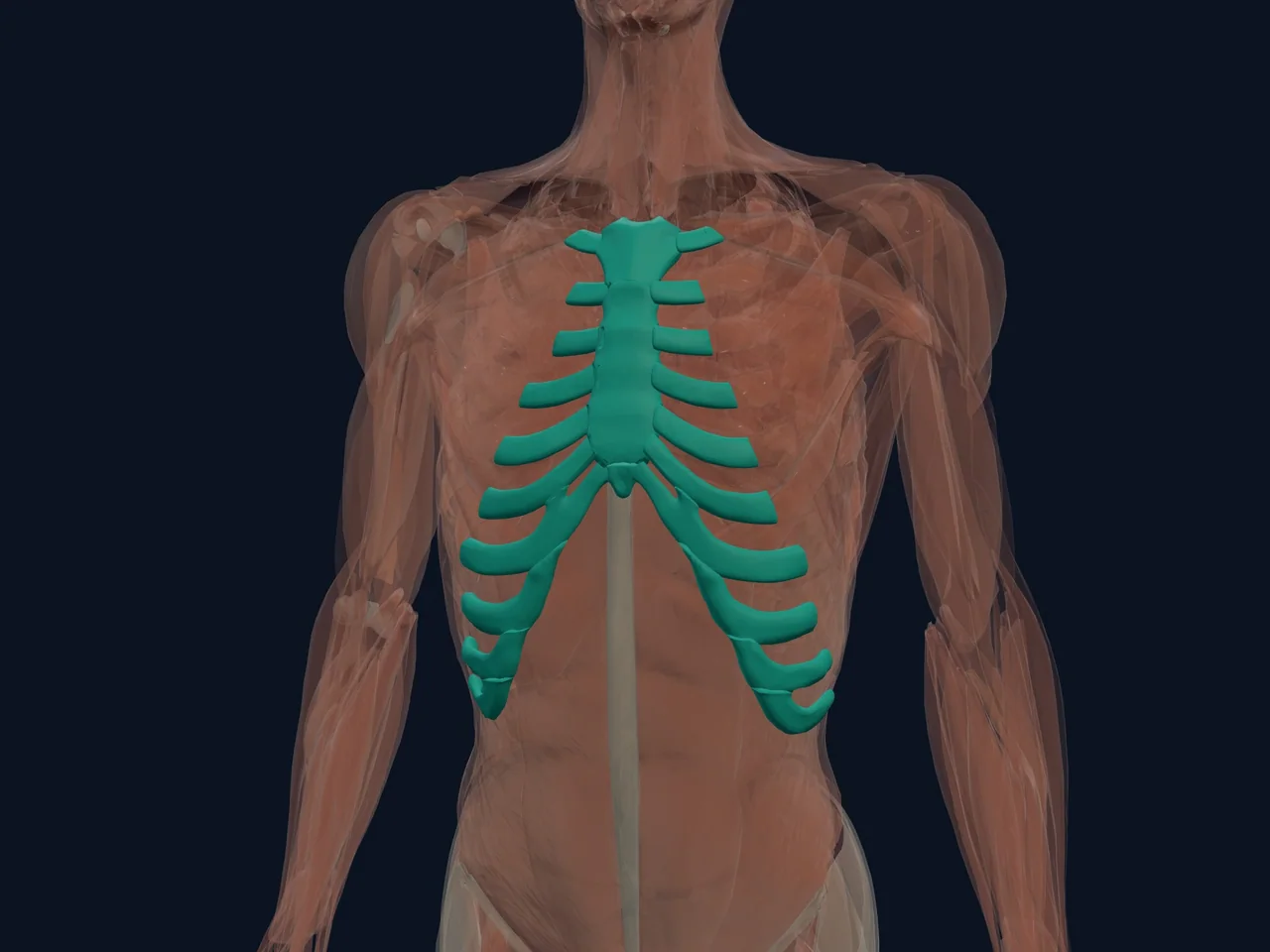
The chest wall is the framework that surrounds and protects the lungs and heart. It is built from the ribcage, the breastbone (sternum), the muscles between the ribs, the pectoral muscles in front, and the large breathing muscle below — the diaphragm.
Most chest wall pain is muscular or rib-related, and knowing the layers helps explain why coughing, twisting and pressing can all irritate different parts of the chest.
Location and Connections
- The ribcage — usually 12 pairs of ribs — connects the spine at the back to the sternum at the front (or attaches to cartilage)
- The sternum runs down the centre of the chest and connects to the collarbones and upper ribs
- The intercostal muscles fill the spaces between the ribs and move the ribcage during breathing
- The pectoralis major and minor sit on the front of the ribcage and move the arm and shoulder
- The diaphragm domes across the bottom of the ribcage, separating the chest from the abdomen
What It Does
The chest wall protects the lungs and heart, supports breathing, and anchors the muscles that move the shoulder, neck and arms. Breathing works by the diaphragm and intercostal muscles expanding the ribcage, which draws air into the lungs.
The chest wall is also a common source of pain: ribs, cartilage, muscles and joints here can all be injured or irritated, which is why "chest wall pain" has many possible patterns.
Common Problems
- Rib fractures and bruised ribs — after a fall, blow or hard cough
- Costochondritis — irritation where the ribs meet the breastbone
- Intercostal muscle strain — a pulled muscle between the ribs
- Sternoclavicular joint sprain — injury at the collarbone–breastbone joint
- Pectoralis major strain or tear — pressing-related chest injuries
- Muscle tightness and breathing-related discomfort
Chest pain can also come from the heart, lungs or other organs. Pain that is heavy, pressing or spreads to the arm or jaw — or comes with shortness of breath, sweating or nausea — needs urgent assessment before assuming a chest-wall cause.
Clinical Relevance
Understanding which layer is involved guides treatment: rib fractures need pain control and breathing exercises, muscle strains respond to graded loading, and joint or cartilage irritation usually settles with load adjustment. Persistent or severe chest pain, pain with breathing difficulty, or pain after major trauma deserves assessment.
Related Anatomy
- Ribcage — the bony cage and its joints
- Intercostal muscles — the muscles between the ribs
- Diaphragm — the main breathing muscle
- Pectoralis major — the large front chest muscle
- Pectoralis minor — the deeper front chest muscle
References
- StatPearls. "Anatomy, Thorax." https://pubmed.ncbi.nlm.nih.gov/32491642/
- StatPearls. "Anatomy, Thorax, Wall." https://www.ncbi.nlm.nih.gov/sites/books/NBK535414/