Overview
Greater trochanteric pain syndrome (GTPS) is pain and tenderness over the outside of the hip, over the bony bump at the top of the thigh (the greater trochanter).
It used to be called "trochanteric bursitis," but the gluteus medius and minimus tendons are often the key sensitive tissues. The bursa may be involved, but it is rarely helpful to assume every outer-hip pain is simply inflammation.
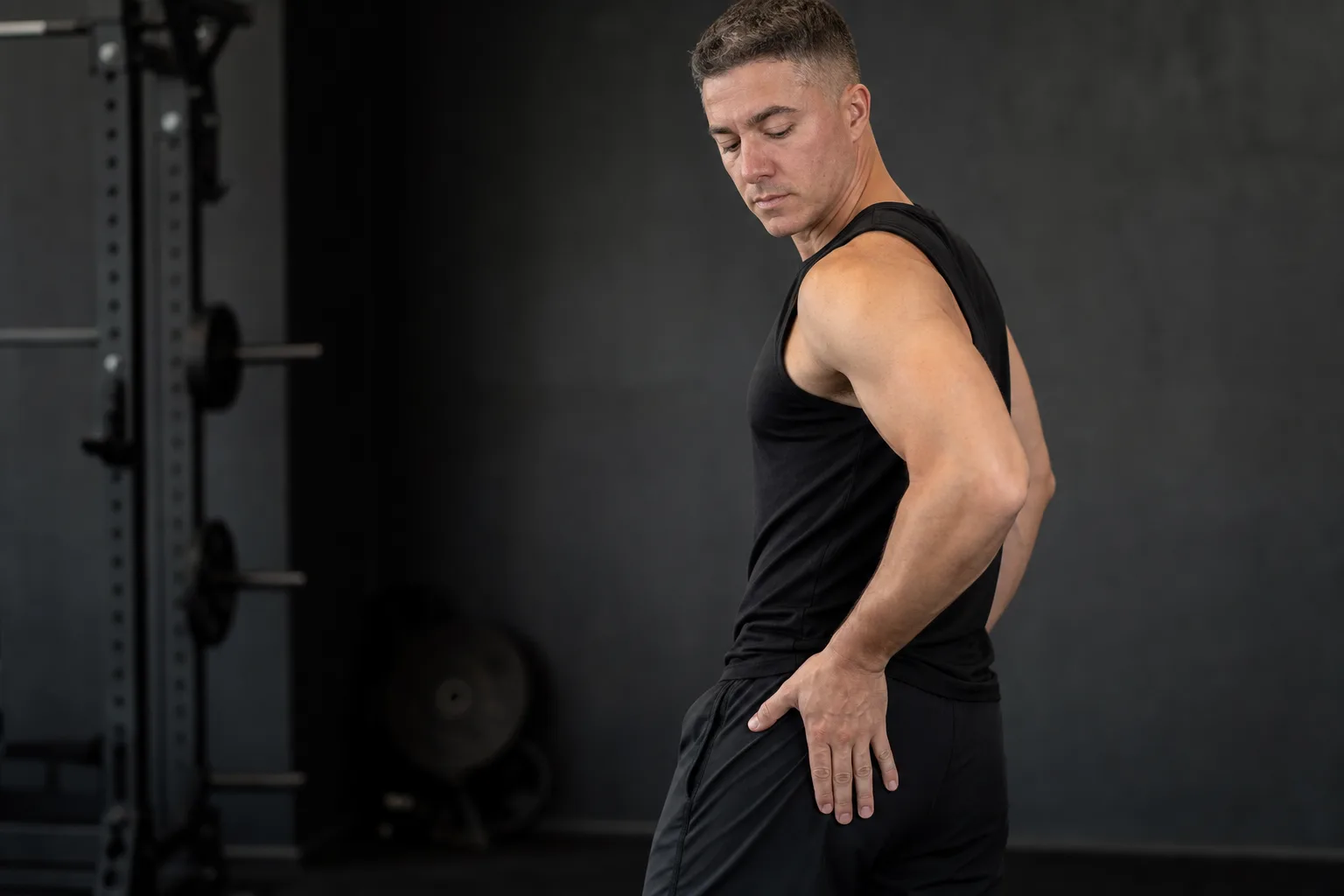
GTPS is usually managed by reducing aggravating compression, gradually rebuilding gluteal capacity and returning to walking, stairs, running or sport in manageable steps.
Anatomy at a Glance
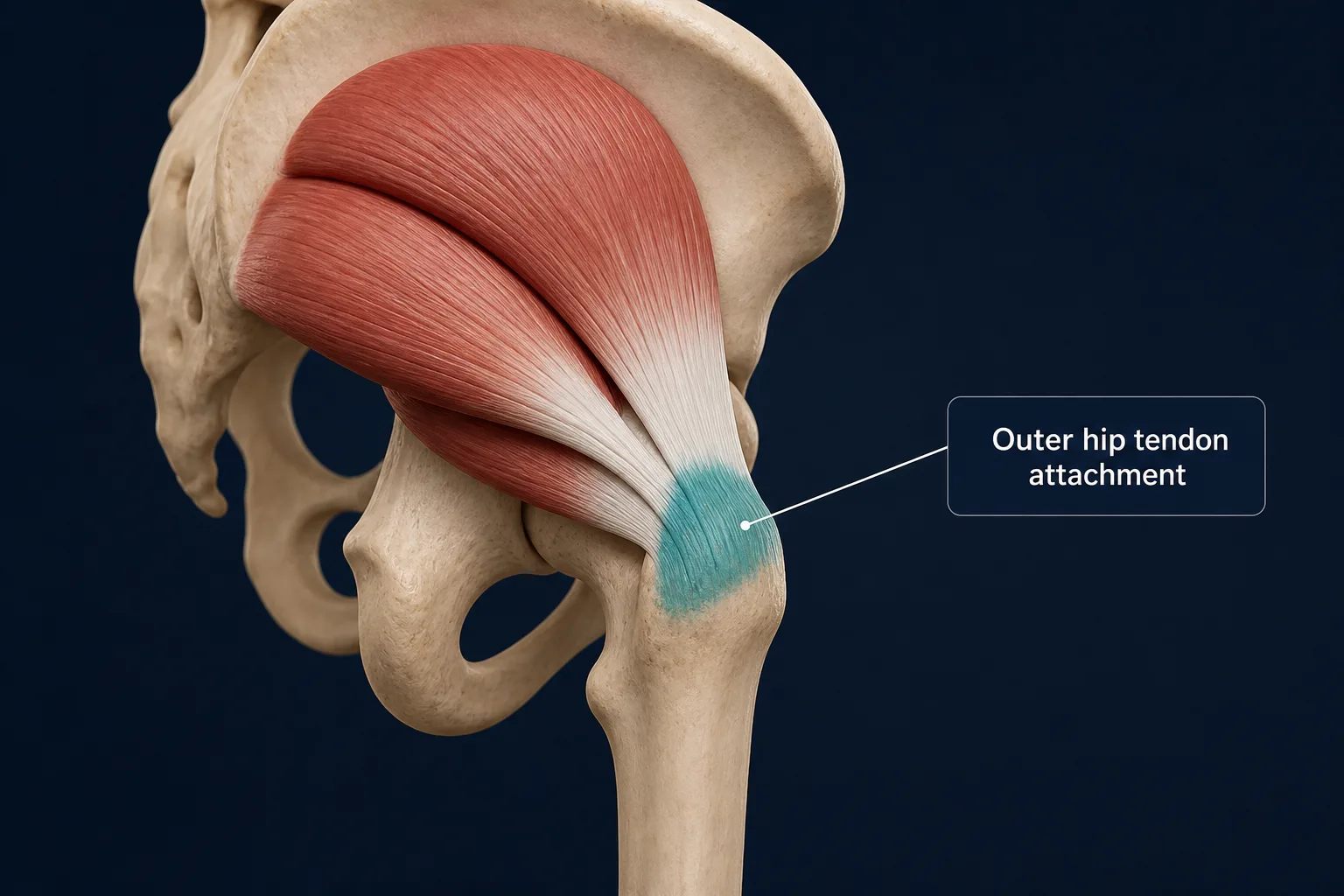
The gluteus medius and gluteus minimus travel from the pelvis to the greater trochanter. They keep the pelvis level when you stand on one leg, walk, run and climb stairs. In GTPS, their tendon attachment can become painful when its current capacity is exceeded or repeatedly compressed against the bone.
Typical Pattern
- Ache or sharp pain on the outer hip, sometimes spreading down the outside of the thigh
- Worse when lying on the affected side at night
- Worse after walking, climbing stairs or standing on one leg
- Tenderness when pressing the bony bump
- Pain when sitting cross-legged or standing with one hip pushed out
Why It Develops
GTPS often develops when the gluteal tendons are loaded more than they can tolerate — a new walking or running routine, more stairs, or a change in training. Repeated compression from crossed-leg sitting, hip-hanging and side-lying can also aggravate it.
How It Is Diagnosed
The diagnosis is mostly clinical: pain and tenderness over the greater trochanter, reproduced by standing on one leg or pressing on the area. A clinician also checks walking, hip strength and the lower back. Imaging is not required for every case; X-rays can help rule out bone or joint causes, while ultrasound or MRI may be useful when symptoms persist or a significant tendon tear is suspected.
Treatment
-
Settle the outer hip
- Reduce side-lying compression and hip-hanging
- Adjust hills, stairs and long walks temporarily
Progress when: Sleep and daily walking are settling
-
Restore early capacity
- Start comfortable gluteal holds and bridges
- Keep the pelvis level during simple standing tasks
Progress when: There is no sharp pain or next-day flare
-
Build single-leg strength
- Progress hip abduction, steps and hinges
- Increase flat-walking tolerance before hills
Progress when: Strength and control are improving
-
Return to demand
- Build walk → jog → run progressively
- Add hills, cutting and jumping last
Progress when: There is no later or next-morning escalation
Stage 1: Reduce Compression and Settle Irritability
- Temporarily shorten long walks, hills, stairs or running if they produce a clear flare
- Avoid hanging on one hip, crossing the legs and aggressive outer-hip stretches
- Sleep on the comfortable side with a firm pillow between the knees, or on your back with support under the knees
- Keep moving within comfort rather than resting completely
Stage 2: Build Early Gluteal Capacity
Start with tolerable low-load work such as a clamshell, bridge or standing hip-abduction hold. The aim is quality and a manageable next-day response, not chasing fatigue or a burn at the painful spot.
Stage 3: Restore Walking and Single-Leg Control
Progress to controlled standing hip abduction, step-ups, hip hinges and single-leg balance. Improve strength through a comfortable range before adding bigger hills, speed or volume.
Stage 4: Return to Demanding Activity
Build flat walking before hills; easy jogging before faster running; and simple single-leg drills before lateral cutting or jumping. Change only one major variable at a time and assess the response later that day and the following morning.
What Treatment Has the Best Support?
Education about load and positioning plus progressive exercise has the strongest practical support. A randomised trial found this approach had better short- and longer-term global improvement than a single corticosteroid injection or waiting alone for people with persistent gluteal tendinopathy. Injections may help selected people but should not replace a capacity-building plan. Surgery is uncommon and reserved for carefully assessed persistent cases, including major gluteal tendon tears.
Recovery Time
Outer-hip tendons usually adapt over weeks to months, not days. Progress is best judged by sleep, walking tolerance, strength and the next-day response—not a fixed deadline.
When to Get Assessed
- Pain that is not improving after several weeks of sensible adjustment
- Pain severe enough to disturb sleep regularly
- A pop, sudden weakness or difficulty bearing weight
- Redness, swelling or warmth over the hip, or pain with fever
Related Reading
- Gluteal muscles anatomy
- Gluteal tendinopathy
- Outer hip pain
- Clamshell exercise
- General hip loading principles
References
- StatPearls. "Greater Trochanteric Pain Syndrome (Greater Trochanteric Bursitis)." https://www.ncbi.nlm.nih.gov/sites/books/NBK557433/
- Grimaldi A, Fearon A. "Gluteal Tendinopathy: Integrating Pathomechanics and Clinical Features in Its Management." Journal of Orthopaedic & Sports Physical Therapy. 2015. https://pubmed.ncbi.nlm.nih.gov/26381486/
This information is for education only and is not a medical diagnosis. InjuryAtlas does not replace an assessment by a qualified health professional. If you have severe pain, visible deformity, numbness, loss of function, or symptoms that are getting worse, seek medical care promptly.