Muscle-growth potentialHow well this movement can be loaded and progressed for building muscle.
Exercises · IA-KNE-EXE-017
Lying Leg Curl
Learn prone lying leg-curl setup, hamstrings worked, benefits, mistakes and practical progression.
At a glance
Exercise profile
- Target muscles
- biceps femoris, semitendinosus, semimembranosus
- Exercise type
- Strength
- Equipment
- Prone selectorized leg-curl machine
- Mechanics
- Isolation
- Movement pattern
- Knee flexion (bilateral or unilateral)
- Experience level
- beginner
- Secondary muscles
- gastrocnemius, gracilis, sartorius
What the science says
Training study comparing prone and seated leg curls
What it found: Twelve weeks of both prone and seated leg curls increased hamstring volume. The seated condition produced more overall growth, likely because it trained the two-joint hamstrings at longer lengths.
What that means here: A lying curl still builds the hamstrings. Pairing it with a hip hinge—or sometimes rotating in a seated curl—creates a more complete plan than arguing that one machine must do everything.
Supported hamstring isolation
What this exercise works
The hamstrings bend the knees while the machine supports the hips and torso; the gastrocnemius assists across the knee.
Primary emphasis
- biceps femoris
- semitendinosus
- semimembranosus
Secondary muscles
- gastrocnemius
- gracilis
- sartorius
Stabilizers
- gluteus maximus
- abdominal muscles
Movement and joint actions
- Knee flexion
Muscle contribution changes with position, range, resistance and individual technique.
Why it can help
Potential benefits and carryover
Benefits depend on technique, dosage, consistency and whether the exercise suits the person. Sport carryover means supporting the physical demands of the activity—not guaranteeing performance or preventing injury.
Everyday benefits
- Directly trains knee-flexion strength in the hamstrings
- Provides stable hamstring volume without loading a hip hinge
- Makes progressive overload easy to measure
- Complements Romanian deadlifts and good mornings by training a different hamstring function
Training carryover
- Pairs well with hinges in a complete hamstring programme
- Supports stronger running mechanics, sprint preparation and knee control
Sport carryover
- Useful for running, sprinting, field sports and activities that demand repeated knee flexion
Technique
Lying Leg Curl tips
Use these cues to keep the movement controlled and focused on its intended purpose.
- Set the roller just above the heels rather than across the calves.
- Keep the hips heavy against the pad as the knees bend.
- Curl smoothly without kicking the roller.
- Lower until the knees are nearly straight while keeping tension on the stack.
Overview
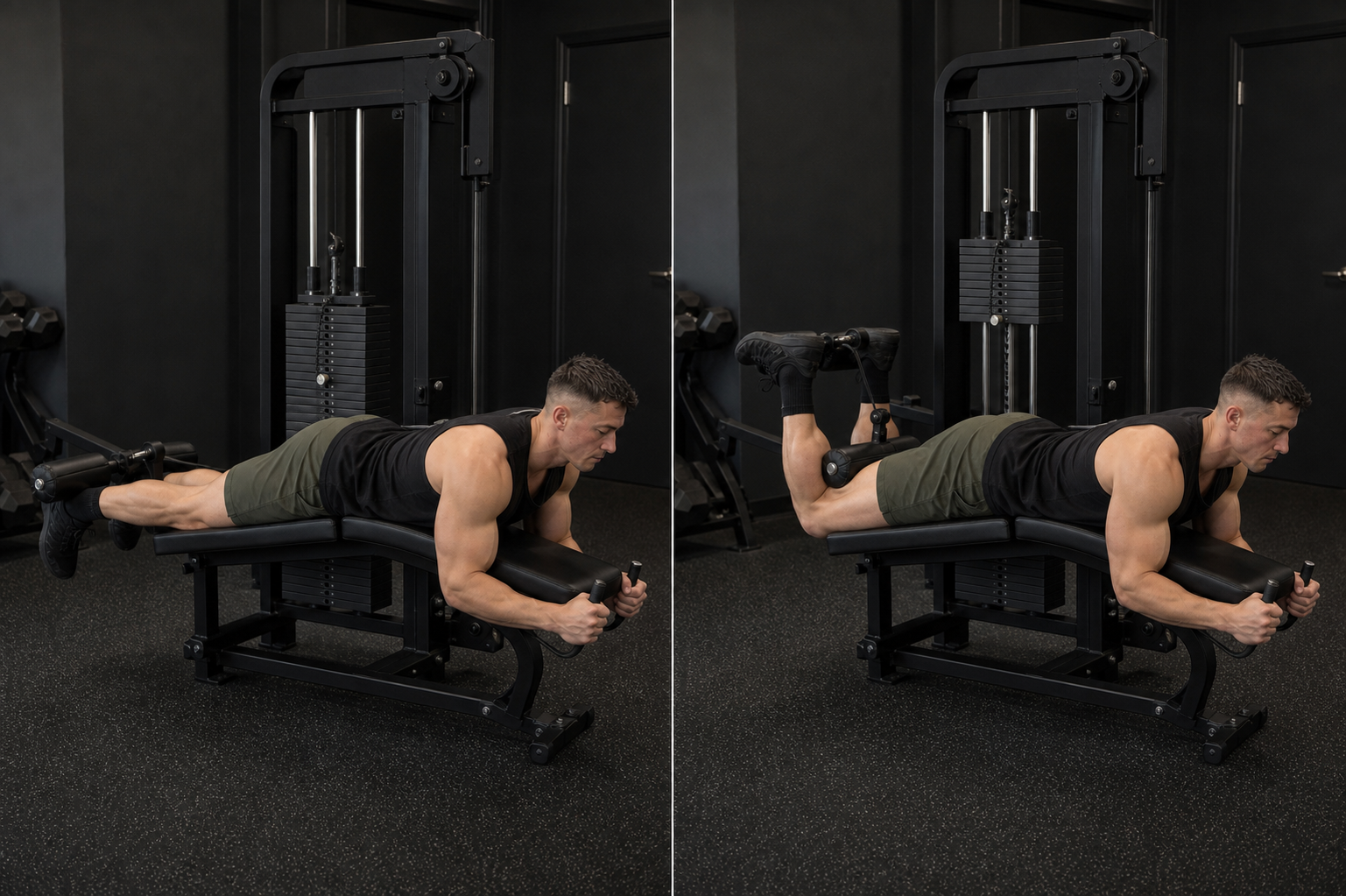
The lying leg curl trains the hamstrings by bending the knees against resistance. It is stable, simple to learn and useful beside a hip-hinge exercise rather than as a replacement for one.
How to Do It
- Lie face down with the knees close to the machine pivot and the roller just above the heels.
- Hold the handles and keep the hips gently pressed into the pad.
- Curl the heels toward the glutes without arching the low back or lifting the hips.
- Pause briefly in a strong position, then lower the stack slowly.
- Stop before the plates crash together. Start with 2–4 sets of 8–15 repetitions.
What You Should Feel
The back of the thighs should do most of the work. The calves may help. Cramping can happen when the hamstrings are not used to direct knee-flexion work, but sharp pain or a sudden pulling sensation is not something to push through.
Common Mistakes
- Lifting the hips off the pad
- Curling so far that the low back arches
- Letting the weight drop through the lowering phase
- Positioning the roller too high on the calf
Progression
Add repetitions before load. When you can control the full set without the hips lifting, increase the stack by one small increment. A seated curl may be a useful alternative when you want the hamstrings trained at longer muscle lengths.
Educational information only — not a diagnosis. Stop if you feel sudden hamstring pain, bruising or a sharp pulling sensation.
This information does not diagnose an injury or replace care from a qualified healthcare professional.