Overview
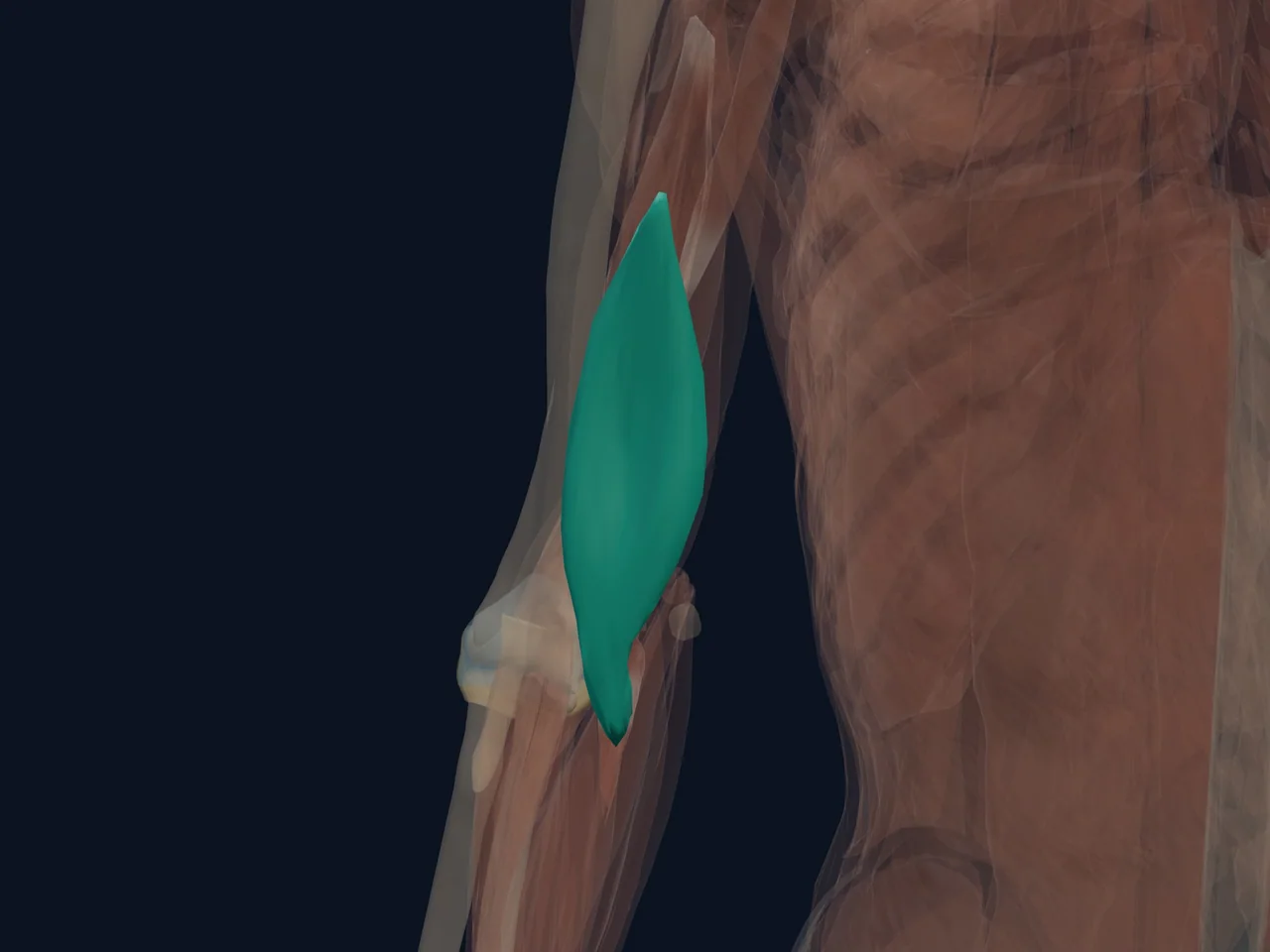
The brachialis is a broad muscle beneath the biceps at the front of the upper arm. It is less visible than the biceps, but it is one of the elbow’s most dependable flexors.
Because the brachialis attaches to the ulna rather than the radius, it bends the elbow whether the palm faces up, down or inward. That makes it active in curls, pulling movements and everyday lifting in almost any hand position.
Location
- Begins on the lower half of the front of the humerus
- Runs deep to the biceps brachii
- Crosses the front of the elbow and attaches to the ulna
Origin, Insertion, Nerve Supply, and Action
- Origin: Distal half of the anterior humerus and nearby intermuscular septa
- Insertion: Coronoid process and tuberosity of the ulna
- Nerve supply: Musculocutaneous nerve, mainly C5–C6; the lateral portion may also receive a radial-nerve branch
- Action: Flexes the elbow in every forearm position
Function
- Produces elbow flexion with the palm up, down or neutral
- Works with the biceps and brachioradialis during lifting
- Controls the elbow while lowering an object
Common Problems
The brachialis can become sore or strained after a sudden increase in pulling, climbing or curl volume. Symptoms are often felt deeper than typical biceps soreness and may sit lower in the upper arm near the elbow.
Pain in this area can also come from the biceps tendon, elbow joint or a nearby nerve, so location alone cannot confirm which structure is involved.
When to Get It Assessed
Seek an assessment after a sudden injury if there is marked bruising, swelling, weakness or loss of elbow motion. Persistent pain that is not responding to reduced loading also deserves review.
Related Anatomy
References
- OpenStax. “Muscles of the Pectoral Girdle and Upper Limbs.” https://openstax.org/books/anatomy-and-physiology-2e/pages/11-5-muscles-of-the-pectoral-girdle-and-upper-limbs
- StatPearls. “Anatomy, Shoulder and Upper Limb, Brachialis Muscle.” https://www.ncbi.nlm.nih.gov/books/NBK551630/
- Moore KL et al. Clinically Oriented Anatomy. Wolters Kluwer.