Overview
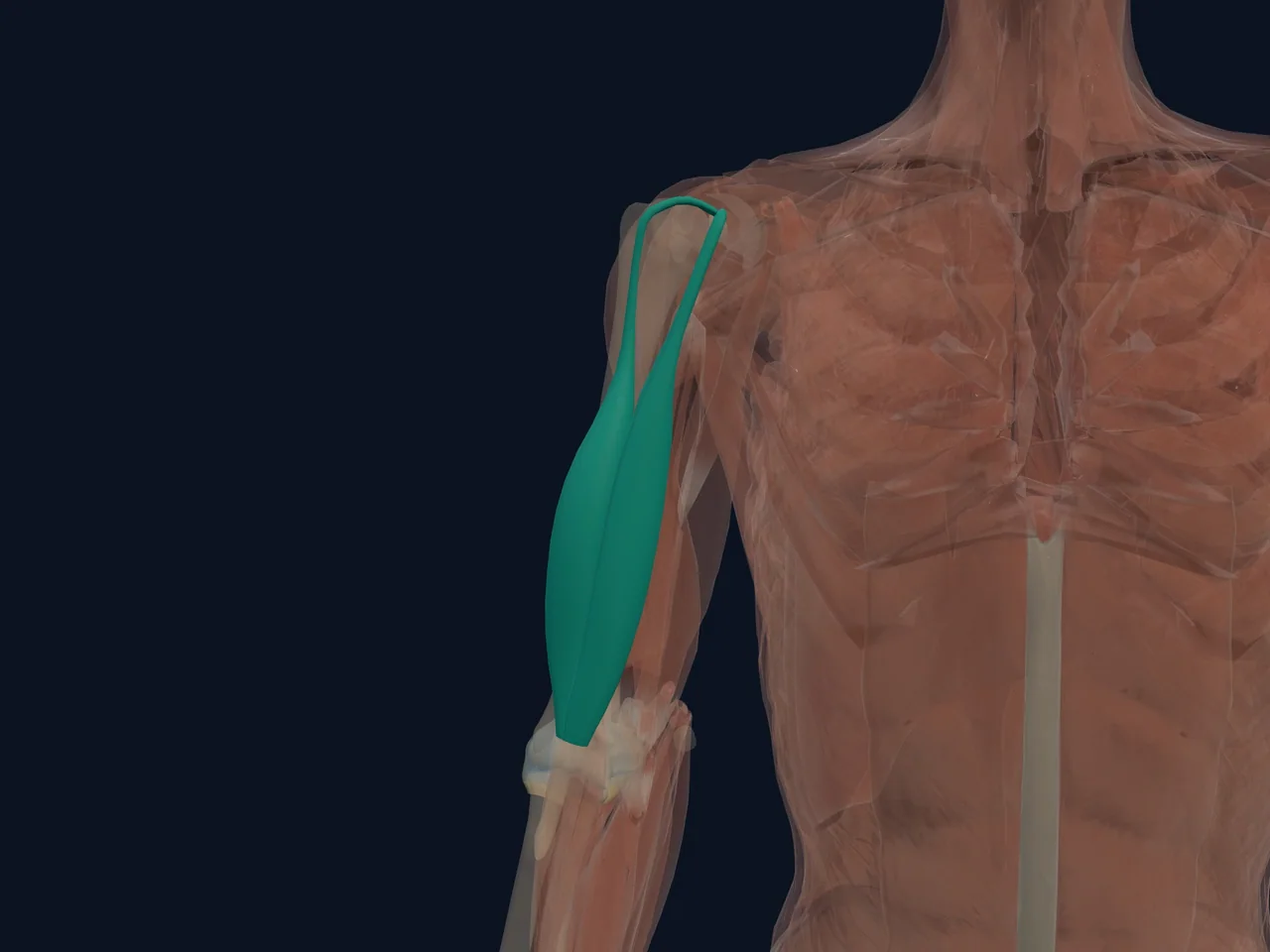
The biceps brachii is the prominent muscle at the front of the upper arm. Its name means “two-headed muscle”: the long head and short head begin at different points on the scapula, then blend into one muscle and share a tendon near the elbow.
The biceps bends the elbow, but that is only part of its job. It is also a powerful supinator, meaning it turns the forearm so the palm faces upward. Holding a bowl, turning a screwdriver and performing an underhand curl all use this combination.
Location
- Runs along the front of the upper arm
- Lies over the brachialis
- Connects the scapula to the radius in the forearm
The Two Heads
- Long head: begins above the shoulder socket, and its tendon passes through the shoulder joint and bicipital groove
- Short head: begins at the coracoid process beside the coracobrachialis
- Both heads join before attaching to the radius through the common distal biceps tendon
The 3D source model includes a mesh labelled “medial head.” Anatomically, biceps brachii has a long head and a short head, not a separate medial head. InjuryAtlas groups that selectable mesh into this overview rather than presenting it as a third head.
Origin, Insertion, Nerve Supply, and Action
- Origin: Supraglenoid tubercle through the long-head tendon; coracoid process through the short-head tendon
- Insertion: Radial tuberosity and bicipital aponeurosis
- Nerve supply: Musculocutaneous nerve, mainly C5–C6
- Action: Supinates the forearm and flexes the elbow; assists shoulder flexion
What It Does in Everyday Movement
- Turns a key or doorknob so the palm rotates upward
- Helps lift objects toward the body
- Controls loads while the elbow straightens
- Assists the shoulder during carrying and some overhead tasks
Common Problems
- Muscle strain after forceful lifting or rapid acceleration
- Long-head biceps tendinopathy at the front of the shoulder
- Distal biceps tendon injury near the elbow
- Proximal tendon rupture, sometimes producing a visible “Popeye” bulge
Pain at the front of the arm does not automatically come from the biceps. The rotator cuff, shoulder joint, neck and nerves can produce similar symptoms.
When to Get It Assessed
A sudden pop followed by bruising, a visible change in muscle shape or a major loss of strength deserves prompt assessment. These features can occur with a tendon rupture.
Related Anatomy
References
- OpenStax. “Muscles of the Pectoral Girdle and Upper Limbs.” https://openstax.org/books/anatomy-and-physiology-2e/pages/11-5-muscles-of-the-pectoral-girdle-and-upper-limbs
- StatPearls. “Anatomy, Shoulder and Upper Limb, Biceps Muscle.” https://www.ncbi.nlm.nih.gov/books/NBK519538/
- Moore KL et al. Clinically Oriented Anatomy. Wolters Kluwer.