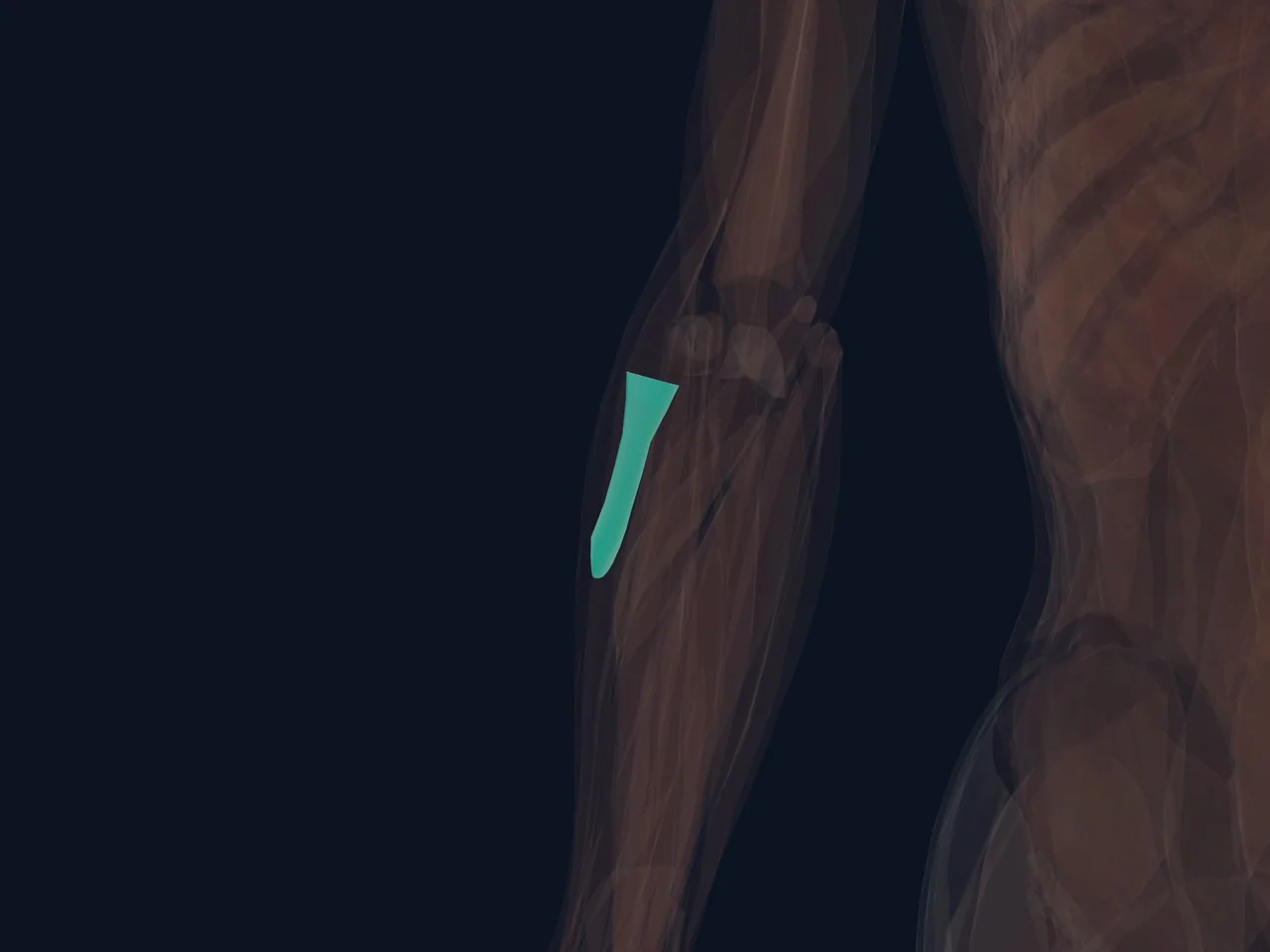
Overview
The biceps has two separate upper attachments — the long head and the short head — but lower down the two muscle bellies join and funnel into a single shared common tendon. This tendon is the final common pathway that delivers the pull of the whole biceps to the bones it moves, so problems here can affect lifting, carrying and turning the palm upward even when the muscle itself feels normal.
Location
- Formed where the long head and short head muscle bellies converge in the lower arm
- Runs down the front of the arm toward the elbow
- Anchors onto the forearm bone and sends a broad sheet of fibres into the deep forearm tissues
Origin, Insertion, Nerve Supply, and Action
- Origin: Convergence of the long head and short head bellies of biceps brachii
- Insertion: Radial tuberosity of the radius, plus the bicipital aponeurosis (lacertus fibrosus) into the deep fascia of the forearm
- Nerve supply: Musculocutaneous nerve (spinal nerve roots C5–C6), which supplies the biceps it serves
- Action: Transmits the biceps' pull to flex the elbow and supinate the forearm (turn the palm up)
In plain English: this is the shared "rope" the whole biceps pulls on. When it is irritated, lifting and twisting-the-palm-up movements tend to hurt at the front of the arm.
Function
- Transmits the combined pull of both biceps heads to the forearm
- Drives flexion of the elbow
- Drives supination of the forearm
- Spreads load into the forearm fascia through the bicipital aponeurosis
Structures It Connects To
- Long head of biceps brachii — one of the two bellies feeding into the tendon
- Short head of biceps brachii — the other belly feeding into the tendon
- Radius (forearm bone) — its main bony anchor at the radial tuberosity
Movements It Assists
- Elbow flexion
- Forearm supination
Common Injuries
- Biceps tendinopathy — irritation of the tendon with repetitive lifting or overhead loading
- Distal biceps tendinopathy — irritation at the radial tuberosity attachment near the elbow
- Biceps tendon instability — the tendon slipping from its normal position, causing anterior pain
Pain Referral Patterns
- Pain at the front of the shoulder or upper arm that worsens with lifting and carrying
- Pain when turning the palm upward against resistance
- Tenderness following the line of the tendon down the front of the arm
Clinical Relevance
Because the common tendon is the final common pathway for everything the biceps does, front-of-arm pain with lifting and supination often traces to the tendon rather than the muscle belly. A sudden pop with a change in the shape of the biceps can indicate a tendon rupture and warrants prompt assessment.
Interesting Facts
- The bicipital aponeurosis (lacertus fibrosus) that spreads from this tendon helps protect the artery and nerve that run just beneath it at the elbow crease — historically useful during blood draws.
Related Anatomy
- Long head of biceps brachii — one of the two heads that feed this tendon
- Glenohumeral joint — the shoulder joint the biceps crosses
- Humerus (proximal) — the upper arm bone the biceps overlies
Related Injuries
References
- Tiwana MS, Charlick M, Varacallo M. "Anatomy, Shoulder and Upper Limb, Biceps Muscle." StatPearls. https://www.ncbi.nlm.nih.gov/books/NBK519538/
- Physiopedia. "Biceps Brachii." https://www.physio-pedia.com/Biceps_Brachii
- Terminologia Anatomica (FIPAT). https://fipat.library.dal.ca/