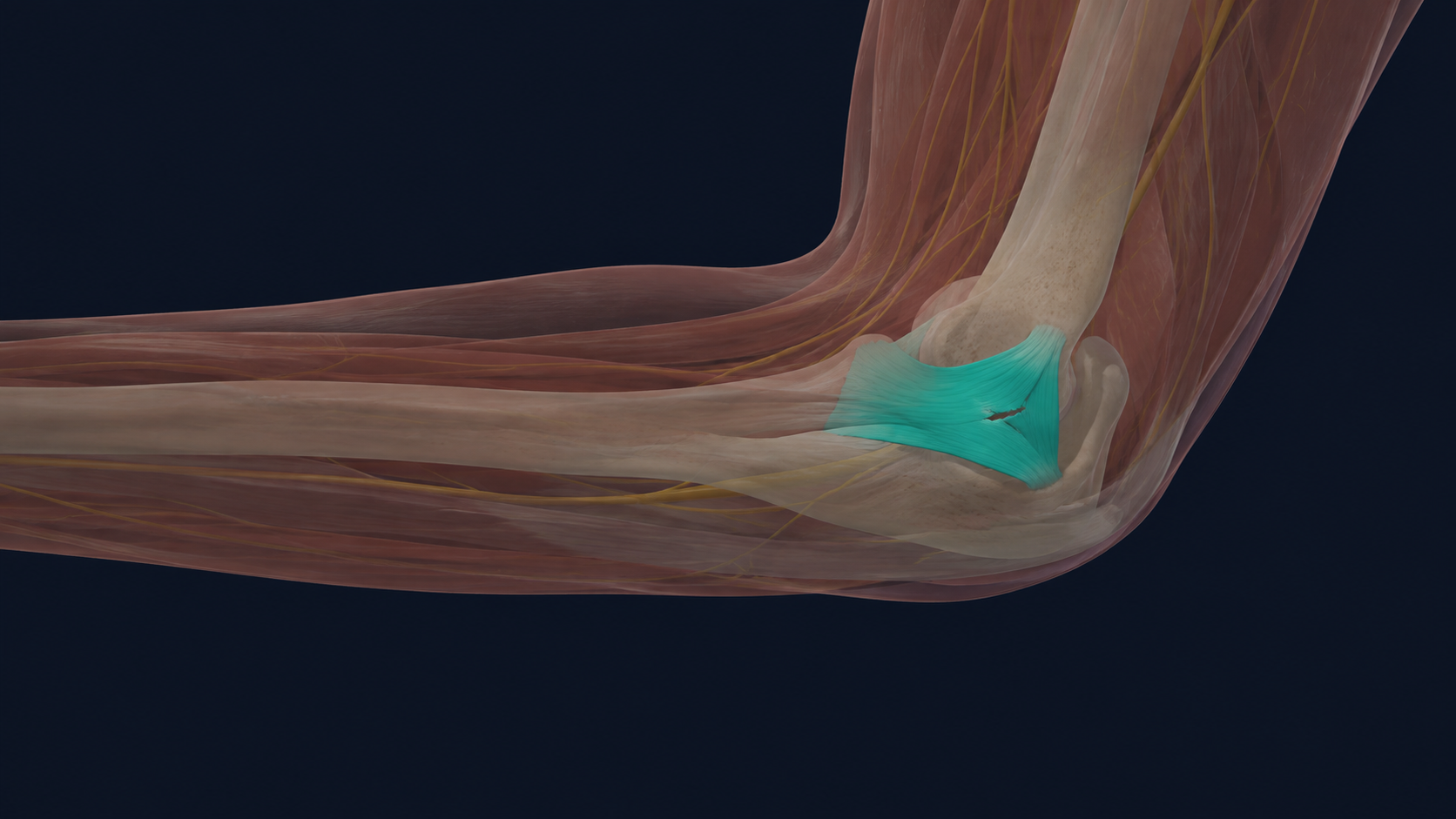
Overview
The ulnar collateral ligament (UCL) is a stabilizing ligament on the inner side of the elbow. It can be sprained by a single forceful event or overloaded gradually by repeated throwing and other movements that stress the inside of the joint.
What It Usually Feels Like
- Pain at the inner elbow during throwing or forceful loading
- Tenderness near the medial epicondyle
- A sense of weakness or instability in more advanced injuries
- Reduced tolerance for throwing, pushing or gripping
Inner-elbow pain is not specific to the UCL. Flexor-pronator tendons and the ulnar nerve can produce overlapping symptoms.
What Often Helps
Stop or reduce the movement that clearly reproduces symptoms and arrange an assessment, especially after a pop, sudden loss of throwing control or bruising. Rehabilitation commonly progresses from comfortable motion and general conditioning toward carefully dosed strength and sport-specific loading. A complete tear or persistent instability may need specialist assessment.
When to Get It Assessed
Seek assessment for a sudden pop, bruising, instability, persistent pain with throwing, hand tingling or a measurable drop in strength. Urgent care is appropriate if there is a deformity, severe loss of function or new circulation or nerve symptoms.
Related Guidance
- Ulnar collateral ligament anatomy — view the ligament in 3D
- Proximal ulna and olecranon anatomy — understand its ulnar attachment
- Golfer’s elbow — a nearby inner-elbow tendon problem
- General elbow loading principles — graded rehabilitation framework
References
- American Academy of Orthopaedic Surgeons. “Ulnar Collateral Ligament (UCL) Injuries of the Elbow.” https://orthoinfo.aaos.org/en/diseases--conditions/ulnar-collateral-ligament-ucl-injuries-of-the-elbow/
- NHS. “Elbow and arm pain.” https://www.nhs.uk/symptoms/elbow-and-arm-pain/
This information is for education only and is not a medical diagnosis. InjuryAtlas does not replace an assessment by a qualified health professional. If you have severe pain, visible deformity, numbness, loss of function, or symptoms that are getting worse, seek medical care promptly.