Exercises · IA-BAC-EXE-004

Side Plank

Learn the side plank for core and hip stability, with hold times, easier versions on the knees and progressions for a stronger midsection.

Browse Lower Back
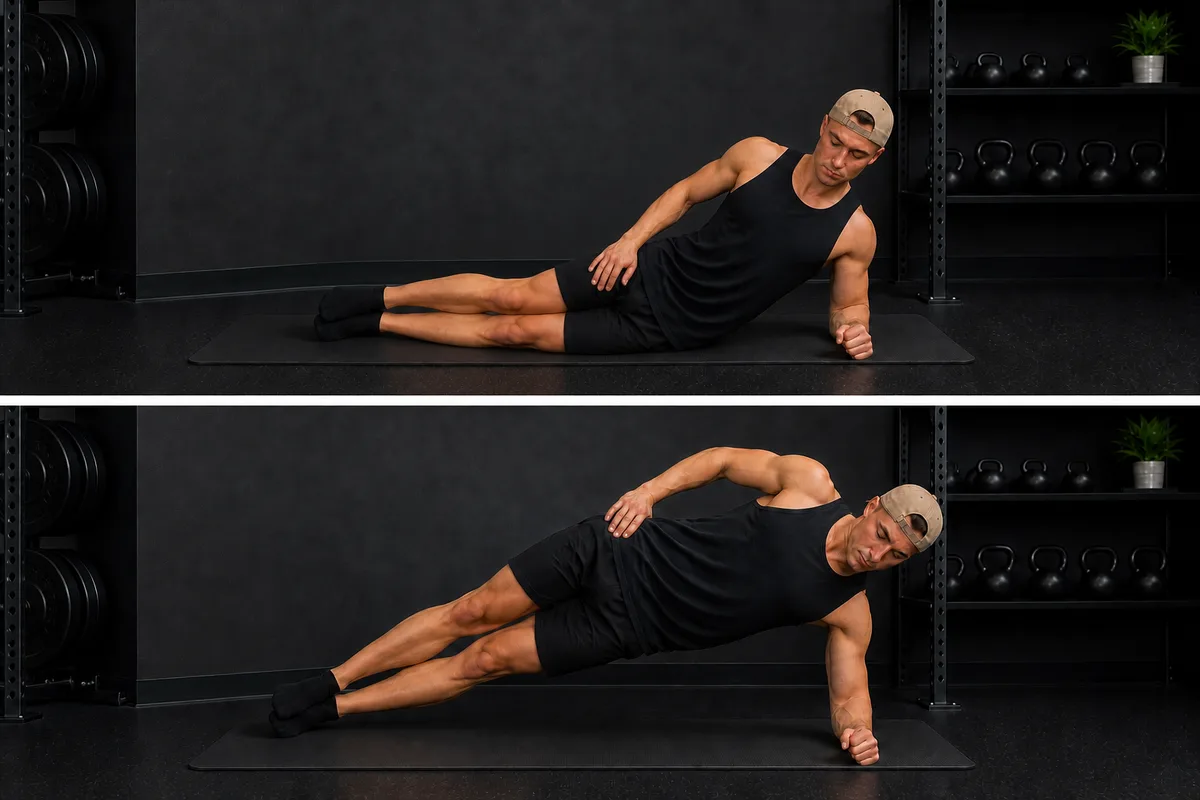
Start and finish demonstration of Side Plank
Start and finishUse the written steps below for the full technique and safety guidance.

At a glance

Exercise profile

Target muscles
internal and external obliques, quadratus lumborum, gluteus medius
Exercise type
Strength and stability
Equipment
Exercise mat
Mechanics
Compound
Movement pattern
Isometric anti-lateral flexion (unilateral)
Experience level
beginner
Secondary muscles
gluteus maximus, transversus abdominis, shoulder stabilizers

Lateral core and hip stability

What this exercise works

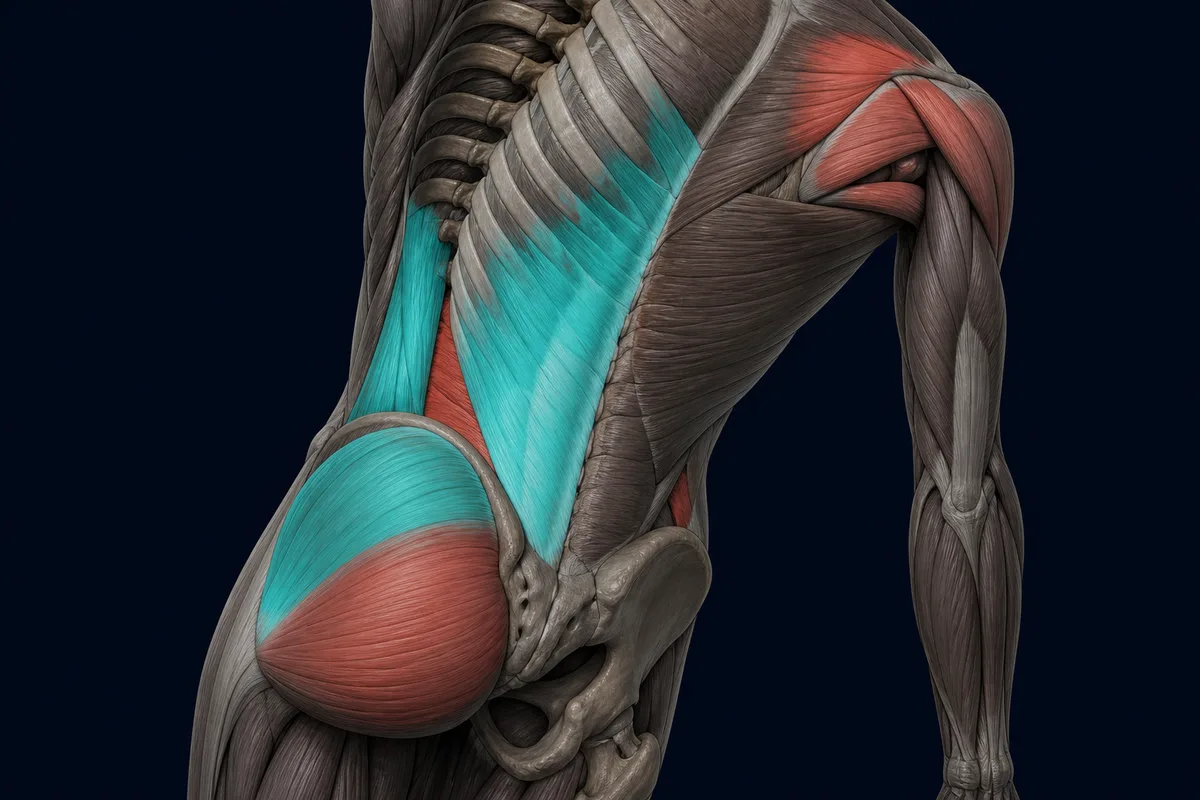
The side plank emphasizes the obliques, quadratus lumborum and gluteus medius while the shoulder and deep core stabilize the body.

Anatomy highlighting the structures involved in Side Plank
Teal — primary muscles doing most of the workRed — secondary muscles assistingGrey — stabilizers and surrounding anatomy

Primary emphasis

  • internal and external obliques
  • quadratus lumborum
  • gluteus medius

Secondary muscles

  • gluteus maximus
  • transversus abdominis
  • shoulder stabilizers

Stabilizers

  • serratus anterior
  • rotator cuff
  • hip adductors

Movement and joint actions

  • Anti-lateral-flexion control of the trunk
  • Pelvic stabilization
  • Shoulder-girdle stabilization

Muscle contribution changes with position, range, resistance and individual technique.

Why it can help

Potential benefits and carryover

Benefits depend on technique, dosage, consistency and whether the exercise suits the person. Sport carryover means supporting the physical demands of the activity—not guaranteeing performance or preventing injury.

Everyday benefits

  • Builds endurance along the side of the trunk
  • Strengthens the lateral hip muscles that help keep the pelvis level
  • Practises maintaining whole-body alignment under gravity
  • Can be scaled from the knees to the feet

Training carryover

  • Supports unilateral lifts and loaded carries
  • Improves trunk stiffness for squats, hinges and pressing
  • Builds shoulder and hip stability in one exercise

Sport carryover

  • Supports pelvic control during running and cutting
  • Helps resist side-bending forces during contact and racquet sports

Technique

Side Plank tips

Use these cues to keep the movement controlled and focused on its intended purpose.

  1. Place the supporting elbow directly beneath the shoulder.
  2. Keep the ribs, pelvis and legs stacked rather than rolling backward.
  3. Push the floor away and keep space between the shoulder and ear.
  4. End the hold when the hips begin to sag; shorter high-quality holds are more useful than longer collapsed ones.

Overview

The side plank strengthens the muscles along the side of your trunk — the obliques and the gluteus medius — that keep your pelvis and spine stable when you walk, carry and lift. It is a natural progression from lying core work like the dead bug.

Start on your knees if needed. A short, controlled hold with good form beats a long wobbly one.

How to Do It

  1. Lie on your side with your elbow under your shoulder and legs stacked.
  2. Lift your hips so your body forms a straight line from head to feet.
  3. Keep your shoulders, hips and ankles in one line — do not let the hips drop or roll backward.
  4. Hold for 10–20 seconds, breathing normally.
  5. Lower slowly and repeat on the other side, 2–3 times per side.

What You Should Feel

Effort through the side of the trunk, the side hip and the shoulder. Stop if you feel sharp pain in the back, hip or shoulder, or if the hips keep sagging no matter what.

Common Mistakes

  • Dropping the hips toward the floor
  • Rolling the hips backward instead of staying side-on
  • Holding the breath
  • Shrugging the supporting shoulder up toward the ear

Make It Easier

  • Bend the knees and balance on the knee instead of the foot
  • Start from the elbow and support with the hand on the floor
  • Hold for shorter intervals (5–10 seconds) with more sets

Progression

  • Hold longer (up to 45 seconds per side)
  • Lift the top leg slightly during the hold to load the gluteus medius
  • Add a slow hip dip and return (side plank hip dips)
  • Progress to a full plank or loaded carries once control is solid

Common Questions

Does the side plank help hip pain?

It strengthens the gluteus medius and lateral core, which support the hip. It can be a useful progression for gluteal tendinopathy and outer-hip pain once the clamshell is comfortable — progress under guidance.

How long should I hold a side plank?

There is no magic number. Aim for a hold you can do with good form — often 15–30 seconds per side — and build gradually. Quality and symmetry between sides matter more than a long single hold.

References

  1. NICE. "Low back pain and sciatica in over 16s: assessment and management." NG59. 2016 (updated 2020). https://www.nice.org.uk/guidance/ng59
  2. Grimaldi A, Fearon A. "Gluteal Tendinopathy: Integrating Pathomechanics and Clinical Features in Its Management." Journal of Orthopaedic & Sports Physical Therapy. 2015. https://pubmed.ncbi.nlm.nih.gov/26381486/
This information is for education only and is not a medical diagnosis. InjuryAtlas does not replace an assessment by a qualified health professional. If you have severe pain, visible deformity, numbness, loss of function, or symptoms that are getting worse, seek medical care promptly.
Educational information only

This information does not diagnose an injury or replace care from a qualified healthcare professional.