Overview
A femoral neck stress fracture is a bone stress injury in the narrow section of femur just below the hip joint. It usually develops when repeated impact outpaces the bone's ability to recover.
This is an uncommon but important cause of deep groin or front-of-hip pain in runners. Continuing to run on it can allow a small injury to progress into a complete or displaced fracture.
Where the Injury Happens
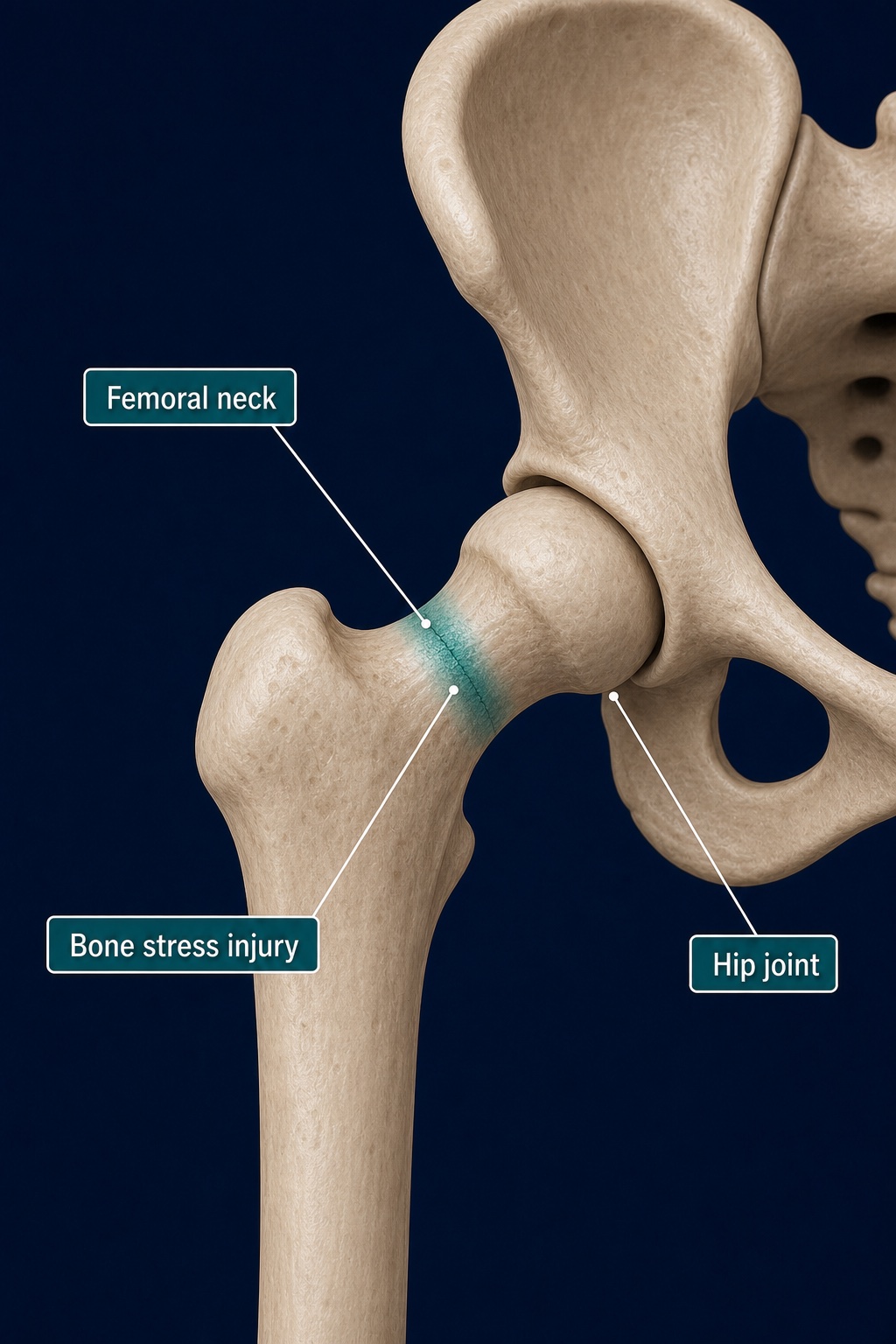
The injury develops in the narrow femoral neck just below the ball of the hip joint. This location carries high force during running and needs more caution than a typical soft-tissue strain.
What It Often Feels Like
- Deep groin or front-of-hip pain during running
- Pain that begins earlier as training continues
- Symptoms that progress from running to walking or stairs
- A limp or pain bearing weight
- Pain at rest or at night in more advanced cases
The pain can be vague and may be mistaken for a hip-flexor or adductor strain. Location alone cannot confirm the diagnosis.
What To Do Now
Stop running, jumping and other impact loading when this injury is suspected. Arrange prompt medical assessment rather than testing it repeatedly with hopping or another run.
Early X-rays can appear normal. MRI is commonly used when clinical suspicion remains because it can identify bone stress injury before a fracture is obvious on X-ray.
Treatment and Return to Running
Treatment depends on the fracture's exact location, severity and stability. Lower-risk injuries may be managed with protected weight bearing and progressive rehabilitation. Higher-risk tension-side, complete or displaced fractures need urgent orthopaedic input and may require surgery.
Return to running begins only after pain settles, walking is comfortable, strength is restored and the treating team is satisfied that the bone has healed. Training load, nutrition, energy availability, menstrual or hormonal health, vitamin D status and bone health may also need review.
Seek Urgent Assessment
- You cannot walk without marked pain or limping
- Groin pain is worsening despite stopping impact activity
- Pain is present at rest or wakes you at night
- Symptoms began after a fall or sudden load
- You have risk factors for low bone density or low energy availability
Connected Guides
References
- Robertson GAJ, Wood AM. "Femoral Neck Stress Fractures in Sport: A Current Concepts Review." Sports Medicine International Open. 2017. https://pubmed.ncbi.nlm.nih.gov/30539120/
- DeFranco MJ, Recht M, Schils J, Parker RD. "Stress fractures of the femoral neck." Journal of Athletic Training. 2004. https://pubmed.ncbi.nlm.nih.gov/15085212/
This information is for education only and is not a medical diagnosis. Suspected femoral neck stress fracture requires prompt medical assessment.