Overview
Snapping hip is a felt or audible snap during hip movement. Many hips click without pain and do not need treatment. The term snapping hip syndrome is more useful when the snap is repeatedly painful, limits activity or comes with other symptoms.
Where the Snapping Happens
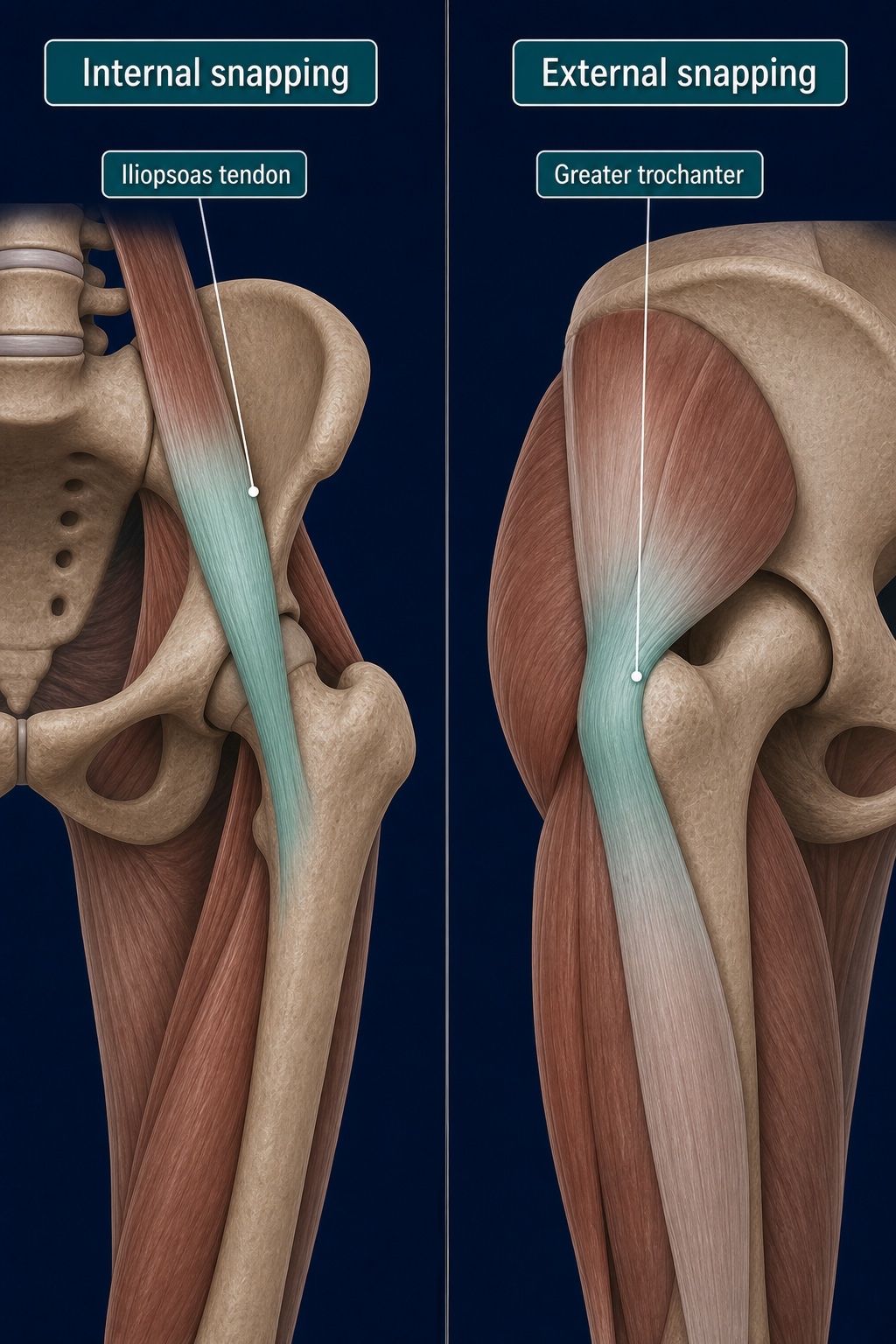
Internal snapping is usually felt at the front of the hip as the iliopsoas tendon moves. External snapping is felt at the outer hip as the iliotibial band or nearby gluteal tissue moves over the greater trochanter.
Where the Snap Comes From
- Front or inner hip: often involves the iliopsoas tendon moving across structures at the front of the hip
- Outer hip: commonly involves the iliotibial band or front edge of gluteus maximus moving over the greater trochanter
- Inside the joint: catching from a labral injury, cartilage problem or loose body can feel different and needs separate assessment
Typical Pattern
- A reproducible snap as the hip moves from bent to straight
- Front-groin snapping during leg lifts, kicks or rising from a chair
- Outer-hip snapping that may be visible over the greater trochanter
- Pain only after repetition, or no pain at all
What Usually Helps
If the snapping is painful, start by reducing the exact movement volume that provokes it rather than stopping all activity. Rehabilitation often focuses on hip and trunk control, gradual strengthening and changing repeated end-range positions. Stretching is not automatically the answer; repeatedly forcing the hip through a painful snap can aggravate it.
When to Get Assessed
- Catching or locking inside the joint
- Pain that is worsening or limiting walking and sport
- A snap after a significant injury
- Loss of strength, range or confidence in the hip
An examination can help separate iliopsoas, outer-hip and joint-related patterns. Dynamic ultrasound can sometimes show a tendon moving during the snap; MRI may be used when an intra-articular problem is suspected.
Connected Guides
References
- Walker P, et al. "Snapping Hip Syndrome: A Comprehensive Update." Orthopedic Reviews. 2021. https://pubmed.ncbi.nlm.nih.gov/34745476/
- Yen YM, Lewis CL, Kim YJ. "Understanding and Treating the Snapping Hip." Sports Medicine and Arthroscopy Review. 2015. https://pubmed.ncbi.nlm.nih.gov/26524554/
This information is for education only and is not a medical diagnosis.