Anatomy at a Glance
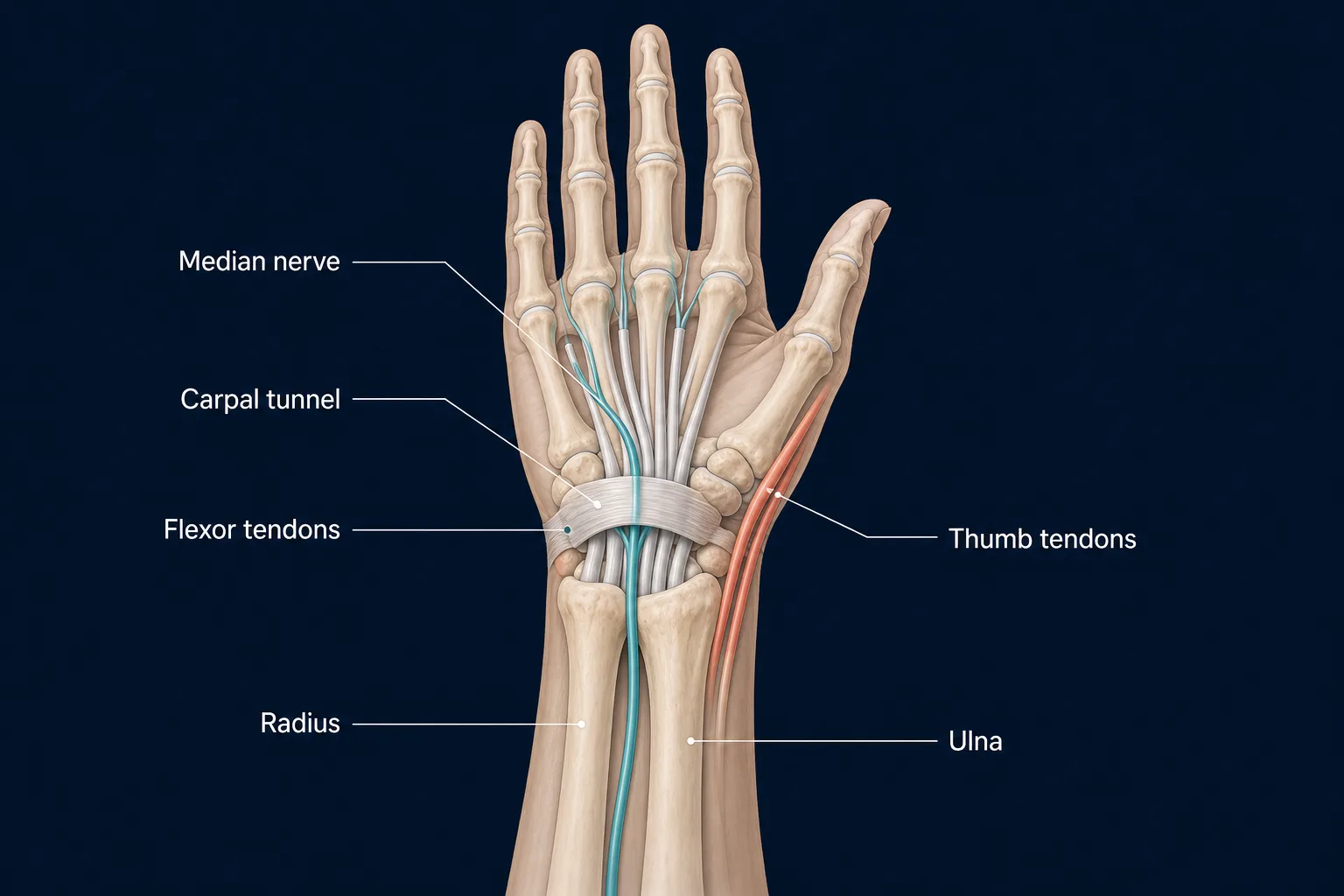
The wrist is a compact connection between the forearm and hand. Eight small carpal bones move together in rows, while tendons, ligaments and nerves pass through tightly packed spaces. A problem in one area can feel like a problem somewhere else, so the exact location and the movement that brings it on are useful clues.
The Main Structures
Radius and Ulna
The radius is the forearm bone on the thumb side; the ulna is on the little-finger side. They rotate around each other when you turn the palm up or down. Pain on the little-finger side with twisting or weight-bearing can involve several structures around the ulna, including the TFCC.
Carpal Bones and Wrist Ligaments
The carpal bones form the base of the hand. Ligaments hold the bones in position while still allowing the wrist to bend, extend and deviate side to side. A fall onto the hand can injure a ligament or bone, which is why persistent focal pain should not automatically be called a sprain.
Median Nerve and Carpal Tunnel
The median nerve runs through the carpal tunnel on the palm side of the wrist with the finger-flexor tendons. Compression here can cause tingling or numbness in the thumb, index and middle fingers, often at night or during sustained gripping. The little finger is usually not part of that pattern.
Flexor Tendons
The flexor tendons bend the fingers and thumb. They slide through tunnels from the forearm into the hand. They are loaded by gripping, carrying, climbing, pulling and typing. Tendons are built to handle load, but they usually respond best when a recent flare is followed by a gradual return to strength rather than complete rest.
Thumb-Side Tendons
The abductor pollicis longus and extensor pollicis brevis tendons run along the thumb side of the wrist. They are the tendons involved in De Quervain's tenosynovitis, which often hurts with pinching, wringing or lifting with the thumb spread.
TFCC: The Little-Finger-Side Stabilizer
The triangular fibrocartilage complex is a combination of cartilage and ligaments that cushions and stabilizes the little-finger side of the wrist, especially while rotating the forearm. It is one possible source of clicking or pain while twisting a jar, pushing up from a chair or bearing weight through the palm.
How Location Can Help
| Where it is felt | A common structure to consider | Important note |
|---|---|---|
| Thumb, index and middle-finger tingling | Median nerve / carpal tunnel | Night symptoms and little-finger sparing make this pattern more typical. |
| Thumb-side wrist pain | Thumb tendons | De Quervain's is common, but thumb-base arthritis and injury can overlap. |
| Little-finger-side wrist pain | TFCC, distal radioulnar joint or tendons | A fall, clicking or instability deserves assessment. |
| Focal pain after a fall | Bone or ligament | Early imaging can be needed to rule out fracture. |
Common Conditions
Building Wrist and Hand Capacity
Start with comfortable movement and everyday use, then progress grip, forearm rotation, wrist strength and finally loaded positions such as carrying, pushing and hanging. Choose exercises that match the problem rather than treating every wrist symptom as the same thing.
- Finger tendon glides
- Gentle median nerve glide
- Forearm pronation and supination
- Wrist extension isometric
Seek Prompt Assessment
- A painful wrist after a fall, especially with focal tenderness or persistent pain
- Numbness that is constant, weakness that is progressing or thumb-muscle wasting
- Major swelling, deformity, a cold/pale hand or loss of movement
- Fever, spreading redness or a hot swollen joint
References
- American Academy of Orthopaedic Surgeons. "Carpal Tunnel Syndrome." https://orthoinfo.aaos.org/en/diseases--conditions/carpal-tunnel-syndrome/
- American Society for Surgery of the Hand. "TFCC Tears & Repairs." https://www.assh.org/handcare/servlet/servlet.FileDownload?file=00P0a00000ocYAbEAM
This is general education, not a diagnosis. Persistent hand numbness or pain after trauma deserves individual assessment.