Creatine has spent decades being treated as everything from a miracle muscle powder to a suspicious tub that someone’s mother wants removed from the kitchen.
The truth is refreshingly normal.
Creatine monohydrate is a well-studied supplement that helps your muscles rapidly recycle energy during hard efforts. It can improve strength, power and repeated high-intensity performance. When you combine it with progressive resistance training, it can also help you gain slightly more muscle than training alone.
It is not a steroid. It will not replace protein, sleep or a sensible programme. It is simply one of the few muscle-building supplements that consistently does something useful.
The Quick Answer
- Best form: plain creatine monohydrate
- Simple dose: 3–5 grams every day
- Loading: optional, not required
- Timing: whenever you will remember it
- Rest days: yes, take it then too
- Cycling: unnecessary
- Main benefits: strength, power, repeated hard efforts and a small additional muscle-building benefit during resistance training
- Common early change: extra water stored inside muscle, which can increase scale weight
- Best use: alongside a progressive training programme, enough protein and adequate recovery
If you want the uncomplicated plan, buy plain monohydrate, take 5 grams daily and get on with your workout.
What Is Creatine?
Creatine is a compound your body makes from amino acids. You also obtain some from foods such as meat and fish. Most of the creatine in your body is stored in skeletal muscle, much of it as phosphocreatine.
During a hard muscle contraction, your muscles use ATP, a small molecule that acts like immediately available energy. ATP stores are limited. Once ATP loses a phosphate and becomes ADP, phosphocreatine can donate a phosphate to help turn it back into ATP.
That is the useful part of creatine supplementation: it increases the amount of creatine and phosphocreatine your muscles can store, giving that rapid energy-recycling system a little more capacity.
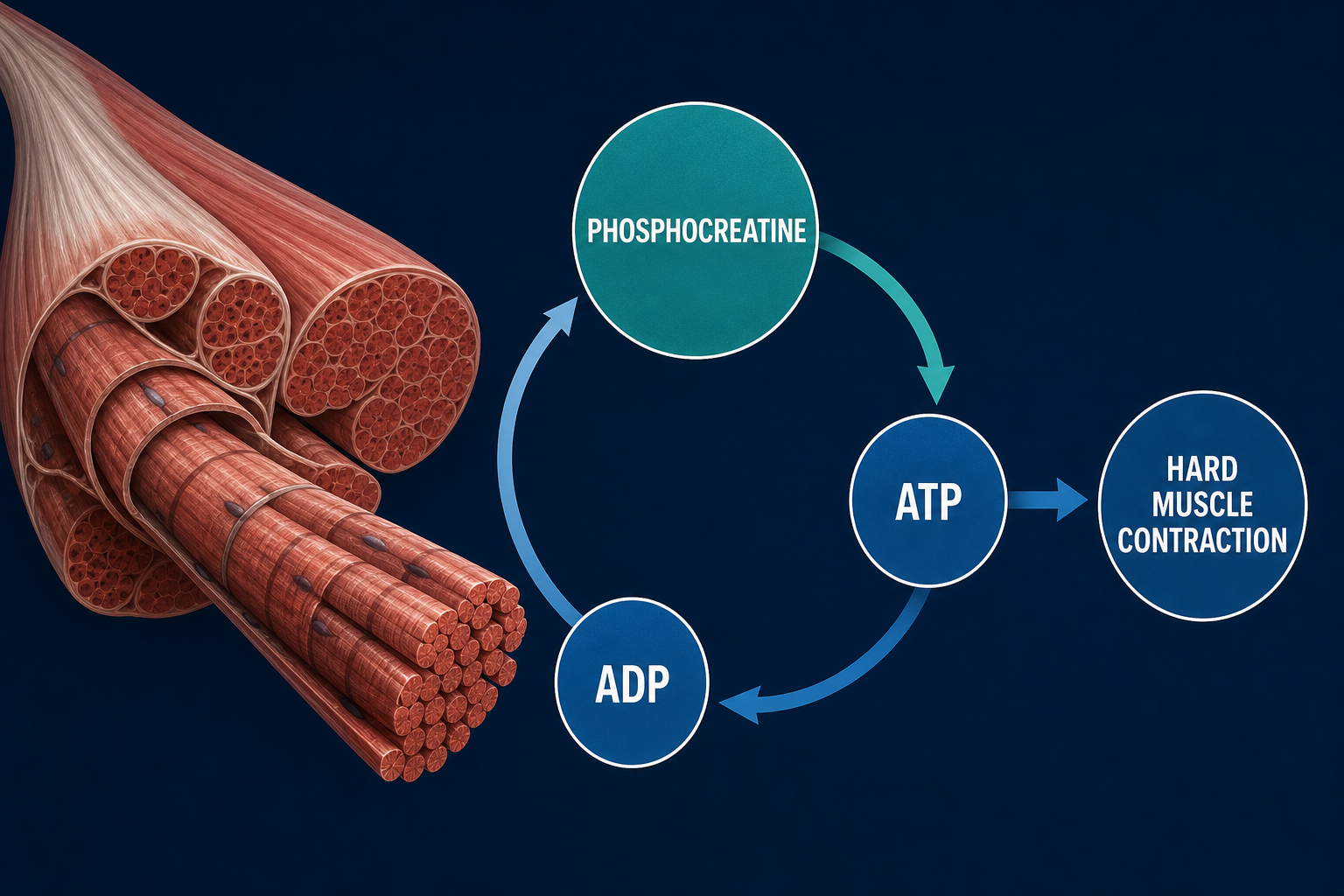
Think of it less like adding a bigger engine and more like making the engine’s short-burst battery recharge slightly faster between hard efforts.
Does Creatine Actually Build Muscle?
Yes, when it is paired with resistance training—but the effect is helpful rather than magical.
Creatine does not directly command a muscle fibre to grow. It can help you complete more high-quality work, maintain performance across hard sets and gradually progress your training. Those slightly better sessions can add up.
A 2024 systematic review and meta-analysis found that adults younger than 50 who combined creatine with resistance training gained more lean body mass than people performing the same training with a placebo. Another review using direct measurements such as ultrasound, MRI and CT found a small additional benefit for actual regional muscle growth.
That distinction matters.
Some Early “Lean Mass” Is Water
Creatine draws additional water into muscle cells as muscle creatine stores rise. That can increase lean body mass and make the muscles look a little fuller before meaningful new muscle tissue could possibly develop.
This is intracellular water—water stored inside the muscle—not the same thing as gaining body fat. It also does not mean every kilogram of early scale gain is newly built muscle.
Over longer periods, the combination of better training and progressive overload is what supports the additional hypertrophy benefit.
What Benefits Can You Expect?
Better Strength and Power
Creatine is most useful during activities that rely on repeated short bursts of high effort:
- resistance training
- sprinting
- jumping
- repeated accelerations
- hard intervals
- team sports with frequent bursts and short recovery periods
The NIH Office of Dietary Supplements notes that creatine can improve strength, power and repeated intense muscular effort. A newer systematic review and meta-analysis also found improvements in several upper- and lower-body strength and power measures, particularly when supplementation was combined with resistance training.
More Productive Training
You may not “feel” creatine like caffeine. There is no required buzz, tingling or dramatic pre-workout moment.
The difference may show up as:
- one more clean repetition late in a set
- slightly less performance drop across repeated sets
- better progress in load or repetitions over several weeks
- a little more tolerance for high-intensity training volume
That is not terribly cinematic, but muscles are often built through boring advantages repeated consistently.
A Small Additional Muscle-Building Benefit
Creatine is not a substitute for hard training. Without a resistance-training stimulus, its effect on actual muscle growth is limited. Combined with training, the evidence supports a modest advantage in lean mass and muscle size.
Older adults may benefit as well. A meta-analysis in older adults found greater gains in lean tissue and upper- and lower-body strength when creatine was added to resistance training.
What About Endurance?
Creatine is not primarily an endurance supplement. It may help with surges, sprint finishes or strength work performed alongside endurance training, but it has less value for long, steady efforts such as distance running or continuous cycling.
The extra scale weight from water may also be unhelpful in sports where every kilogram must be carried for a long time.
How Much Creatine Should You Take?
The Simple Method
Take 3–5 grams of creatine monohydrate every day.
That gradually raises muscle creatine stores, usually over roughly three to four weeks. The exact timeline varies, and you do not need to feel anything happening for it to be working.
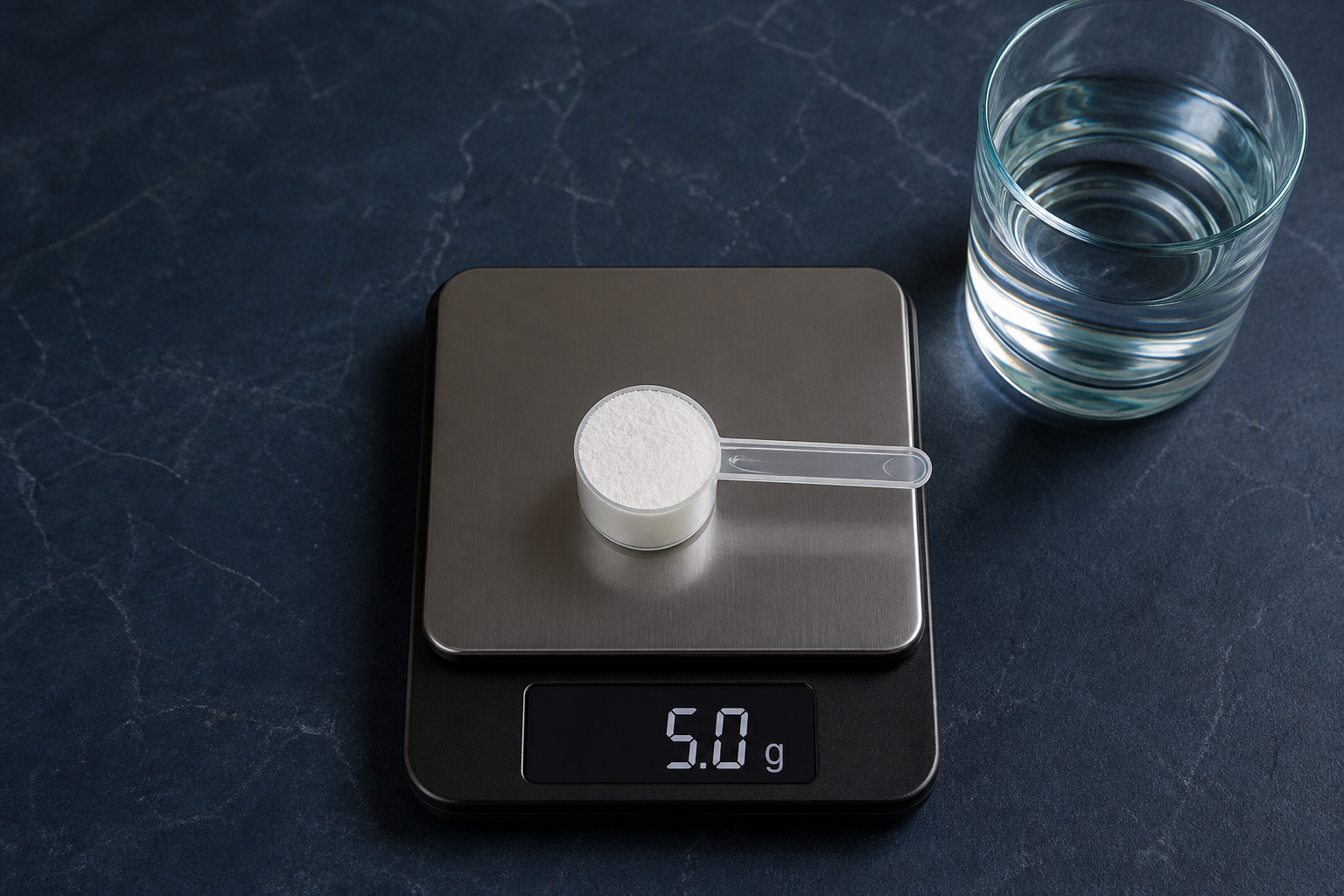
Use the serving information on your product or a small kitchen scale. Scoop sizes vary, so “one scoop” is only a dose when the label tells you what that scoop weighs.
The Loading Method
If you want to saturate your muscles faster, use approximately 20 grams per day for 5–7 days, divided into four 5-gram servings. Then continue with 3–5 grams daily.
A more individualized research protocol uses approximately 0.3 grams per kilogram of body mass per day during loading, followed by a smaller maintenance dose.
Loading is optional. It reaches high muscle creatine stores faster, but it does not create a better final result than simply taking 3–5 grams daily for longer. Large single servings are also more likely to upset your stomach, which is why the loading dose is divided.
When Should You Take It?
Take it at the time you are most likely to remember it.
The long-term effect comes from maintaining elevated muscle creatine stores, not from creating a narrow 20-minute “creatine window.” Research has not established a meaningful timing advantage that matters more than daily consistency.
Easy options include:
- mixed into water with breakfast
- added to a shake after training
- taken with any regular meal
- stirred into a drink at the same time every day
Take it on rest days too. If you miss one day, do not double the next dose. Just return to your normal routine.
Do You Need Carbohydrates With It?
No. Insulin can influence creatine uptake, but you do not need a sugary drink to make a normal daily dose effective. A 2024 body-composition review found that adding carbohydrate did not improve the hypertrophy benefit of creatine.
Take it with a meal if that is convenient or gentler on your stomach. Otherwise, water works.
Which Type Should You Buy?
Choose 100% creatine monohydrate.
It has the largest evidence base and is usually the least expensive form. “Micronized” monohydrate simply has smaller particles, which may help it mix more easily. It is still monohydrate.
Other versions include creatine hydrochloride, buffered creatine, creatine nitrate and various proprietary blends. None has consistently shown a meaningful advantage over monohydrate for muscle creatine storage, performance or muscle growth.
Look for:
- creatine monohydrate as the only active ingredient
- a clearly stated dose in grams
- no proprietary blend
- credible independent testing
- a reasonable price per serving
Competitive athletes should be especially careful about contamination. Certification programmes such as NSF Certified for Sport test products against label and sport-safety standards. Certification does not make the creatine more powerful; it gives you more confidence about what is actually in the container.
Is Creatine Safe?
For healthy adults, creatine monohydrate at recommended doses has a strong safety record in the research.
The most common practical issues are:
- increased scale weight from water stored in muscle
- stomach discomfort or loose stools after a large single dose
- difficulty dissolving some powders completely
Splitting a loading dose, taking creatine with food or skipping the loading phase usually handles the stomach issue.
Creatine and Kidney Tests
Creatine can cause a small rise in serum creatinine, a breakdown product commonly used to estimate kidney function. That can make a creatinine-based kidney estimate appear worse even when the kidneys have not been injured.
Recent systematic reviews found a small increase in serum creatinine but no significant reduction in measured or broader markers of kidney function. Another 2026 analysis similarly concluded that the change likely reflects altered creatinine metabolism rather than kidney injury.
Tell your clinician that you take creatine when having bloodwork interpreted. If you have kidney disease, abnormal kidney tests or a condition affecting fluid balance, discuss supplementation with your clinician first. Evidence in people with established kidney disease is not as reassuring or complete as it is in healthy adults.
Does Creatine Cause Hair Loss?
The hair-loss concern came largely from one small study that found a change in DHT after creatine loading. It did not measure hair loss.
A 2025 randomized trial was the first to directly assess hair and follicle measures. After 12 weeks, the researchers found no difference in DHT or hair-growth measures between creatine and placebo.
That does not prove no person could ever notice a change, but current evidence does not support the claim that normal creatine supplementation causes baldness.
Does It Cause Dehydration or Cramping?
Controlled research has not supported the idea that recommended creatine use causes dehydration or muscle cramping in healthy people. Creatine changes water distribution because more water is held inside muscle, but that is not the same as draining the rest of your body dry.
You should still drink according to thirst, training conditions and heat exposure. Creatine does not grant immunity from doing a hard workout outside in August with one heroic sip of water.
Does Creatine Make You Bloated or Gain Fat?
Creatine can increase body weight through water stored in muscle. Some people notice this within the first week, especially during loading. Others notice very little.
It does not directly add body fat. If your waistband changes after several months, the creatine powder is unlikely to have secretly contained a surplus of pizza.
True digestive bloating is more likely when a large dose is taken at once. Reduce the serving, split it or stop loading.
Is Creatine a Steroid?
No. Creatine is not an anabolic steroid, hormone or stimulant. It does not work through testosterone receptors and does not require post-cycle therapy.
Your body already makes creatine and obtains it from food. Supplementation increases the amount available to the phosphocreatine energy system.
Do Women Benefit From Creatine?
Creatine is not a male-only supplement. Women use the same phosphocreatine energy system and can take standard daily doses.
The female-specific performance literature is smaller and more variable than the male literature. A 2025 systematic review found mixed performance results and highlighted weaknesses in the available studies. Safety data in women have not shown a higher rate of serious adverse outcomes at studied doses.
The practical message is not that creatine “does not work for women.” It is that researchers need better female-specific trials, and the size of the benefit can vary between individuals.
Pregnancy and breastfeeding require a separate conversation with a qualified clinician because routine sport-supplement evidence does not adequately answer those situations.
What About Teenagers?
Creatine has been studied in adolescent athletes and clinical populations, but the long-term evidence is smaller than it is for adults.
A teenager should first have the unglamorous essentials in place: appropriate training, enough food, adequate protein, sleep and responsible coaching. Supplement decisions should involve a parent or guardian and a qualified sports dietitian or healthcare professional—especially when health conditions or medications are involved.
Does Creatine Help the Brain?
The brain also uses creatine, so possible cognitive benefits are an active research area. Some analyses have reported small improvements in memory or performance under stressful conditions such as sleep deprivation. Other reviews and the European Food Safety Authority have concluded that the evidence is inconsistent and does not yet establish a broad cognitive benefit.
That makes cognition an interesting possibility, not the main reason a healthy lifter should buy creatine. The muscle-performance case is much stronger.
Who Is Most Likely to Benefit?
Creatine makes the most sense when you:
- perform resistance training
- play a power or repeated-sprint sport
- want a small evidence-based improvement in strength and training capacity
- can take it consistently
- understand that it supports training rather than replacing it
Vegetarians and vegans often consume less dietary creatine and may experience a larger rise in muscle creatine stores, although individual responses vary.
It may not be worth prioritizing when you:
- do not resistance train or perform high-intensity activity
- compete in a weight-sensitive endurance event where extra water mass is undesirable
- cannot tolerate it even after lowering or splitting the dose
- have a medical reason to avoid it
Do You Need to Cycle Creatine?
No. You do not need to take creatine for eight weeks, stop for four and then begin again. Your body does not require a scheduled “reset.”
If you stop taking it, elevated muscle creatine stores gradually return toward baseline. You may lose some water-related scale weight. Your actual trained muscle does not immediately vanish in protest.
A Simple Creatine Plan
For most healthy adults who resistance train:
- Buy plain, independently tested creatine monohydrate.
- Take 5 grams daily, including rest days.
- Mix it into water or another drink and take it with a meal if that feels better.
- Skip loading unless you have a reason to want faster saturation.
- Keep training, progressing and eating enough protein.
- Judge it over months, not by whether Tuesday’s workout felt mystical.
Pair it with a solid exercise plan. The best exercise for every major muscle guide can help you choose the main lifts, while the lengthened partials versus full-range guide explains how to use range of motion without overcomplicating every repetition.
The Bottom Line
Creatine monohydrate is effective, inexpensive and unusually well studied for a sports supplement.
It can help improve strength, power and repeated high-intensity performance. Alongside progressive resistance training, it can also provide a small additional muscle-building benefit. Some early weight gain is water stored inside muscle, not instant new tissue or body fat.
Take 3–5 grams every day. Loading is optional. Timing is not worth stressing about. Choose plain monohydrate rather than paying extra for a complicated name and a shinier label.
Creatine will not rescue a poor programme. But if your training, food and recovery are already moving in the right direction, it is one of the few supplements genuinely capable of helping.
References
- Antonio J, et al. “Common questions and misconceptions about creatine supplementation: what does the scientific evidence really show?” Journal of the International Society of Sports Nutrition. 2021. https://doi.org/10.1186/s12970-021-00412-w
- Desai I, et al. “The Effect of Creatine Supplementation on Resistance Training-Based Changes to Body Composition: A Systematic Review and Meta-analysis.” Journal of Strength and Conditioning Research. 2024. https://pubmed.ncbi.nlm.nih.gov/39074168/
- Burke R, et al. “The Effects of Creatine Supplementation Combined with Resistance Training on Regional Measures of Muscle Hypertrophy: A Systematic Review with Meta-Analysis.” Nutrients. 2023. https://pubmed.ncbi.nlm.nih.gov/37432300/
- Chilibeck PD, Kaviani M, Candow DG, Zello GA. “Effect of creatine supplementation during resistance training on lean tissue mass and muscular strength in older adults: a meta-analysis.” Open Access Journal of Sports Medicine. 2017. https://pubmed.ncbi.nlm.nih.gov/29138605/
- Lak M, et al. “Does creatine cause hair loss? A 12-week randomized controlled trial.” Journal of the International Society of Sports Nutrition. 2025. https://pubmed.ncbi.nlm.nih.gov/40265319/
- Vahdat S, et al. “Effect of creatine supplementation on kidney function: a systematic review and meta-analysis.” BMC Nephrology. 2025. https://pubmed.ncbi.nlm.nih.gov/41199218/
- Tam R, et al. “Does Creatine Supplementation Enhance Performance in Active Females? A Systematic Review.” Nutrients. 2025. https://pubmed.ncbi.nlm.nih.gov/39861368/
- National Institutes of Health Office of Dietary Supplements. “Dietary Supplements for Exercise and Athletic Performance.” https://ods.od.nih.gov/factsheets/ExerciseAndAthleticPerformance-Consumer/
This guide is educational and is not individualized medical advice. Discuss creatine with a qualified clinician if you have kidney disease, abnormal kidney tests, a condition affecting fluid balance, are pregnant or breastfeeding, or take medication that requires kidney monitoring.