Peptides have become the new backstage pass of fitness and recovery culture. They are promoted for faster tendon healing, more muscle, less fat, better sleep and, if you keep scrolling, probably a cleaner garage.
The biology is genuinely interesting. The marketing is also running several laps ahead of the human research.
BPC-157, TB-500, CJC-1295 and ipamorelin have not been shown in good human trials to build meaningful muscle or accelerate recovery from common sports injuries. Some produce promising effects in cells or animals. Some can change hormone levels in people. Those findings are worth studying, but they are not proof of a useful clinical result.
There are also approved peptide medicines. They are prescribed for specific medical conditions, manufactured to drug-quality standards and backed by indication-specific trials. That is very different from a vial labelled “research use only” arriving through the mail.
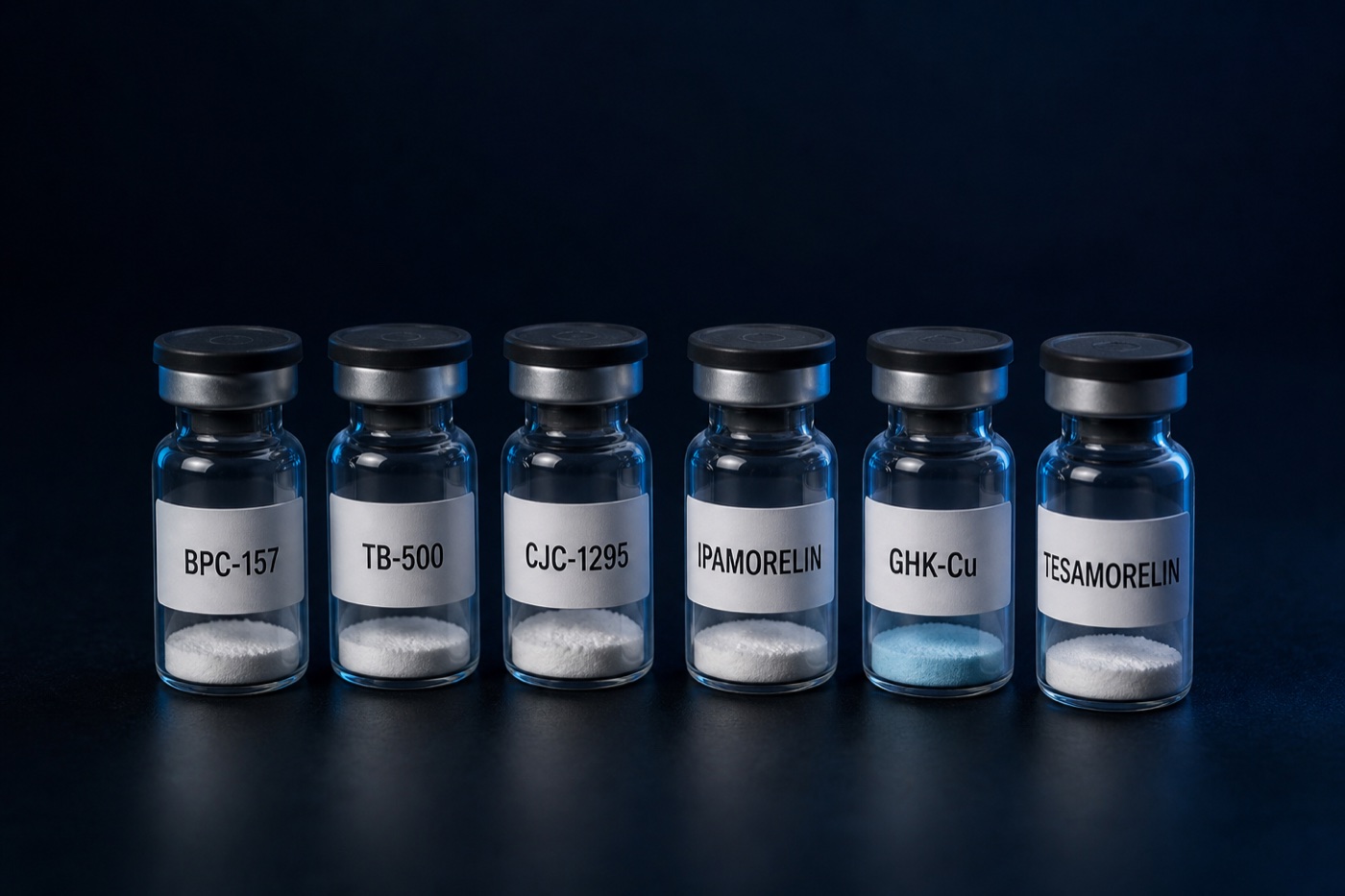
These are generic editorial illustrations, not commercial products or an endorsement of peptide use.
The Short Answer
- BPC-157: interesting animal research; almost no reliable human musculoskeletal evidence and no established clinical safety profile.
- TB-500: preclinical tissue-repair rationale, but no convincing human evidence for healing a tendon, ligament or muscle injury.
- CJC-1295: can raise growth hormone and IGF-1 in humans; that does not prove it builds useful muscle or repairs injuries.
- Ipamorelin: can trigger growth-hormone release; human studies have not established a bodybuilding or sports-recovery benefit.
- GHK-Cu: most plausible as a topical skin and wound-research ingredient; injectable recovery claims are far ahead of the evidence.
- Tesamorelin: an approved prescription peptide for reducing excess abdominal fat in adults with HIV-associated lipodystrophy—not a general fat-loss or muscle-building drug.
- Competitive sport: several of these substances are prohibited at all times under anti-doping rules.
- Canadian context: Health Canada warns against unauthorized injectable peptide drugs sold online and specifically names BPC-157, TB-500, CJC-1295, ipamorelin and GHK-Cu.
If your question is, “Which experimental peptide has enough evidence that InjuryAtlas should recommend it for a torn tendon or more muscle?” the honest answer is none of them right now.
First, What Is a Peptide?
A peptide is a short chain of amino acids. Proteins are made from amino acids too, but they are usually much larger and more structurally complicated.
Your body uses peptides as signals. Some tell cells to release hormones. Others help regulate appetite, blood sugar, inflammation or tissue remodelling. This makes peptides attractive drug candidates: create or modify the right signal, and you may be able to influence a useful biological pathway.
But peptide is a chemical description, not a safety rating.
Insulin is a peptide hormone. So are several well-tested prescription medicines. BPC-157 is also described as a peptide, despite having almost no useful human clinical evidence for the injuries it is advertised to treat. Calling both “peptide therapy” is a little like calling a licensed passenger aircraft and a homemade drone “aviation.” Technically true. Clinically unhelpful.
How We Judged the Evidence
For each compound, the useful questions are:
- Was it studied in humans? A rat Achilles tendon is not a small human Achilles tendon.
- Did the study measure a result people care about? Higher growth hormone is a biological effect; more muscle or a healed tendon is a clinical outcome.
- Was there a comparison group? Without one, improvement may reflect time, rehabilitation, expectation or selection bias.
- Was the product and route comparable to what is being sold? A topical skin study cannot validate a mystery injectable.
- Is there enough safety data to understand the trade-off? “No adverse effects reported” is weak reassurance when hardly anyone has been studied.
Evidence Snapshot
| Peptide | What it is marketed for | Best relevant evidence | What is actually established? |
|---|---|---|---|
| BPC-157 | Tendon, ligament, muscle and gut healing | Mostly animal studies; one tiny uncontrolled knee-pain report | No proven human injury-recovery benefit or established safe dose |
| TB-500 | Soft-tissue repair and recovery | Cell and animal research related to thymosin beta-4 | No convincing human musculoskeletal outcome evidence |
| CJC-1295 | Muscle gain, fat loss and recovery | Small human trials showing higher GH and IGF-1 | Hormone response, not proven muscle or injury outcomes |
| Ipamorelin | GH release, recovery and lean mass | Human pharmacology studies and a negative surgical-recovery trial | Can release GH; bodybuilding and injury claims remain unproven |
| GHK-Cu | Skin repair, hair and wound healing | Laboratory, animal and limited topical/cosmetic literature | Injectable sports-recovery claims are unsupported |
| Tesamorelin | Often repurposed online for fat loss | Controlled trials for HIV-associated lipodystrophy | Approved for one specific indication—not general physique enhancement |
BPC-157
What It Is Claimed to Do
BPC-157 is promoted for tendon, ligament, muscle, bone, nerve and gastrointestinal healing. The sales pitch often sounds unusually certain for something with such little human research.
Why People Are Interested
In animal and laboratory studies, BPC-157 has been linked with angiogenesis, fibroblast activity, inflammatory signalling and tissue repair. Researchers have reported better structural or functional outcomes in several rodent injury models.
That is a legitimate reason to keep studying it. It is not a legitimate reason to describe human tendon healing as settled science.
What the Human Research Shows
A 2025 systematic review found 36 eligible BPC-157 studies: 35 were preclinical and only one involved people. That human report was a small retrospective series in which 7 of 12 people with chronic knee pain reported prolonged relief after an injection. It had no placebo group, involved nonspecific knee pain and did not establish that any damaged tissue healed.
Pain improvement is not meaningless, but twelve uncontrolled cases cannot tell us whether BPC-157 works, which condition it might treat or what risks appear across hundreds or thousands of users.
The same review found no clinical safety data adequate to define its risk profile. The FDA’s 2026 assessment also identified insufficient clinical safety information and concerns about immunogenicity, aggregation and peptide-related impurities.
Bottom Line
Promising laboratory idea; unproven human treatment. There is not enough evidence to recommend BPC-157 for a rotator-cuff tear, Achilles problem, knee pain or muscle strain.
TB-500
What It Is Claimed to Do
TB-500 is sold for faster soft-tissue healing, reduced inflammation, improved mobility and quicker return to training. It is related to a fragment of thymosin beta-4, a naturally occurring protein involved in cell movement, blood-vessel formation and tissue repair.
What the Research Shows
Thymosin beta-4 biology is interesting, and preclinical work suggests possible roles in wound repair and angiogenesis. But products marketed as TB-500 are not automatically equivalent to full thymosin beta-4, and a plausible pathway is not a clinical result.
A recent sports-medicine review found that human orthopaedic evidence for TB-4 and TB-500 was lacking. The FDA reported that it had not identified human exposure data for compounded TB-500 fragment products and could not determine whether they would cause harm.
That leaves the central recovery claims—faster tendon healing, fewer weeks out of the gym, stronger repaired tissue—without reliable human proof.
Bottom Line
The mechanism has scientific interest; the marketed recovery outcome has not been demonstrated in people. TB-500 is also prohibited in tested sport.
CJC-1295
What It Is Claimed to Do
CJC-1295 is a long-acting analogue of growth-hormone-releasing hormone. It is marketed for more growth hormone, higher IGF-1, improved recovery, muscle gain, fat loss and better sleep.
What the Human Research Shows
This is one of the cases where an online claim begins with a real human finding. In small randomized trials, CJC-1295 produced sustained increases in growth hormone and IGF-1 in healthy adults. A 2006 trial found dose-dependent hormonal increases lasting several days after injection.
Here is the catch: the study measured hormone concentrations and short-term tolerability. It did not show that participants built more muscle, lost meaningful fat, healed an injury or performed better.
Changing a laboratory value can be step one in drug development. Fitness marketing often edits out the remaining steps and heads straight for the checkout button.
The FDA has identified limited clinical data and reports of serious adverse events associated with compounded CJC-1295 products, including increased heart rate and systemic vasodilatory reactions.
Bottom Line
CJC-1295 can affect the GH–IGF-1 axis. Its advertised muscle-building and recovery benefits have not been established. It is prohibited in tested sport.
Ipamorelin
What It Is Claimed to Do
Ipamorelin is a growth-hormone secretagogue and ghrelin-receptor agonist. It is commonly paired with CJC-1295 and marketed as a “cleaner” route to growth-hormone release, with claims involving recovery, sleep, fat loss and lean mass.
What the Human Research Shows
Human pharmacology studies confirm that ipamorelin can trigger a pulse of growth hormone. In one dose-escalation study, the hormonal peak appeared within roughly an hour and then declined.
Again, GH release is not the same outcome as muscle gain or injury healing.
Ipamorelin has also been tested for a completely different purpose: recovery of bowel function after abdominal surgery. A randomized phase 2 trial involving 114 patients did not find a statistically significant improvement in its main endpoint.
No robust trial has shown that injecting ipamorelin helps a healthy lifter add muscle or return from a sports injury faster. FDA safety concerns for compounded ipamorelin include immune reactions related to impurities or aggregation, while safety information for commonly promoted injectable routes remains inadequate.
Bottom Line
It releases growth hormone, but the physique and recovery conclusions do not follow automatically. Stacking it with CJC-1295 does not repair the missing outcome evidence; it only adds another active compound and another layer of uncertainty.
GHK-Cu
What It Is Claimed to Do
GHK-Cu is a naturally occurring copper-binding tripeptide. It is promoted for skin quality, hair growth, wound healing, inflammation control and, increasingly, systemic recovery.
What the Research Shows
GHK-Cu has plausible roles in extracellular-matrix remodelling, collagen signalling and wound biology. Some older human cosmetic work and a large preclinical literature support continued study of topical applications.
The evidence becomes much thinner when the claim changes from topical skin ingredient to injectable whole-body recovery therapy. A recent review noted a surprising shortage of strong clinical studies even for cosmetic uses. Injectable GHK-Cu has not been shown to rebuild a tendon, add muscle or speed a return to sport.
Health Canada includes injectable GHK-Cu among unauthorized peptide products it has seized and warns that online products may contain the wrong amount, contaminants or unlisted ingredients.
Bottom Line
Interesting skin and wound-research peptide; not a proven injectable muscle or sports-injury treatment. Route matters. Evidence for a cream cannot be quietly reassigned to a vial.
Tesamorelin
Why It Is Different
Tesamorelin is a growth-hormone-releasing factor analogue with an FDA-approved use: reducing excess abdominal fat in adults with HIV-associated lipodystrophy.
That approval matters. It means a defined product was tested for a defined group, outcome and dose, with manufacturing and prescribing information attached.
It does not mean tesamorelin is approved for general weight loss, bodybuilding, anti-aging or injury recovery. The current prescribing information explicitly says it is not indicated for weight-loss management and notes that long-term cardiovascular safety has not been established.
This is the cleanest example of why “a study exists” is not enough. Evidence belongs to a particular product, population, route, outcome and clinical context. You cannot copy and paste it onto a healthy athlete because both people possess abdominal muscles.
Bottom Line
A real prescription medicine for a specific condition, not a general muscle-building peptide. It is also prohibited in tested sport without the appropriate authorization process.
Why Online Peptide Products Add Another Risk
Even if a peptide eventually proves useful, an online vial introduces a separate question: is the product actually what the label says?
Health Canada’s 2026 advisory warns that unauthorized injectable peptides may:
- contain too much, too little or none of the stated ingredient
- contain bacteria, fungi, endotoxins, heavy metals or physical particles
- be incorrectly labelled or improperly stored
- cause infection or allergic reactions
- interact with medications
- affect hormones, blood sugar, the liver or kidneys
Products labelled “research use only” are not made safe or legal for self-injection by that sentence. It is a disclaimer, not a tiny lab coat.
Peptides can also aggregate or contain closely related impurities that the immune system recognizes. This is one reason regulators pay so much attention to manufacturing, characterization, stability and sterility. A label with a molecular diagram does not provide any of those things.
What About “Peptide Stacks”?
Combining two compounds is often marketed as if one completes the other: BPC-157 plus TB-500 for tissue healing, or CJC-1295 plus ipamorelin for hormone release.
The problem is simple. Two under-studied products do not combine into one well-studied treatment. A stack makes it harder to know:
- which compound caused an effect or side effect
- how the compounds interact
- whether the label is accurate
- what a safe exposure might be
- what happens with repeated or long-term use
There are no strong human trials showing that popular peptide stacks heal common musculoskeletal injuries or produce a favourable muscle-to-risk trade-off.
Are Peptides Banned in Sport?
Many are.
The 2026 World Anti-Doping Agency Prohibited List includes:
- BPC-157 under non-approved substances
- CJC-1295 and tesamorelin as growth-hormone-releasing factors
- ipamorelin as a growth-hormone secretagogue
- TB-500 as a thymosin beta-4 derivative
These prohibitions apply at all times, not just on competition day. Athletes are responsible for what enters their bodies, including substances supplied by a clinic or contaminated product. If you compete under drug-testing rules, verify every medication through your sport organization rather than trusting a salesperson’s “natural” label.
If You Are Already Using One
This article cannot assess your individual risk, and an unknown online product makes that assessment harder. Practical next steps are:
- keep the vial, packaging, receipt and any laboratory paperwork
- write down exactly what you used, when and how much
- speak with a physician, nurse practitioner or pharmacist honestly
- mention other medicines, hormones and supplements
- do not share injection equipment
- seek urgent care for trouble breathing, facial swelling, fainting, severe chest symptoms, spreading redness, fever or a hot and rapidly worsening injection site
In Canada, adverse reactions and unauthorized health products can be reported to Health Canada. Competitive athletes should also contact their sport’s anti-doping authority before taking any further substance.
What Has Better Evidence for Muscle Growth?
The unglamorous list wins again:
- progressive resistance training
- enough weekly hard sets for the target muscle
- adequate protein and total food intake
- sleep and recovery
- creatine monohydrate
- consistent training across months rather than frequent programme replacement
That answer lacks the intrigue of a refrigerated vial, but it comes with actual outcome data.
What Has Better Evidence for Injury Recovery?
The right plan depends on the tissue and severity, but useful care often includes:
- a clear diagnosis or working clinical assessment
- protection from loads that clearly aggravate the injury
- progressive, tissue-specific rehabilitation
- gradually restoring strength and sport demands
- adequate calories, protein and sleep
- surgery or other established medical treatment when the injury genuinely requires it
For most tendon problems, carefully progressed loading has far better human evidence than an experimental injectable. For a rupture, fracture, infection or major neurological deficit, a peptide should not delay appropriate assessment and treatment.
The Bottom Line
Peptides are a serious and potentially useful area of medicine. They are not one unified treatment, and they are not automatically gentle because they are made from amino acids.
For BPC-157, TB-500, CJC-1295, ipamorelin and injectable GHK-Cu, the current evidence does not establish a reliable benefit for muscle growth or musculoskeletal injury recovery. Some early findings are promising. Some hormone effects are real. The human outcomes, product quality and long-term safety data needed for a sensible recommendation are still missing.
Tesamorelin shows what the more complete path looks like: a defined medicine, manufactured to a standard, studied for a specific condition and prescribed within that evidence. Even then, approval for one condition is not permission to invent five others.
Curiosity is reasonable. Certainty is not—not yet.
References
- Health Canada. “Think twice before injecting peptides bought online: unauthorized products can seriously harm you.” 2026. https://recalls-rappels.canada.ca/en/alert-recall/think-twice-injecting-peptides-bought-online-unauthorized-products-can-seriously-harm
- U.S. Food and Drug Administration. “Certain Bulk Drug Substances for Use in Compounding that May Present Significant Safety Risks.” Updated 2026. https://www.fda.gov/drugs/human-drug-compounding/certain-bulk-drug-substances-use-compounding-that-may-present-significant-safety-risks
- Vasireddi N, et al. “Emerging Use of BPC-157 in Orthopaedic Sports Medicine: A Systematic Review.” HSS Journal. 2025. https://pubmed.ncbi.nlm.nih.gov/40756949/
- “Peptide Supplements and Their Therapeutic Applications in Sports Medicine.” 2026. https://pubmed.ncbi.nlm.nih.gov/42578445/
- Teichman SL, et al. “Prolonged stimulation of growth hormone and insulin-like growth factor I secretion by CJC-1295 in healthy adults.” Journal of Clinical Endocrinology & Metabolism. 2006. https://pubmed.ncbi.nlm.nih.gov/16352683/
- Gobburu JVS, et al. “Pharmacokinetic-pharmacodynamic modeling of ipamorelin in human volunteers.” Pharmaceutical Research. 1999. https://pubmed.ncbi.nlm.nih.gov/10496658/
- Shaw M, et al. “Prospective, randomized, controlled study of ipamorelin for postoperative ileus.” Diseases of the Colon & Rectum. 2014. https://pubmed.ncbi.nlm.nih.gov/25331030/
- Pickart L, et al. “The human tri-peptide GHK and tissue remodeling.” Journal of Biomaterials Science. 2008. https://pubmed.ncbi.nlm.nih.gov/18644225/
- U.S. Food and Drug Administration. EGRIFTA WR (tesamorelin) prescribing information. 2025. https://www.accessdata.fda.gov/drugsatfda_docs/label/2025/022505s020lbl.pdf
- World Anti-Doping Agency. 2026 Prohibited List. https://www.wada-ama.org/sites/default/files/2025-09/2026list_en_final_clean_september_2025.pdf
This guide is educational and does not recommend purchasing, compounding or injecting experimental peptides. It cannot tell you whether a product is authentic or safe for you. Speak with a licensed clinician or pharmacist about prescribed medicines, suspected adverse effects and safer evidence-based options.