Lengthened partials are everywhere right now. One person adds a few bottom-half reps to a set of curls, another declares full range of motion obsolete, and suddenly the humble repetition has become a minor internet civil war.
The real answer is much less dramatic.
Full-range reps are still an excellent default. Lengthened partials are a useful option when you want to spend more time in the stretched part of an exercise. Current research suggests they can build a similar amount of muscle in some situations, and may outperform partials done only in the shortened range. They have not made the top half of every rep useless.
The Short Answer
- Use full range for most of your training. It develops strength through more of the movement and has the longest track record.
- Use lengthened partials as a tool. They work well on stable exercises where the stretched position is comfortable and easy to control.
- Do not confuse them with random half reps. Cutting a squat high because the bar is too heavy is not advanced hypertrophy training. It is just a shorter squat with excellent public relations.
- You do not have to choose one forever. A programme can include both.
What Is a Lengthened Partial?
A full-range repetition moves through the full range you can control for that exercise. That does not mean forcing every joint to its absolute limit. It means using a repeatable range that fits your body, the equipment and the goal of the lift.
A lengthened partial uses only the portion where the target muscle is relatively long or stretched.
A shortened partial stays closer to the position where the muscle is contracted or “squeezed.”
Take an incline dumbbell curl:
- At the bottom, your elbows are nearly straight and your upper arms sit behind your torso. The biceps are relatively lengthened.
- Through the first half of the curl, they shorten while producing force.
- Near the top, the elbows are bent and the biceps are much shorter.
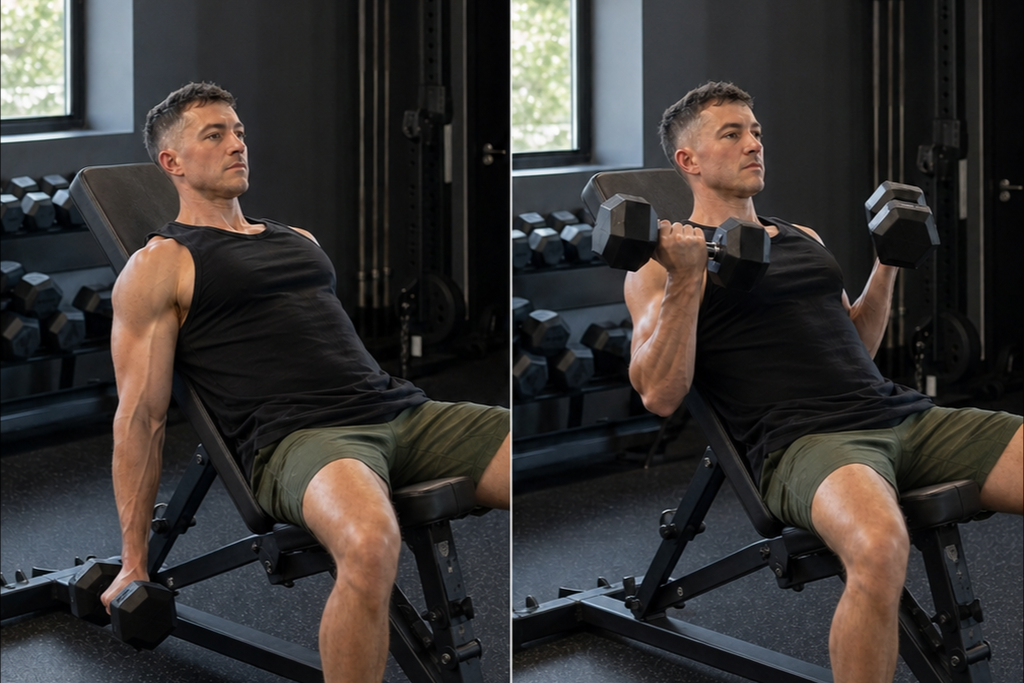
For a lengthened partial, you would move between the bottom position on the left and roughly the middle position on the right. A full rep would continue higher before returning to the bottom.
That is the key detail: “partial” describes how much of the joint motion you use; “lengthened” describes which part you keep.
Why Might the Stretched Part Help?
Muscles grow mainly in response to repeated mechanical tension. When a muscle produces force at a longer length, the active muscle fibres and some of the muscle's elastic structures can experience a different loading stimulus than they do near the shortened position.
Researchers are still working out exactly why this sometimes appears to help hypertrophy. You may hear the phrase stretch-mediated hypertrophy, but it is easy to oversell. The useful takeaway is not that stretching under load magically creates muscle. It is that challenging a muscle while it is long seems to be a valuable part of the growth stimulus for several muscle groups.
This is also why exercise choice matters. A seated leg curl lengthens the hamstrings at the hip before you even bend the knee. An overhead triceps extension lengthens the long head of the triceps at the shoulder. Neither exercise is a partial rep, but both train the target muscle in a more lengthened position.
What Does the Research Actually Say?
The evidence is promising, but it does not support replacing every full rep with a bottom-half rep.
A 2025 study in trained lifters compared lengthened partials with full-range training across several upper-body exercises. Both approaches produced similar changes in muscle size and strength endurance. The practical message was simple: emphasizing the stretched position worked, whether lifters reached it through full reps or lengthened partials.
Earlier reviews found that full-range training generally outperformed conventional partial-range training for strength and lower-body muscle growth. That matters because many older “partial” protocols did not specifically train the lengthened portion. They often lumped very different ranges together.
More recent work separates lengthened partials from shortened partials. A 2023 calf-raise study found greater gastrocnemius growth when partials were performed in the lengthened range than with full-range or shortened-range reps. A newer systematic review and meta-analysis also found an overall advantage for longer- over shorter-length partial training.
But not every comparison produces a dramatic winner. A 2025 systematic review found that the evidence around longer-muscle-length training and the way muscle architecture changes is still mixed. Different muscles, exercises and measurement sites can respond differently.
So the honest conclusion is:
Training the stretched range appears important. Lengthened partials can work very well. Full range remains a reliable way to train that stretched range while preserving strength across more of the movement.
Where Lengthened Partials Make the Most Sense
They are easiest to use when the exercise is stable, the target muscle stays loaded near the stretch and you can reverse direction without bouncing.
Biceps
On an incline dumbbell curl, lower the dumbbells under control until your elbows are nearly straight. A lengthened partial travels from there to roughly the middle of the curl, then returns.
Keep your shoulders against the bench. If the dumbbells swing behind you and your shoulders roll forward, the exercise has quietly become something else.
Calves
Calf raises are one of the clearest examples. Let the heel lower into a comfortable stretch, rise through the bottom half, then return under control. Research on the gastrocnemius makes this one of the more evidence-supported places to try lengthened partials.
The word comfortable matters. Do not bounce off the bottom or force an irritated Achilles tendon into an aggressive stretch. See the calf raise guide for the full setup.
Quadriceps and Glutes
The bottom portion of a squat places the quadriceps and glutes at longer lengths. Full, controlled squats already train this area well. You can use bottom-half partials on a hack squat, leg press or other stable machine, but they are not an excuse to relax at the bottom and ricochet upward.
If your mobility and technique allow it, a well-controlled front squat gives you plenty of useful range without needing any partials at all.
Hamstrings
A Romanian deadlift loads the hamstrings as the hips move back. Here, the goal is usually not to create tiny bottom-half reps. It is to keep tension as you move between a strong hinge and the deepest position you can control without losing your spinal position.
Exercise selection may be the smarter way to get more long-length work. In a 12-week comparison, seated leg curls produced more hamstring growth than prone leg curls, likely because sitting flexes the hip and lengthens several hamstring muscles.
Triceps
Overhead extensions place the triceps long head in a lengthened position. A controlled rep that allows the elbow to bend comfortably can be a useful complement to press-downs. One 12-week trial found greater triceps growth with overhead cable extensions than extensions performed with the arm beside the body.
That study compared exercise positions, not partial reps, but it reinforces the broader point: where the muscle is challenged can matter.
Lats
On a lat pulldown, the lats are relatively long with the arms overhead. Let the shoulder blades move upward naturally, keep your ribs controlled and begin the pull without jerking your body backward.
Lengthened partials can live in that upper portion, but do not turn them into shoulder shrugs. You should still feel the lats initiating the pull.
What Should It Feel Like?
The stretched part of the rep should feel loaded, controlled and muscular. You may notice more local fatigue or soreness when you first add it because the stimulus is unfamiliar.
You should not feel:
- sharp joint pain
- a sudden pulling or tearing sensation
- tingling, numbness or an electric feeling
- a loss of control at the bottom
- a need to bounce just to get the weight moving
More soreness does not prove that an exercise is building more muscle. It proves that you are sore. The two sometimes attend the same party, but they are not the same person.
Three Simple Ways to Use Them
Option 1: Keep Full Range as Your Base
Do your normal full-range sets and choose exercises that load the target muscle well in the stretched position. This is the simplest option and a very good one.
Option 2: Add Partials After Your Full Reps
When you can no longer complete another clean full rep, perform two to five controlled lengthened partials. This extends the set without requiring another full-range rep.
Use this on a stable curl, calf raise, leg curl or machine exercise. It is less appealing when you are pinned under a barbell and reconsidering several life choices.
Option 3: Use Dedicated Lengthened-Partial Sets
Choose one exercise and perform the working sets only through the lengthened half. Start lighter than you think you need, keep the range consistent and progress it like any other exercise.
This works best after you already understand the full movement. Beginners usually benefit from learning a controlled full range before making the rep more specialized.
A Practical Starting Plan
Try this for four to six weeks:
- Pick one muscle group, not your entire programme.
- Keep your main compound lift full range.
- Add lengthened partials to one stable accessory exercise.
- Start with two sets and leave one or two good partials in reserve.
- Track the same things you normally would: load, reps, control and how the area feels over the next day or two.
If you are recovering well and progressing, keep it. If the exercise mainly makes a joint angry, change the setup or return to full-range work. A training method does not become mandatory because it had a good month on social media.
Do Lengthened Partials Make You Stronger?
They make you stronger in the range you train, especially near the lengthened position. Strength is specific. If your goal is to improve a full squat, press or pull-up, you should still practise that full movement.
For pure muscle growth, lengthened partials can be a useful way to add high-quality tension. For strength through a complete lift, full-range practice remains important. Most people want some of both, which is convenient because your programme is allowed to contain more than one idea.
When to Be More Cautious
Do not force long-length loading into a painful range just because it is theoretically good for hypertrophy. Be conservative when you have:
- a recent muscle strain
- a reactive or painful tendon
- joint pain at the bottom of the movement
- recent surgery or a clinician-directed range restriction
- instability, numbness or unexplained weakness
You may still be able to train, but the useful range and load may be different for a while. Persistent pain, a sudden loss of strength, bruising, swelling or a clear injury event deserves an assessment.
The Bottom Line
Full range is the dependable default. Lengthened partials are a useful specialist tool.
You can build muscle with either when the target muscle is challenged, the sets are hard enough and your training progresses. The most sensible approach is to keep controlled full-range reps at the centre of your programme, then use lengthened partials where they feel stable, suit the exercise and help you add productive work.
No rep range has to win the internet. It only has to work in your programme.
References
- Wolf M, et al. “Lengthened partial repetitions elicit similar muscular adaptations as full range of motion repetitions during resistance training in trained individuals.” PeerJ. 2025. https://pubmed.ncbi.nlm.nih.gov/39959841/
- Pallarés JG, et al. “Effects of range of motion on resistance training adaptations: A systematic review and meta-analysis.” Scandinavian Journal of Medicine & Science in Sports. 2021. https://pubmed.ncbi.nlm.nih.gov/34170576/
- Kassiano W, et al. “Greater Gastrocnemius Muscle Hypertrophy After Partial Range of Motion Training Performed at Long Muscle Lengths.” Journal of Strength and Conditioning Research. 2023. https://pubmed.ncbi.nlm.nih.gov/37015016/
- Maeo S, et al. “Greater Hamstrings Muscle Hypertrophy but Similar Damage Protection after Training at Long versus Short Muscle Lengths.” Medicine & Science in Sports & Exercise. 2021. https://pubmed.ncbi.nlm.nih.gov/33009197/
- Maeo S, et al. “Triceps brachii hypertrophy is substantially greater after elbow extension training performed in the overhead versus neutral arm position.” European Journal of Sport Science. 2023. https://pubmed.ncbi.nlm.nih.gov/35819335/
- Reinoso-Sánchez F, et al. “Muscle hypertrophy from partial repetition at long vs. short muscle length: A systematic review and meta-analysis.” Sport Sciences for Health. 2025. https://doi.org/10.1007/s11332-025-01586-5
This guide is educational and is not medical advice. Exercise range should fit your body, goals and current health. Stop and seek assessment for a sudden injury, major weakness, significant swelling or persistent pain that is getting worse.