Overview
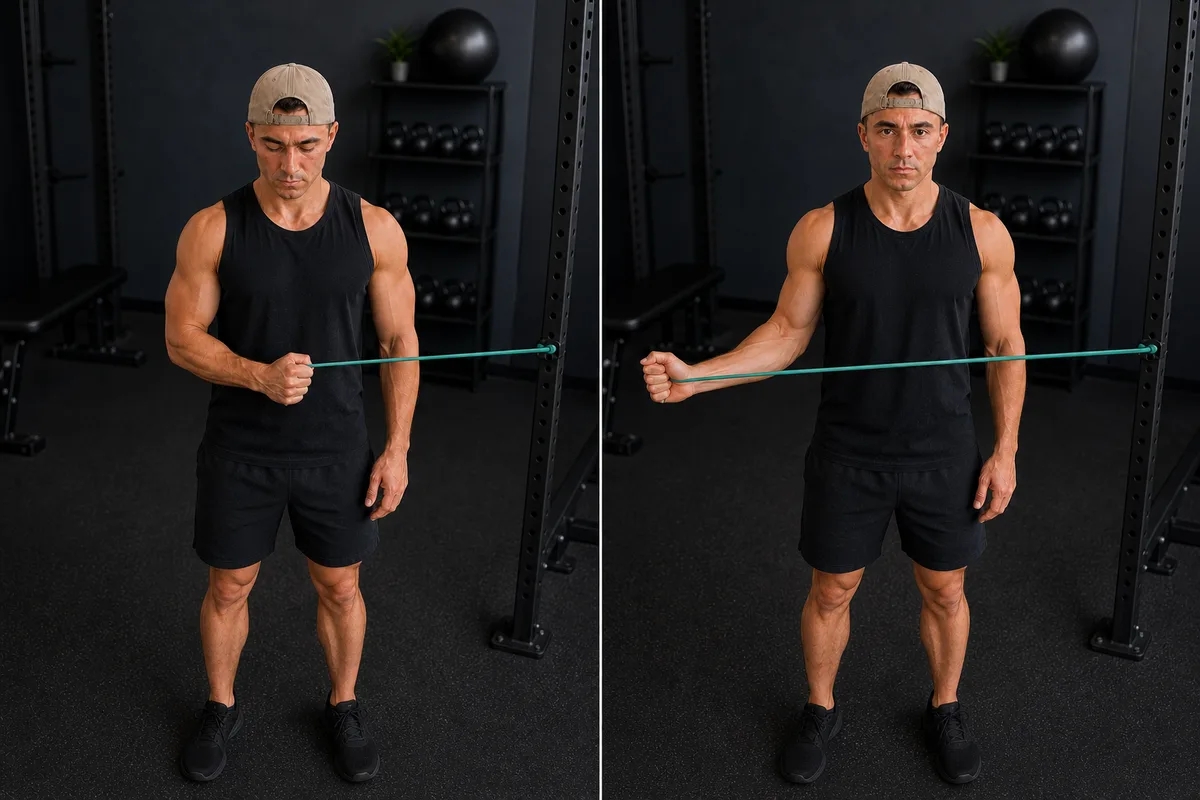
External rotation with band is a classic rotator cuff strengthening exercise. You anchor a resistance band and rotate your forearm outward, away from your body, while keeping your elbow tucked at your side. It directly targets two of the four rotator cuff muscles that help keep your shoulder stable and control rotation.
Exercise Name
External Rotation with Resistance Band
Primary Purpose
- Strengthen the muscles that rotate your upper arm bone (humerus) outward
- Improve shoulder stability by building strength in the rotator cuff, the group of four muscles and tendons that hold your upper arm bone snugly in its socket
- Support recovery from rotator cuff injury, shoulder instability, or general shoulder weakness
Your rotator cuff doesn't just move your shoulder — it also acts like a set of guy-wires that keep your upper arm bone centred in the socket during any arm movement. Strengthening the outward (external) rotators helps balance the pull of stronger, more dominant inward-rotating muscles like your chest and front shoulder muscles.
Target Muscles
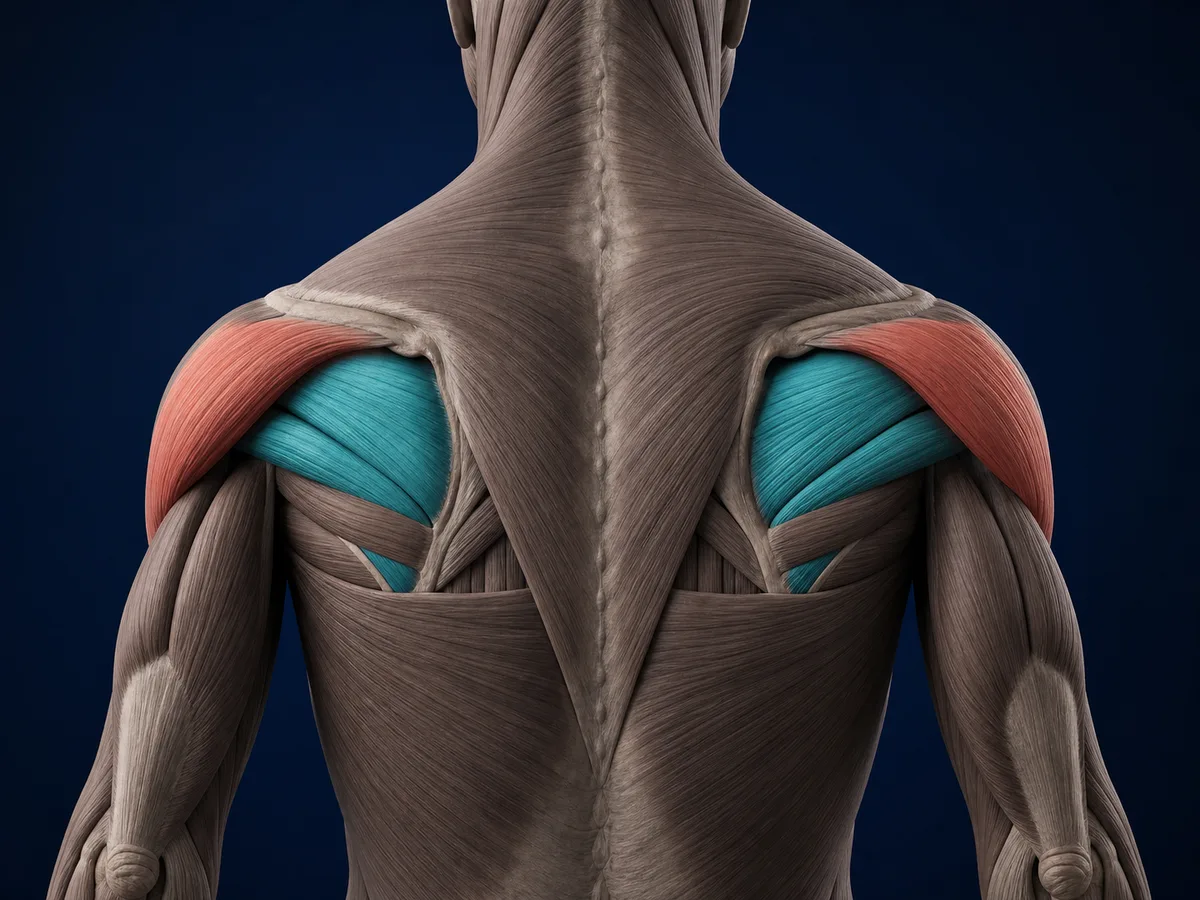
- Infraspinatus — the main muscle producing external rotation
- Teres Minor — assists the infraspinatus in rotating the arm outward
- Rotator Cuff Overview — the whole group works together to stabilize the joint during this movement
The infraspinatus and teres minor sit on the back of your shoulder blade. When you rotate your forearm outward against resistance, these two muscles do most of the work while your rotator cuff as a whole keeps the joint centred.
Difficulty Level
Beginner
Equipment Required
- A light to medium resistance band (looped or with handles)
- A stable anchor point (door handle, hook, or band anchor) at roughly elbow height
Who Should Perform This
- People recovering from a rotator cuff tear or rotator cuff tendinitis, once cleared for active strengthening
- Overhead athletes (swimmers, throwers, tennis players) working on shoulder stability and injury prevention
- Desk workers with rounded shoulders and weak outward rotators from long periods of forward-reaching posture
- Anyone rebuilding strength after a period of shoulder immobilization
Who Should Avoid This
- Anyone in the first few days to weeks after a shoulder dislocation, until cleared for active strengthening by a health professional
- People with an unhealed fracture around the shoulder or upper arm
- Anyone less than a few weeks post-rotator cuff surgery, or before their surgeon's specific clearance for resisted exercise
- People experiencing sharp or worsening pain during the motion — this should feel like effort, not pain
Step-by-Step Instructions
- Anchor the band at roughly elbow height and stand sideways to the anchor point, holding the band in the hand farthest from it.
- Tuck your elbow against your side and bend it to 90 degrees, keeping your forearm pointing across your stomach — this is your starting position.
- Keeping your elbow glued to your side, rotate your forearm outward, away from your body, until it points forward.
- Pause briefly at the end of the movement, feeling the back of your shoulder work.
- Slowly return to the starting position, controlling the band the whole way back — don't let it snap you back.
- Repeat for 10–15 repetitions, 2–3 sets, most days of the week or as directed by your physiotherapist.
Common Mistakes
- Letting the elbow drift away from the body — this shifts the work to other muscles and reduces the benefit to the rotator cuff. Keep the elbow pinned to your side throughout.
- Using the whole body to generate momentum — twisting your torso or shrugging your shoulder to help pull the band means the target muscles aren't doing the work.
- Choosing a band that's too heavy — this often leads to the elbow drifting or the shoulder shrugging up toward the ear. A lighter band with perfect form beats a heavy one with poor form.
- Rushing the return phase — snapping back lets the band do the work instead of your muscles controlling it.
Progressions
- Increase resistance band strength as the exercise becomes easy
- Perform the exercise standing on one leg to add a light balance and core challenge
- Progress to external rotation at 90 degrees of shoulder abduction (arm out to the side) for more sport-specific throwing and overhead strength, once basic strength is established
- Add a brief pause (2–3 seconds) at the fully rotated end position to build control
Easier Alternatives
- Perform the same motion lying on your side with a light dumbbell instead of a band, which some people find easier to control
- Reduce the range of motion, rotating only partway if full rotation causes discomfort
- Use a very light band or even just your own arm weight (no resistance) to practice the movement pattern first
Related Injuries
- Rotator Cuff Tear — this exercise rebuilds strength in the muscles most often affected
- Rotator Cuff Tendinitis — controlled strengthening helps the tendon tolerate load again
- Shoulder Impingement Syndrome — stronger external rotators help balance shoulder mechanics and reduce crowding under the shoulder blade's bony roof
- Shoulder Dislocation — used later in rehab to rebuild the muscular support around the joint
Related Anatomy
- Infraspinatus — the prime mover in this exercise
- Teres Minor — assists the infraspinatus
- Rotator Cuff Overview — the muscle group this exercise strengthens
- Glenohumeral Joint — the joint being stabilized
References
- Physiopedia. "Rotator Cuff Strengthening Exercises." https://www.physio-pedia.com/Rotator_Cuff_Strengthening_Exercises
- Journal of Orthopaedic & Sports Physical Therapy (JOSPT). "An Update of Systematic Reviews Examining the Effectiveness of Conservative Physical Therapy Interventions for Subacromial Shoulder Pain." https://www.jospt.org/doi/10.2519/jospt.2020.8498
- OrthoInfo — American Academy of Orthopaedic Surgeons. "Rotator Cuff and Shoulder Conditioning Program." https://orthoinfo.aaos.org/en/recovery/rotator-cuff-and-shoulder-conditioning-program/
- StatPearls (NCBI Bookshelf). "Anatomy, Rotator Cuff." https://www.ncbi.nlm.nih.gov/books/NBK441844/
This information is for education only and is not a medical diagnosis. InjuryAtlas does not replace an assessment by a qualified health professional. If you have severe pain, visible deformity, numbness, loss of function, or symptoms that are getting worse, seek medical care promptly.