Overview
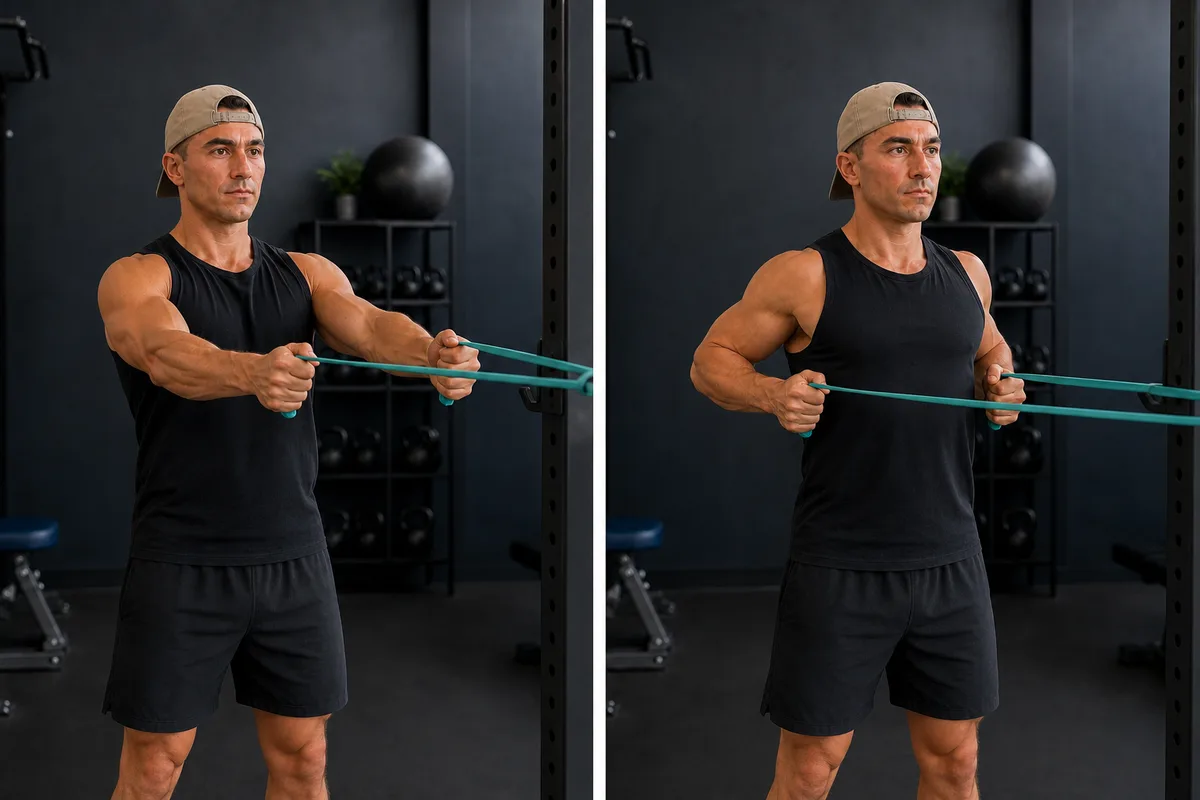
The scapular retraction row trains you to pull your shoulder blades together and down, using a rowing motion with a band or light weight. It's one of the best exercises for countering the rounded-forward shoulder posture that comes from hours of desk work, driving, or phone use, and it builds the mid-back strength that supports healthy shoulder movement.
Exercise Name
Scapular Retraction Row
Primary Purpose
- Strengthen the muscles that pull your shoulder blades back and together (scapular retraction)
- Improve posture by countering the rounded-shoulder position common with desk work
- Support healthy shoulder mechanics by building a stable base for the shoulder blade to move on
Your shoulder blade (scapula) needs to move smoothly against your rib cage for your arm to work well overhead. If the muscles that retract (pull back) your shoulder blade are weak, your shoulder often compensates in ways that can lead to pain, especially with repeated reaching or lifting.
Target Muscles
- Trapezius — particularly the middle and lower fibers, which pull the shoulder blade back and down
- Rotator Cuff Overview — works alongside the trapezius to keep the shoulder joint stable during the pulling motion
The middle and lower parts of your trapezius (a large, kite-shaped muscle spanning your upper back and neck) are often underused if you spend a lot of time hunched forward. This exercise directly targets those under-used fibers.
Difficulty Level
Beginner
Equipment Required
- A resistance band anchored at chest height, or a cable row machine, or light dumbbells for a bent-over row variation
- A chair (optional, for a seated version)
Who Should Perform This
- Desk workers or anyone with a rounded-shoulder, forward-head posture
- People recovering from shoulder impingement syndrome who need better shoulder blade control
- Anyone building a well-rounded shoulder strengthening program alongside rotator cuff exercises
- Older adults working on posture and upper back strength
Who Should Avoid This
- Anyone with an acute, unstable shoulder injury where pulling movements haven't yet been cleared
- People with an unhealed fracture around the shoulder, collarbone, or upper spine
- Anyone in early recovery after shoulder or neck surgery without their surgeon's clearance for resisted pulling
- People with sharp neck pain that worsens with this movement — check with a health professional first
Step-by-Step Instructions
- Anchor a resistance band at chest height, or sit at a cable row station, and hold the handles with arms extended in front of you.
- Sit or stand tall with your core gently engaged and shoulders relaxed down away from your ears.
- Pull your elbows straight back, squeezing your shoulder blades together and slightly down, as if trying to pinch a pencil between them.
- Keep your elbows close to your sides as you pull — avoid flaring them wide.
- Pause for 1–2 seconds at the point of maximum squeeze.
- Slowly return to the starting position, resisting the band or weight the whole way back.
- Repeat for 10–15 repetitions, 2–3 sets, 3–4 times per week.
Common Mistakes
- Shrugging the shoulders up toward the ears — this brings the upper trapezius into the movement instead of the middle and lower fibers you're trying to target. Keep your shoulders down throughout.
- Leaning back with the torso to help pull — the movement should come from the shoulder blades, not from rocking your body backward.
- Using too much weight or band resistance — this often causes the elbows to flare out and the movement to become jerky instead of controlled.
- Only focusing on the pulling phase — the slow, controlled return is just as important for building strength.
Progressions
- Increase resistance band strength or dumbbell weight gradually
- Add a longer hold (3–5 seconds) at the point of full retraction
- Progress to a standing single-arm row for added core and balance demand
- Combine with prone Y-T raises for a fuller mid-back and shoulder strengthening routine
Easier Alternatives
- Perform the movement without any resistance first, focusing purely on squeezing the shoulder blades together
- Use a very light band and reduce the range of motion if pulling causes discomfort
- Try a seated version against a wall to help with posture awareness during the movement
Related Injuries
- Shoulder Impingement Syndrome — better shoulder blade control can reduce crowding of structures under the shoulder's bony roof
- Rotator Cuff Tendinitis — improved posture and scapular strength reduce ongoing strain on the rotator cuff tendons
Related Anatomy
- Trapezius — the primary muscle strengthened by this exercise
- Scapula (Shoulder Blade) — the bone being retrained to move well
- Rotator Cuff Overview — supports joint stability during the pulling motion
References
- Physiopedia. "Rotator Cuff Strengthening Exercises." https://www.physio-pedia.com/Rotator_Cuff_Strengthening_Exercises
- Journal of Orthopaedic & Sports Physical Therapy (JOSPT). "An Update of Systematic Reviews Examining the Effectiveness of Conservative Physical Therapy Interventions for Subacromial Shoulder Pain." https://www.jospt.org/doi/10.2519/jospt.2020.8498
- OrthoInfo — American Academy of Orthopaedic Surgeons. "Rotator Cuff and Shoulder Conditioning Program." https://orthoinfo.aaos.org/en/recovery/rotator-cuff-and-shoulder-conditioning-program/
This information is for education only and is not a medical diagnosis. InjuryAtlas does not replace an assessment by a qualified health professional. If you have severe pain, visible deformity, numbness, loss of function, or symptoms that are getting worse, seek medical care promptly.