Overview
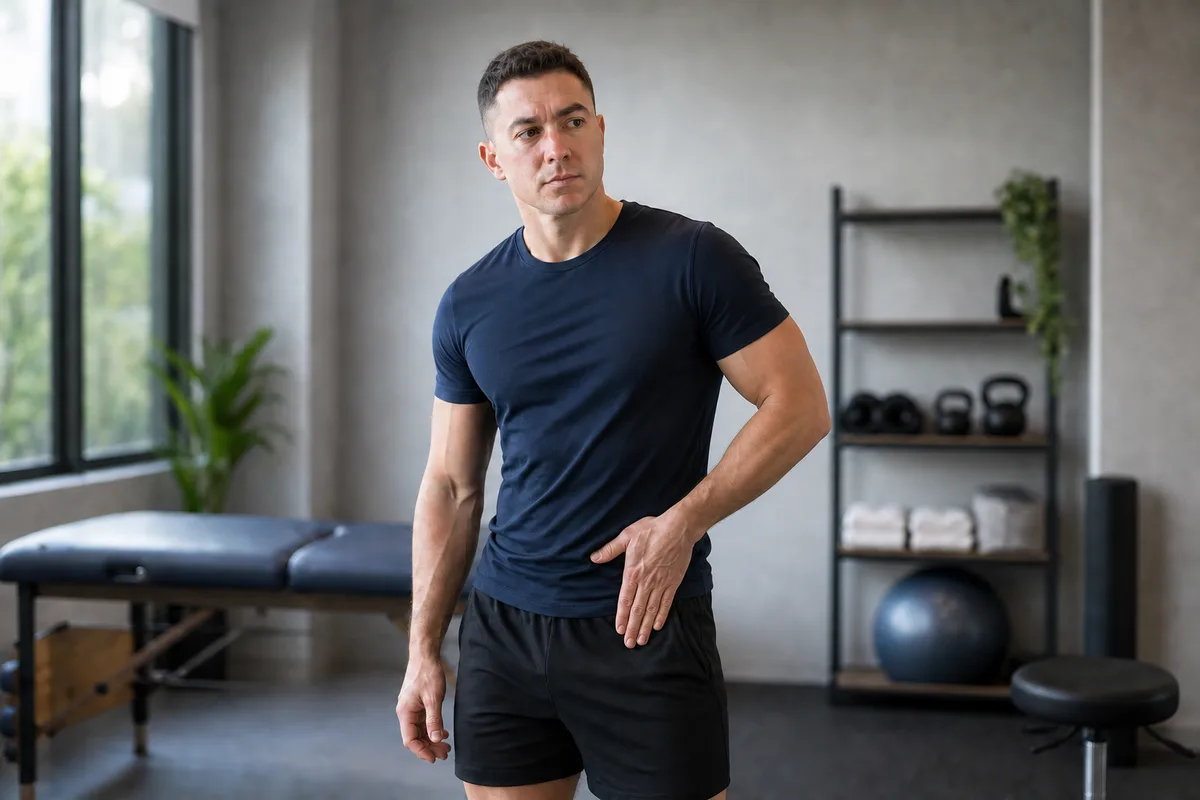
Hip flexor strain is an injury to one or more muscles that lift the thigh toward the torso. The iliopsoas—the psoas major and iliacus working together—is the deepest and most important hip flexor. The rectus femoris, sartorius and tensor fasciae latae can also contribute to pain at the front of the hip.
An acute strain usually follows a forceful sprint, kick, acceleration or sudden stretch. More gradual pain may reflect iliopsoas or rectus femoris overload rather than a fresh muscle tear. Front-of-hip pain is not automatically a hip flexor injury: the hip joint, labrum, bone, groin, abdominal wall and lower back can produce similar symptoms.
Anatomy: What Is Actually Injured?
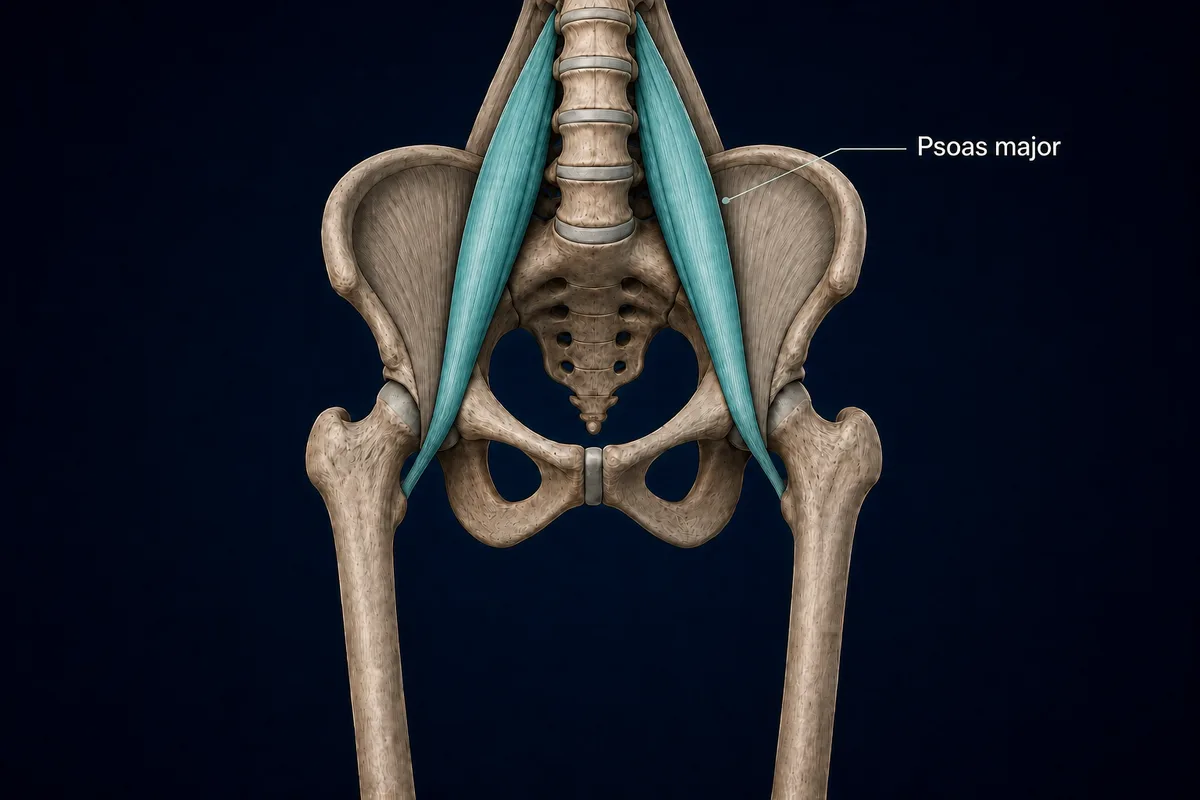
- Psoas major: runs from the lumbar spine to the inside of the upper femur and contributes to hip flexion and lumbopelvic control
- Iliacus: lines the inside of the pelvis and joins the psoas tendon to form the iliopsoas
- Rectus femoris: crosses both the hip and knee, helping lift the thigh and straighten the knee; it is heavily loaded in sprinting and kicking
- Sartorius and tensor fasciae latae: assist hip flexion and may contribute to more superficial front-of-hip discomfort
Muscle injuries often occur near the musculotendinous junction, where muscle fibres transition into tendon. The exact tissue involved affects which movements hurt and how quickly loading can progress.
Strain Grades
- Grade 1 — mild: a small amount of fibre disruption, local soreness and little or no measurable strength loss
- Grade 2 — moderate: a partial tear with clearer pain, weakness, possible swelling or bruising and difficulty running or lifting the knee
- Grade 3 — severe: a complete or near-complete tear with major weakness and loss of function; specialist assessment and imaging are usually required
Grades are clinical categories, not precise recovery clocks. Two people with the same label can have different injured structures, sport demands and recovery times.
Typical Pattern
- Pain at the front crease of the hip, upper thigh or deep groin
- Pain when lifting the knee, climbing stairs, getting into a car or bringing on socks
- Pain with sprinting, accelerating, kicking or taking a long stride
- Tenderness over the front of the hip or upper rectus femoris
- Weakness or pain when hip flexion is tested against resistance
- Possible swelling, bruising or a sudden pulling sensation after an acute strain
A painless click can occur in healthy hips. Repeated painful snapping, catching or locking deserves assessment because it may involve the iliopsoas tendon or structures inside the hip joint.
Why It Develops
The hip flexors accelerate the thigh during running and kicking, then control the leg as it extends behind the body. Risk rises when the demand exceeds current capacity. Common contributors include:
- A rapid increase in sprinting, hills, kicking or high-knee drills
- Returning to speed work before strength and coordination have recovered
- Fatigue during repeated accelerations or games
- Limited exposure to high-speed running followed by a sudden maximal effort
- Reduced trunk, pelvic or hip control that changes how load is shared
- A previous hip or groin injury
Prolonged sitting can make the front of the hip feel stiff, but feeling tight does not prove the muscle is shortened or injured. Repeated stretching is not the answer to every case and may aggravate a recent strain.
What Else Can Feel Similar?
Several conditions overlap with hip-flexor pain:
- Femoroacetabular impingement or labral irritation: deeper groin pain, often with flexion, twisting, catching or prolonged sitting
- Adductor-related groin pain: pain closer to the inner thigh or pubic region, often reproduced by squeezing the legs together
- Inguinal or abdominal-wall injury: pain with coughing, sneezing, sit-ups or forceful trunk effort; a bulge may suggest hernia
- Femoral-neck stress injury: deep groin pain with weight-bearing, running or hopping that may progress to pain at rest
- Rectus femoris strain: often more superficial and may hurt with both resisted hip flexion and knee extension
- Lumbar or nerve-related pain: back symptoms, numbness, tingling or pain travelling down the leg
Do not keep treating presumed “tight hip flexors” when weight-bearing pain, night pain, neurological symptoms or joint catching are increasing.
How It Is Diagnosed
A clinician reviews the onset, exact location and training changes, then checks walking, hip and spine range, palpation, resisted hip flexion, knee extension, strength and sport-specific movement. The examination also looks for hip-joint, groin, abdominal-wall, bone and nerve-related causes.
Imaging is not required for every uncomplicated mild strain. It becomes more useful when there was significant trauma, a pop with marked weakness, extensive bruising, inability to bear weight, concern about fracture or stress injury, or symptoms that do not improve as expected. For traumatic hip pain, radiographs are generally the first study when fracture is a concern; MRI is particularly useful when radiographs are negative but a significant muscle, tendon, ligament or occult bone injury remains suspected.
Recovery: A Staged Approach
-
Settle and protect
- Keep walking comfortably
- Pause sprinting, kicking and aggressive stretching
Progress when: Daily activities are settling
-
Restore motion and control
- Begin gentle hip-flexion isometrics
- Build trunk control and comfortable hip extension
Progress when: There is no sharp pain or next-day flare
-
Build strength
- Progress resisted hip flexion
- Train glutes, adductors and trunk
Progress when: Strength and range approach the other side
-
Return to sport
- Walk → jog → strides → acceleration
- Add cutting and kicking last
Progress when: There is no later or next-morning escalation
Stage 1: Settle Irritability and Protect Function
- Pause sprinting, kicking, deep lunges and forceful knee lifts that reproduce sharp pain
- Keep walking and ordinary movement within a comfortable range when possible
- Use ice or heat only if it improves comfort; neither is required for tissue healing
- Avoid aggressive stretching, deep massage or repeated “testing” of a fresh injury
- Seek medication advice from a pharmacist or clinician if pain relief is needed, especially if you have other health conditions
The goal is not complete inactivity. It is to reduce the most provocative load while maintaining comfortable function.
Stage 2: Restore Comfortable Motion and Early Strength
Once daily activities are settling, rehabilitation commonly introduces:
- Gentle hip-flexion isometrics at tolerable effort
- Controlled short-lever hip flexion in lying or sitting
- Trunk and pelvic control exercises such as the dead bug
- Glute and posterior-chain exercises such as the hip hinge or hip thrust, if comfortable
- Gradual restoration of hip extension without forcing the front of the hip
Pain response matters more than an exact calendar. Exercise should not cause sharp pain or a clear worsening that persists into the next day.
Stage 3: Build Capacity Through Range
Progress from low-load control to stronger and more functional hip flexion:
- Resisted hip flexion in lying, sitting and then standing
- Slower lowering work to build eccentric control
- Progressive glute, adductor and trunk strengthening
- Marching, step-ups and controlled split-stance patterns
- Gradually faster movements as strength and range become symmetrical
Evidence on iliopsoas activation supports a graded progression: resistance increases muscle demand, while trunk and pelvic control remain important throughout.
Stage 4: Return to Running and Sport
A sensible progression moves from walking to easy running, then strides, acceleration, higher speed, cutting and kicking. Change one major variable at a time—speed, volume, range or resistance—and check the response later that day and the next morning.
Recovery Time
There is no single reliable timeline. A mild strain may improve over days to a few weeks; a partial tear often takes several weeks or longer; a major tear can require months and specialist management. Tendon-related or recurrent pain may progress more slowly than a straightforward mild muscle strain.
Recovery depends on the structure and severity involved, baseline strength, previous injury, sport demands and whether another source of groin pain is present. Use milestones rather than a promised date.
Return-to-Sport Checklist
Before unrestricted sprinting, kicking or competition, aim for:
- Normal walking, stairs and daily activities without a limp
- Comfortable hip range comparable with the other side
- Strong resisted hip flexion without sharp pain
- Good pelvic and trunk control during progressively harder hip-flexion exercises
- Jogging, acceleration, deceleration and sport-specific drills completed without symptoms escalating
- No meaningful flare later that day or the following morning
- Confidence performing the movements your sport requires
Contact athletes and high-speed runners may need formal strength testing and a supervised field progression. Return should reflect the demands of the sport, not simply the passage of time.
Prevention and Recurrence Reduction
- Increase sprint, hill and kicking volume gradually
- Keep some appropriate high-speed exposure in training rather than jumping from none to maximal effort
- Strengthen hip flexors through progressively longer ranges and higher loads
- Train glutes, adductors, trunk and single-leg control so the hip flexors do not work in isolation
- Warm up with movements that resemble the session ahead
- Allow recovery when fatigue is changing running or kicking mechanics
- Complete the final speed and sport-specific stages of rehabilitation instead of stopping when ordinary walking feels normal
Seek Urgent or Prompt Assessment
- Inability to bear weight, a major limp or severe pain after trauma
- A sudden pop with major weakness, extensive bruising or visible deformity
- Deep groin pain that is worsening with walking, running or hopping
- Fever, chills, redness, significant swelling or feeling systemically unwell
- A new groin bulge, especially with severe pain, nausea or vomiting
- Numbness, progressive weakness, bowel or bladder changes, or pain travelling down the leg
- Pain at rest or at night that is worsening
- Persistent catching, locking or symptoms that are not improving with sensible load adjustment
Children and adolescents with acute hip or groin pain require extra caution because growth-plate and avulsion injuries can resemble muscle strains.
Common Questions
Should I stretch a pulled hip flexor?
Not aggressively at first. A gentle, comfortable range may be reasonable as symptoms settle, but forcing a recent strain into deep hip extension can increase pain. Strength and gradual exposure are at least as important as flexibility.
Can I keep running?
Easy running may be possible in a mild case if gait stays normal and symptoms do not increase during or after the run. Sprinting, hills and kicking create higher demand and usually return later. If running changes your stride or produces a next-day flare, reduce the load.
Is clicking in the front of the hip dangerous?
Not always. Painless snapping can occur without injury. Painful or persistent snapping—especially with catching, locking or loss of function—should be assessed to distinguish iliopsoas tendon movement from an intra-articular hip problem.
Do I need an MRI?
Most mild, improving strains do not. Imaging is more relevant after significant trauma, with marked weakness or bruising, when bone or joint injury is suspected, or when the diagnosis and recovery pattern remain unclear.
Related Reading
- Hip joint anatomy
- Groin pain
- Hip pain: common causes
- Femoroacetabular impingement
- Hip hinge exercise
- Hip thrust exercise
- Dead bug exercise
- General hip loading principles
References
- Cheatham SW, Kolber MJ, Salamh PA. "Rehabilitation of Soft Tissue Injuries of the Hip and Pelvis." International Journal of Sports Physical Therapy. 2014. https://pmc.ncbi.nlm.nih.gov/articles/PMC4223288/
- Goom T, Malliaras P, Reiman MP, Purdam CR. "Rehabilitation of Soft Tissue Injuries of the Hip and Pelvis." Clinics in Sports Medicine. 2021. https://pubmed.ncbi.nlm.nih.gov/33673896/
- American College of Radiology. "ACR Appropriateness Criteria: Acute Hip Pain." Revised 2024. https://acsearch.acr.org/docs/3082587/narrative
- Dello Iacono A, et al. "Hip Flexor Muscle Activation During Common Rehabilitation and Strength Exercises: A Systematic Review." 2024. https://pmc.ncbi.nlm.nih.gov/articles/PMC11546833/
- Pollock N, et al. "Return to Sport, Reinjury Rate, and Tissue Changes after Muscle Strain Injury: A Narrative Review." 2024. https://pmc.ncbi.nlm.nih.gov/articles/PMC11390226/
This information is for education only and is not a medical diagnosis. InjuryAtlas does not replace an assessment by a qualified health professional. If you have severe pain, visible deformity, numbness, loss of function, or symptoms that are getting worse, seek medical care promptly.