Anatomy at a Glance
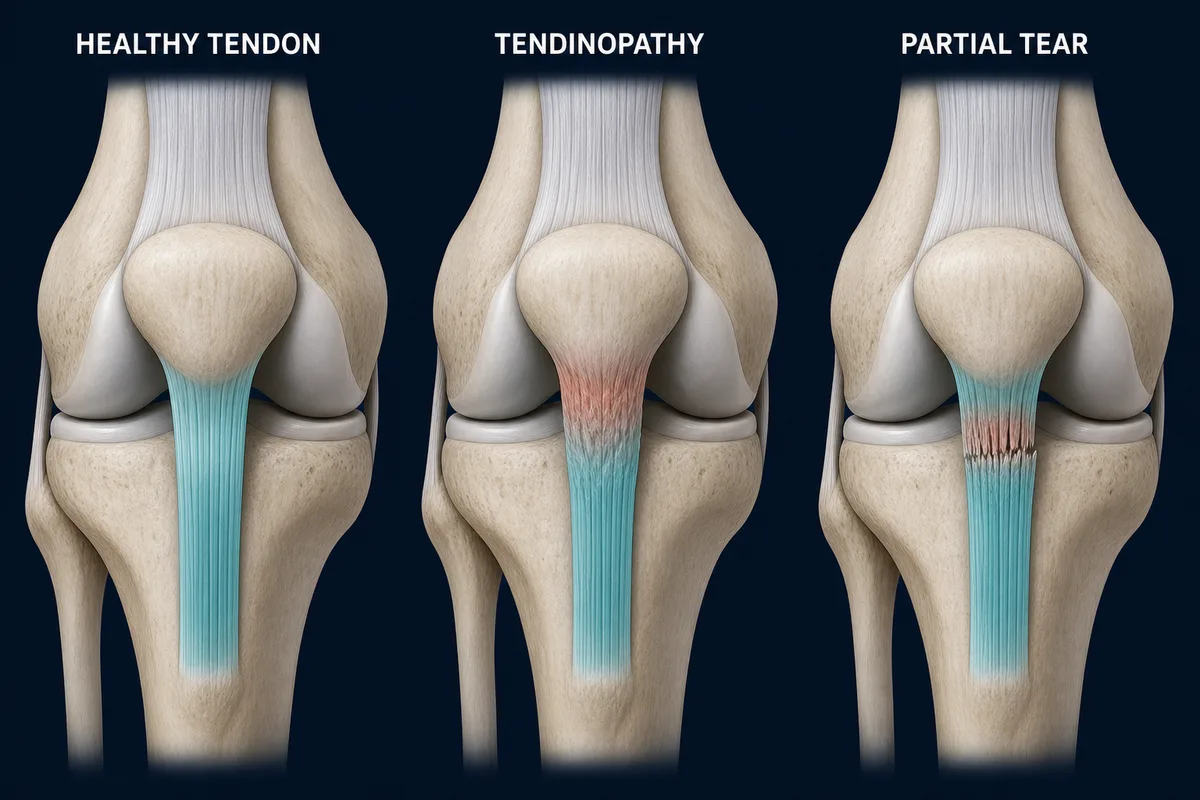
Patellar tendinopathy usually affects the upper tendon just below the kneecap. Tendinopathy is not the same as a partial tendon tear.
First, Make Sure the Pattern Fits
Patellar tendinopathy usually causes localized, load-related pain in the tendon just below the kneecap. Jumping, landing, sprinting, heavy squatting and rapid changes in training volume are common triggers.
That is not quite the same as “runner's knee,” which usually refers to patellofemoral pain felt more diffusely around or behind the kneecap. Fat-pad irritation, bursitis, cartilage problems and pain in growing athletes can also feel similar.
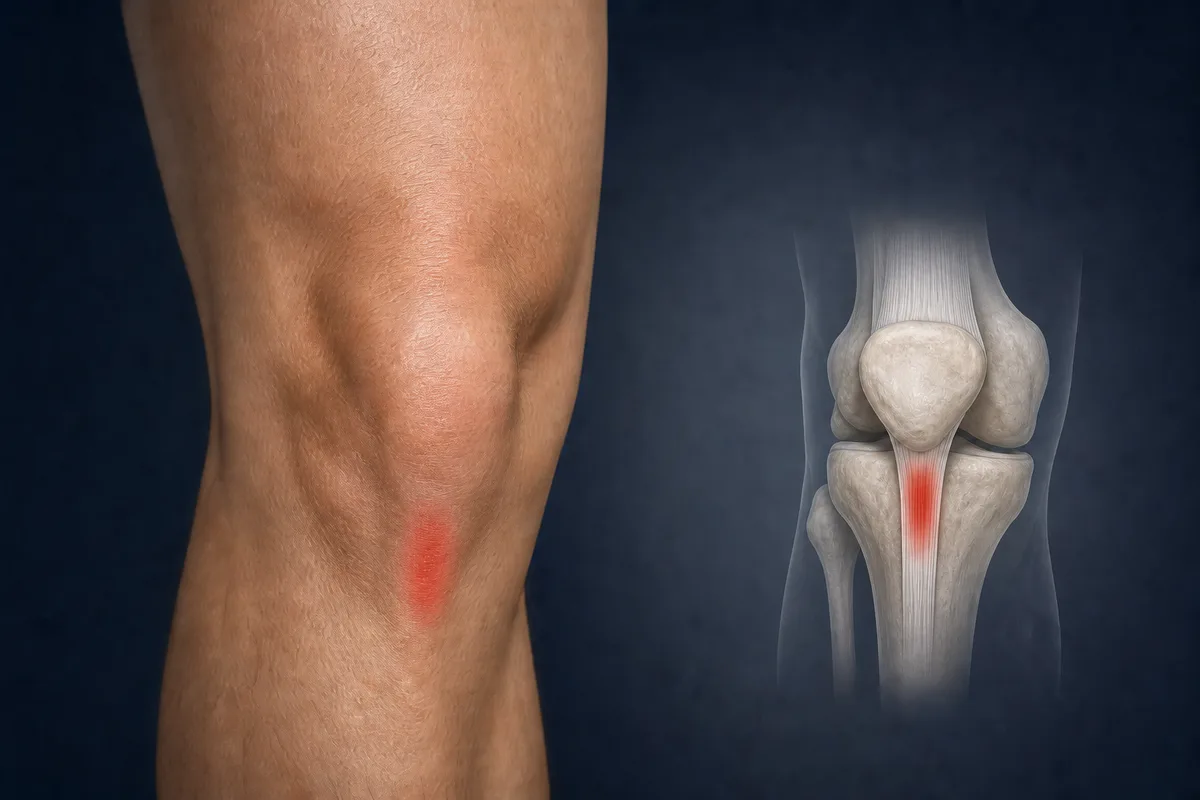
Patellar tendinopathy is usually felt in the upper tendon just below the kneecap; pain location alone does not confirm the diagnosis.
No single tender spot or exercise can diagnose the problem. An assessment is worthwhile when the location is unclear, symptoms are persistent or you are unsure which structure is involved.
Seek prompt care after a sudden pop, rapid swelling, a palpable gap or loss of the ability to actively straighten the knee or perform a straight-leg raise. Those findings raise concern for a tendon rupture rather than ordinary tendinopathy.
Why Complete Rest Usually Is Not the Answer
Patellar tendon symptoms often reflect a mismatch between current capacity and recent demand. That demand might come from a sudden increase in:
- jumping or landing volume;
- sprinting or hill running;
- heavy or deep squatting;
- court or field sessions;
- training intensity after time off; or
- several demanding activities layered into the same week.
Temporarily reducing the most provocative work can settle irritability, but rest alone does not rebuild the tendon or quadriceps. Rehabilitation gradually restores the ability to tolerate slow strength, then faster energy-storage work such as jumping and sprinting.
Use Pain as Feedback, Not a Pass-or-Fail Test
Some discomfort during tendon rehabilitation can be acceptable. A commonly used pain-monitoring approach allows mild pain during activity when it remains controlled and returns to its usual level by the following day.
Do not chase an exact number as though it guarantees safety. Look at the whole response:
- Does pain climb through every set?
- Is technique changing to avoid the sore side?
- Are stairs or walking worse afterward?
- Is morning stiffness meaningfully worse the next day?
- Is the tendon becoming more irritable across the week?
If so, reduce one variable: range, resistance, speed, repetitions or training volume.
Stage 1: Reduce the Spike in Irritation
Main goals: identify the load that triggered the flare, keep the knee moving and find a tolerable starting dose of quadriceps work.
You may need to temporarily reduce repeated jumping, sprinting, deep heavy squats or high-volume running. That does not necessarily mean stopping all lower-body exercise.
An isometric option can be useful when repeated bending is irritable:
- wall-sit isometric;
- Spanish-squat hold with suitable equipment and coaching; or
- an isometric knee-extension hold on a machine.
Choose an angle that produces strong thigh effort without steadily escalating tendon pain. A practical starting point might be several holds of 20–45 seconds with generous rest, but the depth, effort and duration should match your tolerance.
Isometrics are not mandatory and do not “heal” the tendon instantly. They are one way to maintain load and sometimes reduce pain enough to begin strength work.
Signs you may be ready to progress
- Everyday walking and stairs are stable or improving.
- Morning stiffness is not worsening across the week.
- Isometric or light repeated loading is tolerated.
- Pain returns to its usual level by the next day.
- You can load both legs without marked compensation.
Stage 2: Build Slow, Progressive Strength
Main goals: strengthen the quadriceps and patellar tendon through an increasingly useful range.
Progressive tendon loading can use both the lowering and lifting portions of an exercise. Eccentric decline squats are one option, but they are not the only effective approach and may be too provocative at the beginning.
Useful exercises may include:
- sit-to-stand;
- squat or leg press through a tolerable range;
- knee extension on a machine;
- split squat;
- low step-up; and
- calf and hip strengthening to support the whole task.
Move with control and use resistance that feels like genuine strength training. When a chosen exercise is well tolerated, progress one variable at a time:
- Add repetitions within the target range.
- Increase resistance.
- Increase knee-bend depth.
- Progress toward more single-leg work.
Two or three substantial strength sessions per week often provide a useful starting structure, with recovery between harder sessions. The correct frequency depends on the rest of your sport and training week.
A simple early strength template
- One squat or leg-press pattern
- One knee-extension or other quadriceps-focused exercise
- One single-leg pattern such as a split squat or step-up
- Calf and hip work as needed
Begin with two or three controlled sets per exercise. Select loads and ranges that allow a stable next-day response rather than copying somebody else's heaviest program.
Signs you may be ready to progress
- Slow resistance exercise is getting heavier without a worsening weekly trend.
- Squats, stairs and basic single-leg tasks are controlled.
- The tendon tolerates deeper range gradually.
- Quadriceps strength is improving.
- There is no meaningful increase in next-day pain or stiffness.
Stage 3: Add Faster Loading and Energy Storage
Main goals: prepare the tendon for the speed and repeated force of running, jumping and landing.
Slow strength does not fully prepare a tendon for explosive sport. Add faster work only after a solid strength base and stable symptom response.
A progression may include:
- small two-leg pogo hops;
- controlled two-leg jumping and landing;
- skipping or low-level bounds;
- faster squat patterns with light load;
- single-leg hops; and
- repeated multi-direction landings.
Start with low height and a small number of contacts. Increase total contacts before adding maximal height, speed or unpredictable direction changes.
Energy-storage sessions are demanding. Avoid adding hard jumping, sprinting and a heavy knee-strength session all at once simply because each element is tolerated separately.
Stage 4: Return to Running, Jumping and Sport
Main goals: rebuild the exact work that originally exceeded capacity.
For a runner, this may mean easy flat running before hills, speed work and consecutive training days. For a jumping athlete, it may mean planned submaximal jumps before repeated maximal efforts, reactive play and full competition.
Progress one exposure at a time:
- predictable and submaximal;
- more repetitions;
- greater speed or height;
- more reactive movement;
- fatigue and full practice; and
- normal competition or training volume.
Useful return markers include:
- minimal and stable symptoms during daily activity;
- restored quadriceps and calf strength;
- confident single-leg squatting, jumping and landing;
- tolerance of progressive running or jumping sessions;
- no meaningful next-day flare; and
- exposure to the actual speed and volume required by the activity.
How to Arrange the Training Week
The rehabilitation exercises and your normal training draw from the same capacity. A useful week separates harder tendon-loading sessions instead of stacking every demanding activity together by accident.
An early-to-middle-stage week might include:
- Day 1: progressive quadriceps and lower-limb strength;
- Day 2: easier cardio or upper-body training;
- Day 3: rest, light activity or pain-tolerable isometrics;
- Day 4: progressive quadriceps and lower-limb strength;
- Day 5: easier activity;
- Day 6: a third strength exposure or controlled running/jumping when ready; and
- Day 7: recovery or ordinary comfortable activity.
This is an example, not a required seven-day schedule. A basketball player, runner and recreational lifter will need different distributions. The main idea is to count all demanding tendon work—including sport, sprints, hills and heavy leg training—not only the exercises labelled “rehab.”
Track More Than Pain at Rest
Choose a few repeatable measures and record them once or twice per week rather than testing the tendon constantly:
- A consistent loading task: for example, the same squat depth or a controlled step-down.
- Morning response: note whether stiffness is stable, improving or worsening.
- Training capacity: record the load, repetitions and range completed with an acceptable next-day response.
Pain can fluctuate while capacity improves. Being able to perform more controlled work without a worsening weekly trend is meaningful progress even if the tendon is not yet symptom-free.
How Long Does Patellar Tendinopathy Take to Improve?
Tendon rehabilitation is usually measured in months rather than days. A 12-week progressive program is a common research timeframe, but symptoms that have persisted for a long time or athletes returning to high jump volumes may need longer.
Improvement is rarely perfectly linear. A flare after an abrupt increase does not mean the tendon is permanently damaged or that all progress has been lost. Adjust the recent load, return to the last tolerable level and build again.
What About Running While Rehabilitating?
Running is not automatically forbidden. Its place depends on symptom irritability, the type of running and the total weekly load.
Flat, easy running may be tolerated before sprinting, hills or repeated accelerations. If ordinary runs consistently worsen pain during the session or the following morning, reduce distance, speed, frequency or hills while strength capacity develops.
Do not judge the program from running alone. Court sports, jumping, lifting and work demands all contribute to the same weekly load.
What About Straps, Tape, Massage or Injections?
A patellar strap or taping may temporarily alter symptoms for some people. Manual therapy or massage may feel helpful. These can be symptom tools, but they do not replace progressive loading.
Injection decisions require a clinician who can discuss the diagnosis, evidence, risks and alternatives. Avoid assuming that an injection which reduces pain has restored tendon capacity.
Common Rehabilitation Mistakes
Doing only isometrics
Holds can be a useful entry point, but the tendon eventually needs heavier slow strength and faster loading.
Starting with aggressive decline squats
Decline squats can heavily load the patellar tendon. That can be useful later and excessive early.
Keeping sport volume unchanged while adding rehab
Rehabilitation adds load. If the original weekly demand stays too high, the new exercises can become extra stress rather than a manageable progression.
Resting until pain disappears, then returning at full speed
Symptoms may settle while capacity stays low. Rebuild strength and energy-storage tolerance before restoring the full workload.
Treating every pain below the kneecap as tendinopathy
Patellofemoral pain, fat-pad irritation, bursitis, growth-related conditions and partial tendon injury can require a different interpretation.
When to Get Reassessed
Arrange an assessment when:
- the diagnosis is uncertain;
- pain is severe during ordinary walking or at rest;
- swelling is substantial;
- the knee locks or gives way;
- symptoms followed a sudden force or pop;
- strength or function is declining; or
- a consistent loading program is not producing progress.
Related InjuryAtlas Resources
- Patellar tendinopathy
- Patellar tendon anatomy
- Why does my knee hurt when I squat?
- General knee loading principles
- Wall-sit isometric
- Explore the patellar tendon in 3D
References
- Breda SJ, et al. “Effectiveness of Progressive Tendon-Loading Exercise Therapy in Patients With Patellar Tendinopathy: A Randomised Clinical Trial.” British Journal of Sports Medicine. 2021;55:501–509. https://pmc.ncbi.nlm.nih.gov/articles/PMC8070614/
- Rosen AB, et al. “Clinical Management of Patellar Tendinopathy.” Journal of Athletic Training. 2022;57(7):621–631. https://pmc.ncbi.nlm.nih.gov/articles/PMC9528703/
- Bisseling P, et al. “Patellar Tendon Load Progression During Rehabilitation Exercises: Implications for the Treatment of Patellar Tendon Injuries.” Medicine & Science in Sports & Exercise. 2024;56(3):545–556. https://pmc.ncbi.nlm.nih.gov/articles/PMC10925836/
- Sprague AL, et al. “Pain-Guided Activity Modification During Treatment for Patellar Tendinopathy: A Feasibility and Pilot Randomized Clinical Trial.” Pilot and Feasibility Studies. 2021;7:68. https://pmc.ncbi.nlm.nih.gov/articles/PMC7905015/
This information is for education only and is not a diagnosis or personalised rehabilitation program. Seek urgent assessment after a sudden pop with loss of active knee straightening. Persistent or unclear front-of-knee pain should be assessed before assuming it is patellar tendinopathy.