Overview
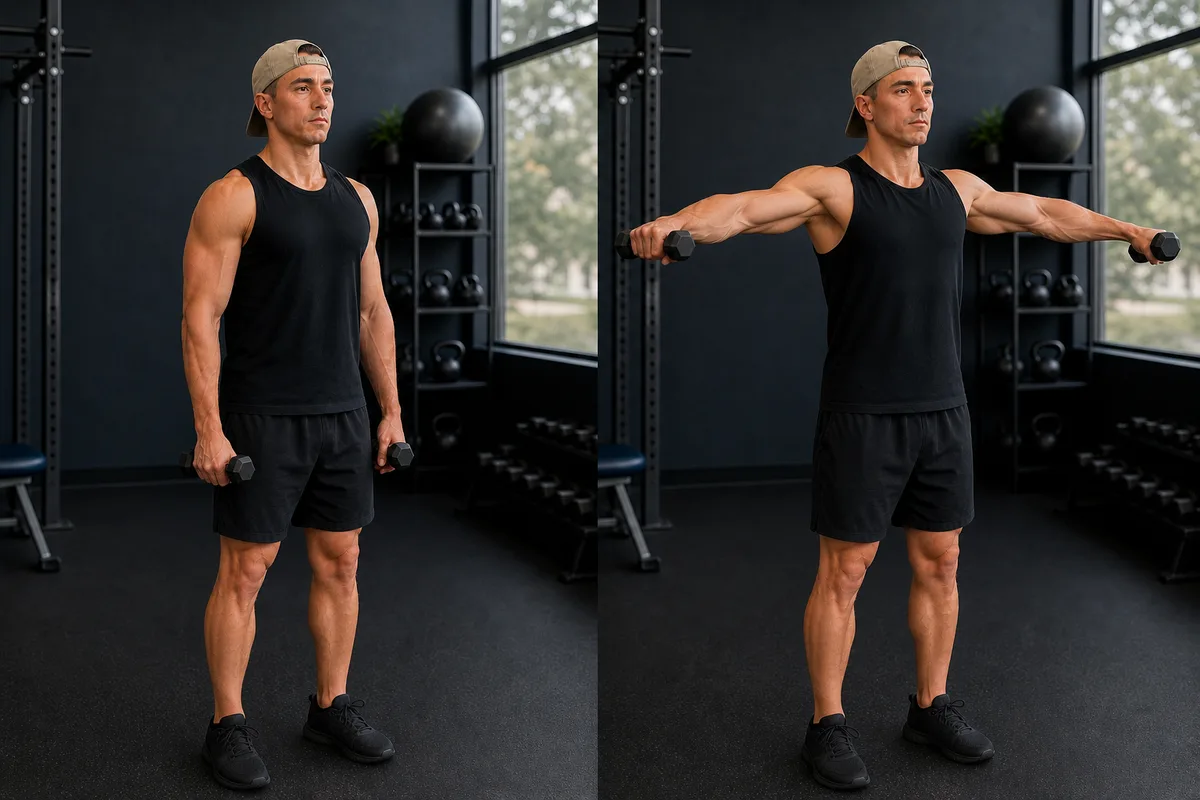
The empty can raise is a well-known exercise for strengthening the supraspinatus, one of your four rotator cuff muscles. You lift your arm out and slightly forward with your thumb pointing down, as if emptying a can. It's effective at isolating this muscle, but it's also one of the more debated exercises in shoulder rehab — read the caution note below before adding it to your routine.
Exercise Name
Empty Can Raise
Primary Purpose
- Strengthen the supraspinatus, the rotator cuff muscle most responsible for starting the motion of lifting your arm out to the side
- Build shoulder strength for overhead lifting, reaching, and sport-specific movements
- Often used in testing and rehab settings to isolate supraspinatus strength
The "empty can" position (thumb down, as if pouring out a can) increases activation of the supraspinatus compared to a neutral grip. This is exactly why it's popular for isolating that muscle — but it's also part of why the exercise is debated, explained below.
Common Misconceptions
- "The empty can raise is always bad for your shoulder." Not true — for many people, especially those with healthy shoulder mechanics, this exercise is a well-tolerated, effective way to strengthen the supraspinatus.
- "Everyone should avoid it and use the full can instead." Also not quite right — the full can position isn't automatically superior for everyone; the two positions simply create different amounts of muscle activation and joint crowding depending on the person's anatomy and shoulder mechanics.
- The real nuance: the thumb-down, empty-can position narrows the space under the bony roof of your shoulder (the acromion) slightly more than the thumb-up, full-can position. In people who already have a tight or crowded subacromial space — such as those with shoulder impingement syndrome — this narrowing can provoke pinching pain. For people without that crowding, it's often perfectly fine.
- The full can alternative: the "full can raise" is performed in the same lifting path but with your thumb pointing up (as if holding a full can upright) and your palm rotated so the forearm is in a more neutral or slightly outward-rotated position. Research and clinical experience suggest the full can position creates similar or only slightly less supraspinatus activation while typically causing less pinching discomfort, which is why many physiotherapists recommend starting with the full can version, especially if you have any history of impingement-type pain.
- Bottom line: if the empty can raise causes pinching, sharp, or catching pain at the top of your shoulder, switch to the full can version or reduce the height of the raise. If it feels fine, either version can be an effective strengthening tool.
Target Muscles
- Supraspinatus — the main muscle targeted, especially activated in the empty-can (thumb-down) position
- Deltoid — assists significantly in lifting the arm, particularly the middle fibers
- Rotator Cuff Overview — the group as a whole helps keep the upper arm bone centred during the lift
Difficulty Level
Intermediate
Equipment Required
- Light dumbbells (start with 0.5–2 kg / 1–4 lb) or light resistance bands
Who Should Perform This
- People without a history of shoulder impingement or subacromial pain who want to strengthen the supraspinatus specifically
- Athletes and lifters building comprehensive rotator cuff strength as part of a broader program
- Anyone under the guidance of a physiotherapist who has assessed that this movement is appropriate for their specific shoulder
Who Should Avoid This
- Anyone with active shoulder impingement syndrome or a history of pinching pain with overhead lifting — try the full can version instead, or avoid raising above shoulder height
- People with a current or recent rotator cuff tear that hasn't been cleared for resisted lifting
- Anyone with an unhealed fracture around the shoulder or upper arm
- People less than several weeks post-shoulder surgery without specific clearance for this movement
- Anyone who feels sharp or catching pain during the lift — stop and switch to the full can position or a lower range
Step-by-Step Instructions
- Stand tall holding a light dumbbell in each hand, arms relaxed at your sides.
- Turn your thumbs down so your palms face behind you slightly (the "empty can" position).
- Raise your arms out and slightly forward, roughly 30 degrees in front of your body (this angle is called the scapular plane), up to about shoulder height.
- Stop at shoulder height — going higher increases the risk of pinching and offers little added benefit.
- Pause briefly at the top, then lower slowly and with control back to your sides.
- Repeat for 10–12 repetitions, 2–3 sets, 2–3 times per week.
- If you feel any pinching or sharp pain at any point, stop and switch to the full can version (thumb up, palm facing forward) instead.
Common Mistakes
- Raising the arms above shoulder height — this increases crowding under the shoulder's bony roof and raises the risk of pinching pain, with little extra strength benefit.
- Using too much weight — this often causes shrugging or swinging, which shifts effort away from the supraspinatus and toward the upper trapezius.
- Ignoring pinching or sharp pain — this is a sign to stop and switch to the full can position, not push through.
- Shrugging the shoulders up during the lift — keep your shoulders down and away from your ears throughout the motion.
Progressions
- Gradually increase weight as strength improves, keeping the range capped at shoulder height
- Add a brief pause (2–3 seconds) at the top of the lift for more control
- Progress to functional overhead patterns like the prone Y-T raise once basic strength is established
Easier Alternatives
- Use the full can position (thumb up) instead of empty can if you notice any pinching
- Reduce the range of motion, raising only to hip or chest height at first
- Try isometric shoulder holds first if any raising motion is uncomfortable
Related Injuries
- Rotator Cuff Tear — used carefully in later-stage rehab to rebuild supraspinatus strength
- Rotator Cuff Tendinitis — the full can variation is often preferred here to avoid provoking symptoms
- Shoulder Impingement Syndrome — this exercise should be used cautiously, with the full can version usually preferred
Related Anatomy
- Supraspinatus — the primary target muscle
- Deltoid — a major assisting muscle in the lift
- Rotator Cuff Overview — supports joint stability throughout the motion
References
- Physiopedia. "Supraspinatus." https://www.physio-pedia.com/Supraspinatus
- Physiopedia. "Rotator Cuff Strengthening Exercises." https://www.physio-pedia.com/Rotator_Cuff_Strengthening_Exercises
- Journal of Orthopaedic & Sports Physical Therapy (JOSPT). "An Update of Systematic Reviews Examining the Effectiveness of Conservative Physical Therapy Interventions for Subacromial Shoulder Pain." https://www.jospt.org/doi/10.2519/jospt.2020.8498
- StatPearls (NCBI Bookshelf). "Shoulder Impingement Syndrome." https://www.ncbi.nlm.nih.gov/books/NBK554518/
This information is for education only and is not a medical diagnosis. InjuryAtlas does not replace an assessment by a qualified health professional. If you have severe pain, visible deformity, numbness, loss of function, or symptoms that are getting worse, seek medical care promptly.