Overview
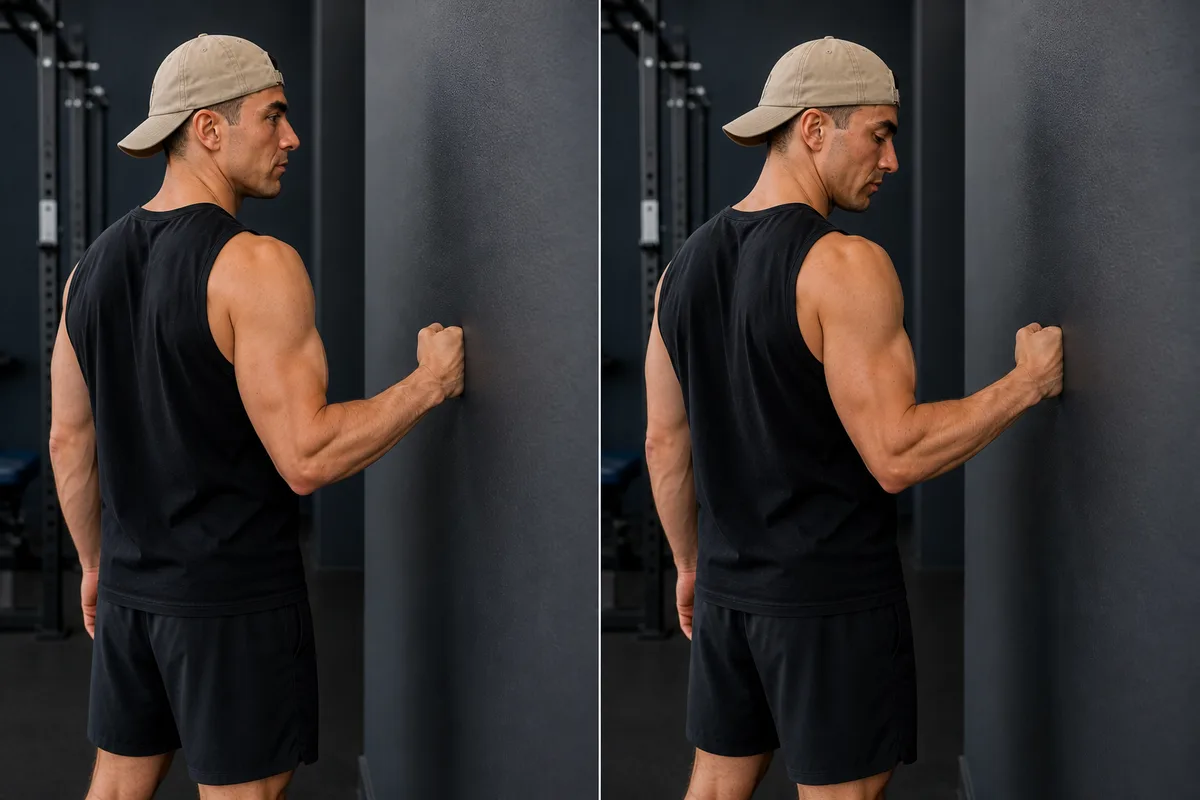
Isometric shoulder holds involve pushing against something immovable — a wall, a doorframe, or your own opposite hand — and holding steady without any joint movement. Because the joint doesn't move at all, this is often one of the earliest and gentlest ways to reload a painful or healing shoulder with real strength work.
Exercise Name
Isometric Shoulder Holds
Primary Purpose
- Build strength in the shoulder muscles without moving the joint, which is often better tolerated by an irritated or healing shoulder
- Reduce pain through gentle, sustained muscle contraction — a well-documented pain-easing effect of isometric exercise
- Bridge the gap between a very painful shoulder and exercises that involve full-range movement
An isometric contraction means the muscle tightens and produces force, but the joint angle doesn't change — think of pushing hard against a wall that isn't going to move. Because there's no movement, there's no repetitive motion that might otherwise aggravate sensitive tissue, which makes this a useful early step in rehab.
Target Muscles
- Rotator Cuff Overview — the muscle group most commonly trained with isometric holds
- Supraspinatus — engaged during holds that resist arm lifting
- Infraspinatus and Teres Minor — engaged during holds that resist outward rotation
- Subscapularis — engaged during holds that resist inward rotation
- Deltoid — assists in holds that resist lifting the arm out to the side or forward
Because you can choose the direction you push in, isometric holds let you target almost any rotator cuff muscle simply by changing which way you push against the resistance.
Difficulty Level
Beginner
Equipment Required
- A wall or sturdy doorframe
- Optional: a rolled towel to place between your elbow and your side for comfort
Who Should Perform This
- People with a painful shoulder from rotator cuff tendinitis or a partial rotator cuff tear who need gentle, low-irritation strengthening
- Anyone in early rehab after shoulder surgery, once cleared for isometric (non-moving) exercise by their surgical team
- People with shoulder impingement syndrome or subacromial bursitis whose pain flares with movement-based exercise
- Anyone wanting a low-impact way to maintain strength during a painful flare-up
Who Should Avoid This
- Anyone with an unhealed fracture around the shoulder, collarbone, or upper arm — pushing against resistance could disrupt healing bone
- People less than a few days post-surgery without their surgeon's clearance for any muscle contraction
- Anyone with a recent, unstable shoulder dislocation that hasn't yet been assessed
- People whose pain is sharp or worsens during the hold — this should feel like effort or mild muscle burn, not joint pain
Step-by-Step Instructions
- Stand facing a wall or doorframe, with your elbow bent to about 90 degrees and tucked at your side.
- Choose a direction to press: forward into the wall (works front-of-shoulder muscles), or use a doorframe to press outward or inward against the frame (works rotator cuff rotators).
- Press firmly but steadily — aim for about 50–70% of your maximum effort, not an all-out push.
- Hold the contraction for 5–10 seconds, breathing normally throughout — don't hold your breath.
- Relax completely for a few seconds between holds.
- Repeat for 5–8 holds per direction, and perform 2–3 directions (forward, outward rotation, inward rotation) per session.
- Perform once or twice daily, or as directed by your physiotherapist.
Common Mistakes
- Holding your breath during the push — this raises blood pressure unnecessarily and adds tension elsewhere. Breathe steadily throughout each hold.
- Pushing at 100% maximum effort — this isn't necessary and can increase strain. A firm, controlled 50–70% effort is enough to build strength safely.
- Letting the elbow drift away from the body — keep your elbow anchored at your side so the effort stays focused on the shoulder muscles you're targeting.
- Jerking into the hold — ease into the push gradually over 1–2 seconds rather than snapping into full force immediately.
Progressions
- Increase the hold time gradually, from 5 seconds up to 10–15 seconds
- Increase the effort level slightly, from 50–60% up toward 70–80% of maximum, as tolerated
- Progress to resistance band exercises like external rotation with band or internal rotation with band once isometric holds feel easy and pain-free
- Try isometric holds at different arm positions (arm slightly out to the side, or slightly forward) to challenge the shoulder through more of its range
Easier Alternatives
- Reduce the effort level to a gentle 30–40% push if higher effort causes discomfort
- Shorten the hold time to 3–5 seconds and build up gradually
- Perform the exercise lying down for extra support if standing is uncomfortable
Related Injuries
- Rotator Cuff Tear — often the first strengthening exercise introduced after injury or surgery
- Rotator Cuff Tendinitis — helps build tendon tolerance without provoking pain
- Shoulder Impingement Syndrome — a pain-friendly way to keep strengthening during a painful phase
- Subacromial Bursitis — allows strengthening without compressing the irritated bursa through movement
Related Anatomy
- Rotator Cuff Overview — the primary muscle group trained
- Supraspinatus, Infraspinatus, Teres Minor, Subscapularis — individually targeted depending on push direction
- Deltoid — assists during forward and side-pressing holds
References
- Physiopedia. "Rotator Cuff Strengthening Exercises." https://www.physio-pedia.com/Rotator_Cuff_Strengthening_Exercises
- Journal of Orthopaedic & Sports Physical Therapy (JOSPT). "An Update of Systematic Reviews Examining the Effectiveness of Conservative Physical Therapy Interventions for Subacromial Shoulder Pain." https://www.jospt.org/doi/10.2519/jospt.2020.8498
- StatPearls (NCBI Bookshelf). "Rotator Cuff Syndrome." https://www.ncbi.nlm.nih.gov/books/NBK531506/
This information is for education only and is not a medical diagnosis. InjuryAtlas does not replace an assessment by a qualified health professional. If you have severe pain, visible deformity, numbness, loss of function, or symptoms that are getting worse, seek medical care promptly.